Wednesday, 23 September 2020

Symon Divers, George Edwards, Roy Stevenson (?) - 27/3/1938.

In my teens, I had many happy summers at Lake Ohau, on camping holidays with my family.  I recall going to Monument Hut, and seeing the cairn built to the memory of the three climbers whose deaths are mentioned here.  My father was a younger member of tramping and mountaineering circles than those of the Mt Trent party, and no doubt would have heard the tales told around campfires of what happened in 1937 - one of the members of the party, W S Gilkison, was a close friend of my father, and I recall him from my younger years. 


FALL TO DEATH

MOUNTAINEERS KILLED. 

TRAGEDY IN THE SOUTH.

Per Press Association. DUNEDIN. March 28. A mountaineering tragedy which resulted in the loss of three lives occurred at Mt. Trent, near Lake Ohau, yesterday. Those killed were: — 

SYMON D. DIVERS, of Dunedin, aged 24. 

GEORGE M. EDWARDS, of Dunedin, aged 21. 

ROY STEVENSON, of Oamaru, aged about 18. 

Twenty-one climbers from Dunedin and Oamaru were in the party, which had arranged to scale Mount Trent during the holidays. The party left Oamaru on Thursday night by car and spent Friday packing gear at the high camp at the head of the north branch of the Huxley River, making ready for the ascent. 

Yesterday nineteen of the party set out on the expedition. The mountain carried many snow patches and the surface proved difficult to cut into with ice axes for the making of steps. The party divided into five groups, each group being roped together. Good progress was made, and the leading party, in charge of Gordon Edwards, brother of George, was the first to reach the top, realising the aim of making the first conquest of the peak. Almost immediately upon this success, news was flashed along the route of the climbers that the three youths had been hurled to death.

Divers, George Edwards and Stevenson formed the final party in the ascent. Stevenson being in the middle of the trio. When they were about 7000 ft up. Stevenson, in avoiding a falling stone, failed to get his foot into one of the steps cut by the leading climbers. The three young men were on a steep snow slope on which small rocks were scattered. Stevenson stumbled and jerked his two companions out of their steps, though George Edwards managed to delay the impending tragedy for a few seconds. The weight of his companions, however, pulled him off his feet and the three young men were launched on a 1000 ft slide over hard snow to death.

Well-known climbers, W. G. McClymont and Russell Edwards, brother of George, immediately started down the slope, reaching the bottom an hour later to discover the three youths dead. Arrangements have been made to bring out the bodies, which are on a glacier 6000 ft above sea level.  -Manawatu Standard, 29/3/1937.


A mountaineering tragedy which resulted in the loss of three lives occurred on Saturday on Mt. Trent, in the Southern Alps. George Edwards, one of the young men to lose his life in the accident, is seen looking at the Rudolph Glacier, north of the scene of the tragedy. Inset, "Don" Divers (left) and George Edwards, both of Dunedin, and two of the most outstanding young New Zealand mountaineers, who, with Roy Stevenson, of Oamaru, were killed while attempting the conquest of Mt. Trent.  -Evening Post, 29/3/1937.


No advice has yet been received of the return of the party which is bringing out the bodies of S. D. Divers, G. M. Edwards, and R. Stevenson, the three victims of the Alpine tragedy on Mount Trent on Saturday. Everything is in readiness at the base camp in the Huxley Gorge, where pack horses are awaiting the arrival of the bodies for conveyance to the road. Owing to the roughness of the country, however, the progress of the party must necessarily be slow, and it is not expected that the base camp will be reached until Thursday afternoon. From there a further distance of three miles has to be traversed to the road. It is anticipated that the party will arrive at Lake Ohau on Thursday night and travel on to Kurow on Friday.   -Evening Star, 30/3/1937.


VICTIMS OF MOUNTAINEERING TRAGEDY Mr S. D. Divers (left) and Mr G. M. Edwards, both of Dunedin, who, with Mr R. Stevenson, of Oamaru, lost their lives while climbing Mount Trent, near Lake Ohau, on Saturday.

DEAD CLIMBERS’ PREVIOUS EXPLOITS Mr S. D. Divers (left) and Mr G. M. Edwards, two of the victims of the tragedy at Mount Trent on Saturday, photographed on the summit of Mount Cook, of which they made a successful ascent some time ago.  -Otago Daily Times, 30/3/1937.


BODIES BROUGHT TO OAMARU.

A Hazardous Task.

OAMARU, April 1. Members of the party engaged in the hazardous and exhausting task of bringing out the bodies of G. M. Edwards, S. D. Divers and Roy Stevenson, who lost their lives in attempting to climb Mount Trent on Saturday, completed their difficult task at noon to-day, when the pack-horses at the base camp were reached. The few miles to the road-head were covered by 2.45 p.m., and the remains were placed in caskets for conveyance by motor vehicle to Oamaru, which is expected to be reached on Friday morning.  -Mt Benger Mail, 1/4/1937.


SAD ORDEAL OVER

BODIES OF ALPINE VICTIMS BROUGHT HOME 

TWENTY MEN ENGAGED IN HAZARDOUS TASK 

DISLODGED BOULDER CADSED TRAGEDY 

[Special to the ‘Star.’] OAMARU, April 2. Looking dishevelled and weary, but with the air of men with a hard task completed, the members of the party who were engaged in bringing out the three bodies of the victims of the Mount Trent tragedy, Messrs G. M. Edwards and S. D. Divers (Dunedin) and Roy Stevenson (Oamaru) arrived at Oamaru early this morning. The first party arrived at 12.30 a.m., and the others followed at various intervals. 

All showed the effects of long exposure to wind and rain, and the traverse of particularly difficult and dangerous country, but nevertheless all evinced manifestations of gratitude at the safe accomplishment of one of the most hazardous and exhausing feats of alpine work in the history of mountaineering in New Zealand. 

HAZARDOUS JOURNEY. Some idea of the magnitude of the task of bringing out the bodies was detailed to a reporter by the members of the first party home. Mount Trent (8,300 ft) is situated on the main divide of the Southern Alps, and contains many difficulties known to alpinists in this country because of its position at the head of the Huxley Valley. The mountain has previously withstood the efforts of alpinists to reach its summit, but during Easter a combined effort was made by the members of the Dunedin Alpine Club, assisted by one Oamaru member. Four members only reached the top; the tragedy, occurring early on Saturday afternoon, caused the others near the top to abandon the attempt. 

The difficulties confronting the members in recovering and bringing out the bodies were soon made manifest. The party commenced to recover the bodies from the ice fall down which they had fallen, over 1,000ft. This task involved the difficult feat of hauling the remains up the precipice and lowering them on to Gosos Glacier (discovered by Messrs H. Stevenson, A. Gilkison, Ombler, and O’Riley).

The magnitude of this accomplishment is exemplified by the fact that the whole of Sunday was required to complete the task, over 20 men assisting. The bodies were slid over the snow, foot by foot. Each man took turns in anchoring himself with his ice axe while another progressed a few feet. To make the matter worse, heavy rain in squalls made the going difficult and dangerous, and many narrow escapes from further tragedy were experienced. Continuous rain on Monday and Tuesday prevented fires being lighted, so that members were obliged to sleep and work in wet clothes and to eat soaked food, this resulting in chills and frostbite. The party kept progressing from daylight till dark, sleeping and working in conditions of the worst. 

SAD CEREMONY. At the extreme edge of the snowfield an appropriate little ceremony was conducted by the Rev. J. T. Crozier prior to commencing the long portage down the Huxley. 

Appreciation of the efforts of the party was made by Mr F. C. Dawson on behalf of the relatives, he stating that pride of place must be given to those of the party who stayed on and accomplished a superhuman task under adverse conditions; also to Constables Voyce and Vurney for assistance and to Sergeant McGregor for the tactful manner in which he conducted the case. He also conveyed thanks to all those who had assisted in any way, especially Mr Preston for arranging pack horses. Sergeant McGregor expressed thanks for the assistance given by members of the party. 

THE INQUEST. The inquest was opened to-day before the coroner, Mr W. H. Frith. Sergeant McGregor represented the police. 

Francis Newmarch (clerk, Dunedin), gave evidence of identification. He then related the finding of the bodies and the extent of their injuries. In witness’s opinion the three deceased would not have been allowed to proceed up the slope had they not been roped. He considered that every precaution was taken, and that Mount Trent was no more dangerous than any other peak in New Zealand. Edwards and Divers were members of the New Zealand Alpine Club, and were very experienced climbers. Everything possible was done to avoid accident. 

The Coroner; Is it possible to avoid such accidents? 

Witness: The only way to avoid such calamities is not to climb mountains. 

Walter Scott Gilkison, accountant, Dunedin, said the objective of the party was Mount Trent, and the approach to it was made over a considerable glacier which formed the main course of the Huxley River. Witness stated that when near the slope he saw a boulder slide down the mountain side about 20 feet, and then strike a projecting rock. The stone crossed further over the slope, and appeared to take a bound through the air just in front of the second man in the fifth party, comprising the three deceased. Edwards attempted to steady them, and drove his ice axe deep into the snow, but it was apparently wrenched from his hold. His axe remained firmly embedded in the snow, and the three men slid rapidly down the slope to the snowfield about 1,500 ft below. Witness considered that the accident was occasioned by the boulder becoming dislodged and falling in the path of the climbers. In his opinion every precaution was taken to prevent accident. 

James Hogg Gilkison, accountant (Dunedin), said he was one of a party of 17 who left Dunedin for the Huxley Gorge on March 25. The following day they left Lake Ohau to pack into North Huxley to establish a camp. On Saturday, March 27, 10 of the party left the camp to climb Mount Trent in fine weather. As soon as the glacier beneath the mountain was reached, the party was roped up, with two experienced climbers on each rope.

There were five independent ropes, the three deceased being on one rope by themselves. Technically speaking, the climb was not a severe one, the distance from the glacier to the summit being about 2,000 ft, but the face was snow-clad and steep, with rock outcrops. The various parties were more or less using the same route, using steps made by the leading party, and at the time of the accident the party comprising the three deceased was last on the slope. 

THE DISLODGED BOULDER. When witness was on the summit of a ridge about 50ft from the top he saw a boulder about the size of a man’s head rolling down the slope. He had no idea where the boulder came from. On occasions boulders were loosened by the elements on peaks, but usually in falling they followed defined courses. For this reason they were usually avoided. The boulder in question seemed to take an unexplainable swing, and swung in the direction of the deceased Stevenson, who was the middle man on the rope. It did not actually hit him, but he appeared to step back to avoid it. Deceased Divers was leading on the rope at this stage, and the unexpected pull seemed to take him out of the step. As far as witness could see, both Divers and Stevenson commenced to slide down the slope simultaneously. Deceased Edwards, apparently noticing this, drove his axe into the snow to get an anchorage, and was able to stop them momentarily, but the momentum of the others was too great, and he was unable to hold them, being pulled out of his step. The three climbers slid down the slope ou to the glacier, approximately 200 ft below. Witness had a good view of them all the time during the fall, and saw them come into contact with jutting rocks. After they came to rest there was no sign of movement. 

IMMEDIATE RESCUE EFFORT. Immediately afterwards Russell, Edwards, and W. G. McClymont roped up and went down the slope as quickly as possible. To witness’s knowledge both Edwards and Divers had done a considerable amount of climbing in high altitudes over a period of several years, including ascents of Mount Cook, Mount Haidinger, and numerous other peaks in the Cook and Western Otago districts. On Sunday, the party set about the task of taking the bodies down off the glacier. This proved a very difficult task, and by evening they had managed to get the bodies through the top of the ice fall. Towards the end of the following day, they got the bodies down as far as the snowfield, at the head of the valley. Wednesday and Thursday were taken up in bringing the bodies down the Huxley, where pack horses were waiting under Mr Preston’s (Glen Lion) charge to bring the remains on to Hopkin’s Valley. From the time the news of the accident became known, the Otago and North Otago sections of the New Zealand Alpine Club, with which a large number of the party were associated, worked in conjunction with the police in the organisation of everything required. He was satisfied that the time taken to bring out the bodies could not have been shortened. 

The Coroner (summing up) said he was satisfied that the accident was purely misadventure. The universal feeling and sympathy for the relatives had been exemplified by the manner in which the members had worked to bring out the bodies. The police had rendered invaluable service, and also many others, and all would appreciate their endeavours. 

The verdict was that the three deceased met their death as the result of injuries received from sliding down the mountain side, the accident being caused by misadventure.  -Evening Star, 2/4/1937.


SCENE OF TRAGEDY IN THE MOUNTAINS
A recent picture of Mount Trent, on which, Messrs 
Edwards, Divers and Stevenson lost their lives. The distance between the two crosses marks the extent of their fall.  -Otago Daily Times, 2/4/1937.


ALPINE CLUB

MT. TRENT TRAGEDY

Admiration "of the magnificent manner in which the difficult and arduous task of bringing out the bodies of the unfortunate victims of the Mount Trent tragedy, had been effected," was expressed at the recent meeting of the New Zealand Alpine Club. Wellington Section. Motions of sympathy with the relatives of those who had lost their lives, and with the members of the Otago and North Otago Sections of'the Club, were passed. The annual report of the.Alpine Club also refers to the irreparable loss caused by the deaths of the three young men, George Edwards, "Don" Divers, and Roy Stevenson, and to the tragic death as a result of 14 days' exposure on Mt. Bogong, Victoria, Australia, of a keen supporter of skiing and mountaineering, and an associate member of the club, Mr. C. J. M. Cole. 

Mr. H. K. Douglas, who presided at the annual meeting of the Wellington Section of the Alpine Club, referred to the rapidly-increasing popularity of mountaineering. The Alpine Club roll stood at 320 members, and associates. He thanked the lecturers, who had delivered a number of excellent addresses during the year. The finances were in a healthy state. 

The following officers for the year were elected:— Chairman, Mr. H. K. Douglas; vice-chairman, Mr. L. K. Wilson; secretary, Mr. H. J. Newberry; treasurer, Mr. R. D. Greenwood; committee, Mess. P. C. Weenink and G. P. Rayward, Dr. J. D. Willis and Professor J. Williams.  -Evening Post, 16/4/1937.


IN MEMORIUM

DIVERS. EDWARDS.—In loving memory of Symon Donald Divers and George Machan Edwards, killed In Alpine accident, Mount Trent, March 27, 1937. “The mountains can sometimes be stern with those who love them.”  -Otago Daily Times, 26/3/1938.


Northern Cemetery, Dunedin.


Andersons Bay Cemetery, Dunedin. DCC photo.


A SPLENDID GESTURE

ECHO OF MOUNT TRENT TRAGEDY 

MEMORIAL CAIRN ERECTED 

Adventure greeted those members of the Otago section of the New Zealand Alpine Club who travelled to the Lake Ohau district at Easter. The intention of the trip was the erecting of a cairn in memory of Roy Stevenson, of Oamaru, Symon Donald Divers and George Machin Edwards, of Dunedin, who lost their lives on the slopes of Mount Trent, Easter Sunday, 1937. The party numbered 35 in all, and included the members of the unfortunate climbing party of last year, as well as several friends.

The heavy rain which fell on the Thursday before Easter caused flooding of all creeks and streams in the district. The procession of motor cars was continually held up, and the crossing of the swollen waterways frequently presented a serious problem. On more than one occasion members of the party had to pull the cars across the streams. On other places parts of the roadway were washed out, and considerable time was occupied in rebuilding these washouts and making the road safe for the unusual string of traffic. It was necessary for some of the cars at least to get through to the proposed site of the cairn, as it would have been impossible to carry bags of cement several miles up the valley in the deluge that was falling.

Despite the unfavourable conditions a start was instantly made to erect the cairn. The site chosen was in a clearing in the forest clothing the hillside, and about 10ft above the floor of the valley. A good deal of work, which was in the hands of two capable stonemasons, had to be carried out under the protection of a tarpaulin. The party was keen, and worked hard to collect suitable rocks, which were outlined in position by black lime mortar. 

The cairn was erected in slightly less than two days. Immediately upon completion a dedication service was conducted by the Rev. James Crozier, who had been a member of the ill-fated party. In an impressive ceremony Mr Crozier made feeling references to the lives and characters of the three young men, and paid a tribute to the generous actions that had made the erection of the cairn possible. He said also that the tragedy had occurred on the anniversary of another tragedy — the death of Captain Scott and his companions in the Polar wastes in 1912. 

The cairn stands 5ft high, and carries a bronze tablet, the inscription of which is:— 

In loving memory of Roy Stevenson, Don. Divers, George Edwards, who lost their lives in an attempt on Mount Trent, March 27, 1937. Erected by members of their climbing party and friends.   -Evening Star, 22/4/1938.


Monument Hut, Hopkins Valley, Lake Ohau region. Photo: Department of Conservation.


Lieutenant (A) Leslie Walden Ellyet Maffey, RNZVR, 1921-22/2/1945.


Apart from the plaques in Dunedin's Northern Cemetery, there is not much to mark the passing of Leslie (Bill) Maffey.  He is listed as "missing, presumed killed on active service" and I assume, after a length of time, his death would have been made official.


Bill Maffey joined the Royal New Zealand Navy and was embarked as an officer pilot on board the carrier HMS Trumpeter in 1945, flying the Fairey Barracuda, a single engined torpedo/ reconnaisance/bomber aeroplane for 821 Squadron, Fleet Air Arm.  On February 22nd, nine planes took off to drop mines off Haugesand Fiord in Norway, part of the strategy of isolating what was left of German forces towards the end of the Second World War.

Two Barracudas were shot down by shore defences and no survivors were seen.  Bill Mafffey's name can be found on the New Zealand Naval Memorial at the naval base at Devonport, Auckland.


ROLL OF HONOUR

MAFFEY. — In loving memory of Sergeant Harold Gilbert Ellyett (Anti-tank Regiment, N.Z.A.), killed in action, Libya, November 25, 1941 and of Leslie Walden Ellyett, Lieutenant (A) R.N.Z.N.V.R., killed on active service off Norway, February 22, 1945, sons of H. G. and J. R. Maffey, Silverstream, and brothers of J. E. Price, Dunedin.  -Evening Post, 24/11/1945.


Northern Cemetery, Dunedin.

Sunday, 16 August 2020

James Anderson 1897/28/4/1911.


KILLED ON THE RAILWAY.

BOY'S BODY FRIGHTFULLY MANGLED

DUNEDIN, April 29

James Anderson, aged fifteen, fell off the platform of a carriage in the Caversham tunnel last evening. He dropped under the train and was killed. His body was frightfully mangled.  -Northern Advocate, 29/4/1911.


THE CAVERSHAM TUNNEL FATALITY.

Mr C. C. Graham, coroner, held an inquest at Fairfield on Saturday concerning the death of the lad James Anderson, who fell from the platform of one of the carriages of Friday's 5.15 p.m. train for Mosgiel while the train was passing through the Caversham tunnel. 

John Anderson, the boy's father, identified the body. 

John Hollows, aged 16, employed in the State coal office, said that he travelled on the train with deceased and another lad named McCallum. They were in the habit of travelling on one particular second-class carriage on this train, and as it was full the previous evening they stood on the platform of it. After leaving Caversham deceased crossed over to the platform of a first class carriage to have a better place from which to observe the Otago Central train when it passed them in the tunnel. Deceased went to lean on the gate of the platform on the first class carriage, which must have been open — it was too dark for witness to see whether it was or not — and fell out off the train. There was no skylarking going on among them. Witness thought that the gate was shut when the train pulled up at Caversham, but two passengers had left the carriage there, and possibly the gate had been left open. 

George McCallum, aged 16, employed at the Otago Daily Times office, corroborated the evidence of the last witness, and denied that there was any skylarking going on. He himself could not see whether the gate was open or shut.

William Rush, railway porter at Caversham, said that the stationmaster called on him to leave the signal box and go into the tunnel with a lamp, as Burnside advised that a boy had fallen off the train which had recently left. The stationmaster suspended traffic through the tunnel pending witness reporting himself at either Caversham or Burnside. Two porters left Burnside at the same time with a stretcher. Witness found the boy about a quarter of a mile from the Caversham end of the tunnel. Anderson was then quite dead. He was lying near the "down" road, with his face six inches from the right hand (or inner) rail. On the porters arriving with the stretcher the body was conveyed back to Caversham, whence it was taken to his father's residence.

Thomas F. Scully, guard of the train by which deceased was travelling, did not remember seeing him on the train that day. Witness was first informed of the accident by George McCallum when the train reached Burnside. Witness at once informed the stationmaster at Burnside, and suggested the suspension of all traffic through the tunnel. Witness instructed his two assistants on the train to remain at Burnside to form a search party to go into the tunnel. Witness had not noticed the gate of that carriage open at Caversham. Some passengers alighted at Caversham. Witness always kept a sharp look-out for open gates on the platforms, especially when leaving stations, and his two assistants, stationed one at the front and one in the centre of the train, were also instructed to do so. The boy fell off the platform of a first class carriage, and passengers holding second class tickets had no right on such platforms. Deceased had evidently crossed over to this platform while the train was in the tunnel. His train passed the Otago Central train about 300 yards from the Burnside end of the tunnel, so that the accident occurred before the two trains met. There was plenty of room on the train for all the passengers it carried. The boys would have had to go through one carriage to obtain seating accommodation.

William Johnston Will, medical practitioner; said he examined the body yesterday at Caversham station. There was a large scalp wound over the right temple and a deep wound at the back of the skull, where there was a depressed fracture. The face was covered with skin abrasions. There was a compound fracture of the right leg above the ankle. The injuries were quite sufficient to account for instantaneous death. 

In reply to the Coroner, the witness Scully said the train was going about 20 miles an hour at the spot where the body was found. Possibly an axle box had struck deceased after he fell. 

The Coroner said that the evidence showed that death was caused by an accidental fall from a train, and that no blame was attachable to anyone. The railway regulations were very explicit about passengers riding on platforms, and anyone doing so did it at his own risk. It was possible that at small stations, where trains did not stop long, an open platform gate might be overlooked, and the evidence did not show whether it was shut or open. Presumably it was open, or deceased would not have fallen out. The verdict was "Accidental death, caused by a fall from a train."  -Otago Daily Times, 1/5/1911.


Green Island Cemetery, Dunedin.


Thursday, 13 August 2020

Maribel French Muirhead, 1884-16/12/1926.


FALL FROM A TRAIN.

FATALITY IN OTAGO. 

ACCIDENT NOT WITNESSED.

[BY TELEGRAPH, —OWN CORRESPONDENT. ] DUNEDIN. Thursday. The Dunedin police have received telephonic advice from. Poolburn that a passenger by the Central Otago train, believed to be Miss M. Muirhead, fell from the train at Poolburn Gorge and was killed. She was travelling on the return half of a Dunedin-Cromwell ticket and was alone. No one saw the accident. The body is being brought on to Dunedin by this evening's train.  -NZ Herald, 17/12/1926.


FATAL FALL FROM TRAIN.

SINGLE WOMAN'S DEATH. 

EVIDENCE AT THE INQUEST. 

[BY TELEGRAPH.—OWN CORRESPONDENT.] DUNEDIN, Friday. The inquest was opened to-day into the death of Maribel French Muirhead, a single woman, 42 years of age, who fell from the platform of the Otago Central train yesterday and was killed. As far as can be ascertained no one saw the accident, the victim being the only occupant of a second class carriage. 

Mr. H. W. Bundle S.M., was the coroner, Sergeant McCarthy representing the police. 

Margaret Muirhead identified the body as that of her daughter, who had lived with her at St. Kilda. The deceased had been in ill-health for some time and received medical attention. She was returning home from a holiday with her sister at Alexandra when she met her death. The inquest was adjourned sine die.  -Otago Daily Times, 18/12/1926.


An open verdict was returned at the adjourned inquest in Dunedin on Maribel French Muirhead, whose death occurred on December 16 as the result of being run over by a train on the Otago Central line. The Coroner, Mr. H. W. Rundle, said the evidence showed that deceased was the only passenger in the carriage adjoining the van. The gangway and the rails between the van and car and the gates on the car were in good order. The gates being shut at the time, it was impossible to say how deceased’s body got on to the track. Whether she fell off the platform, or whether the mishap occurred as the indirect result of her bad health, was unknown. The coroner found that there was no possible negligence on the part of the Railway Department.   -Poverty Bay Herald, 24/1/1927.


Headstone5
Andersons Bay Cemetery, Dunedin. DCC photo.


Tuesday, 11 August 2020

2414 Lance Corporal Colin Campbell (Bos) Boswell 25/1/1915-26/4/1941.

 Colin Boswell was a builder when he joined the NZ Army in 1940. His profession made him a valuable recruit for the  NZ Engineers and he served in 6 Field Company.

The Engineers joined the British response to the German invasion of Greece in 1941 and they did much work during the retreat in the face of German armoured units, delaying them with demolition and mines. By late April the 6th Field Company were in the vicinity of the Corinth Canal - an area of vital military importance, especially the bridge which crossed it.  It was vital that it be kept usable for the continued retreat of friendly forces.  It was equally vital to destroy it before it fell into enemy hands.

It was probably not known to the men in the field until just before the crucial event but was certainly known to their commanders that the Canal was an essential part of the German plan for the invasion of Greece.  A fuel tanker was waiting for it to be secured so it could head through and reach the nearby port of Piraeus to unload fuel for the arriving tanks and other vehicles.


image002
German troops on the Corinth Canal bridge.


The story is best told by J F Cody, the author of "New Zealand Engineers, Middle East," one of the volumes of the Official History of NZ in the Second World War, published in 1961:

Sixth Field Company, which we left on the road to and on the bridge over the Corinth Canal, did not embark as a company. At the time the others were moving to the beaches, the company was wandering in small groups all over southern Greece. That is, those of them who were not already prisoners of war.

This was the way of it — Lieutenant Kelsall decided to move to a quieter area nearer Corinth so, leaving Sergeant Jay and a sub-section guarding mined road blocks, the trucks and crews were moved after dark (25–26 April) into a lemon orchard a couple of miles south of the bridge, where it was possible to get some sleep.

The sleep had a sudden termination at daybreak. Kelsall's diary explains why:

‘0530 hrs: Heard noise of straffing and was told by sentry that paratroops were landing on the undulating ground to the E. Dumfounded. Started to put the orchard in a state of defence: 1 and 3 Secs running N-S and facing E and S. HQ Sec covering the SW. We could not see the bridge for the trees and we were probably not seen ourselves in the orchard. The paratroopers were jumping from about 500' and fighter planes were skimming the tops of tall pines bordering the orchard. It was possible to see inside the planes thro’ the open doors.

PAGE 118

‘As my troops were not trained infantry, told the sec commanders to husband ammunition and not to fire until the enemy were at least 400x away. No. 3 section a bit eager must have fired at 800x and perhaps let the enemy know we were there…. At 0650 hrs a terrific explosion and it seemed to me that the br had gone up…. The show began with fire from automatics and when our resistance stiffened mortars were brought into action….

‘0900 hrs: Decided to make a break, ordered all trucks to be emptied of equipment with the intention of racing trucks out and going south. I climbed a tree … and saw to my horror blazing tanks of 4H—at least three (men had run to them and then been shot at I think), and Bren carriers in an open field. The Messerschmidts were taking to them very successfully and the rd out was dead straight and ideal for straffing. With 6 wheeled 30 cwt Morris trucks decided to stay and fight….

‘1300 hrs: Running very short of ammo — no communication with the bridge. I decided to make a break with the rest of the Coy — 140 men. We divided into small groups (NCO and 6 ORs) to fight our way out and make for the coast.

‘1430: Decided to order the move….’

No. 2 Section was wakened by the usual morning hate and was preparing for the day's work when, to their paralytic astonishment, they saw parachutes dropping from the sky. Some stood petrified with amazement, others grabbed their rifles and waited for instructions as to what to do next.

Lieutenant Wheeler ordered them to disperse before they were surrounded by the waves of dropping paratroops and to concentrate again behind Corinth village. Some made it but the majority did not, for there were Germans all over the area. Major Rudd, who as acting CRE had his small headquarters in rear of 6 Field Company, went forward to see what was happening and collected approximately twenty sappers whom he led to eventual embarkation at Monemvasia. Wheeler with another dozen or so embarked after much marching and hiding at Argos. Lieutenants Kelsall and Wells and party were betrayed, one of the few cases on record; Lieutenant Chapman with twenty others, after island hopping in borrowed and stolen boats, evaded capture; another score or so found various embarkation beaches; still others got as far as Kalamata beach, where 5000 waited and only 500 could be taken; some escaped even after that, but approximately seventy more sappers of 6 Field Company joined the forty taken at the Servia Pass.

PAGE 119

It only remains to describe the end of the Corinth bridge, and to do so it is necessary to go back in time a few days.

It was originally intended to embark 4 Brigade from the Athens area, but force of circumstances had compelled a change of plan and 4 Brigade Group was now to follow 6 Brigade down into the Peloponnese, only a few hours' run from Crete. Lieutenant Wheeler's instructions regarding the canal bridge, pontoon bridges, ferries, etc., ended with the intimation that the order to destroy the bridge would be given in writing by an officer from Force Headquarters, and that he (Wheeler) would ensure that the bridge did not fall into enemy hands intact.

Some time during the 25th and unknown to Wheeler, who was working on the pontoon bridge moored to the far bank of the canal, a staff officer whom it has not been possible to identify added a verbal order that on no account was the bridge to be demolished for another twenty-four hours, during which time 4 Brigade Group would pass across. From the section camp a mile and a half away, Lieutenant Wheeler was sure the bridge had been blown.

‘In all the complexity of noise it had been impossible to tell whether the bridge had been fired but I didn't entertain any doubt. The picquet had clear written orders. “Under no conditions will you allow the bridge to fall into enemy hands intact.” But the fate of the boys themselves was more uncertain. Their chances would be pretty lean.

‘It was not given to me to know that a few hours earlier that a Very Senior Officer had stopped to have a word with the sappers. And that he had firmly impressed on them that there was another convoy yet to pass through. He added that “under no conditions was the bridge to be destroyed for at least twenty four hours”. Which put the n.c.o. in charge of the party in rather a spot when the band began to play in the morning. Disobey a written order from a subaltern or a verbal order from a Staff Officer with red braid all around his hat? He did the obvious thing—left the bridge cold, jumped a truck, came out through a hail of lead. Happily ignorant of this development, I watched the fourth or fifth row of parachutes laid neatly across what had been our camp. Not a sign of the lads and another trio of 52's hove in sight. I deemed it high time to head for the horizon.’

The bridge was thus seized intact, no mean prize to a commander who wanted to push south after the elusive Anzacs. 
PAGE 120
And no mean embarrassment to a commander who had planned to move the rest of his division into the Peloponnese and embark from beaches there.

The German elation terminated when, with a roar followed by an immense smoke cloud, the structure collapsed into the canal.

A mass of conflicting evidence has been collected regarding the cause of the explosion that wrecked the Corinth bridge, but there is at least one witness who is quite certain that two New Zealand sappers lost their lives in the attempt.

Here is the testimony of Gunner H. E. Smith who had been wounded at Tempe, missed embarkation at Megara, and was being taken by truck to another beach:

‘We were hardly across the bridge, travelling south, when the blitz started…. we jumped the transport and I made for a clump of rocks. I was still hugging a bren and some ammo picked up the night before. It was here that I first met the two engineers. One remarked that if Jerry hit the bridge she'd go sky high as it was loaded to the gills with TNT. The longer the raid continued the more they remarked on it not getting hit. They couldn't understand it…. I looked up and saw the Parachutists dropping. We jumped up, and being firmly convinced that the parachutists wouldn't take prisoners we decided to sell out as dear as possible. I made for a mound, followed by the two sappers and it was then we saw the bridge still intact. One sapper said to the other, “They're after that bridge Boss” (It was either Boss or Bossie)…. It was here that the idea came to blow the bridge. There was a hurried huddle to see whether the three of us went or one or two. It was decided on two and I'd cover with the bren as the Huns were well on the ground and making things hot. From where I was I could give complete cover as the bridge was plain ahead. The next second the boys were gone and so long as I could I kept them in my sight, but believe me, trying to keep up with the Huns didn't leave much time.

‘Quite a fair bunch of Huns were coming in from the northern end and soon apparently guessed what was going on and endeavoured to stop them. Just short of the bridge, one of the boys fell. The other made the bridge for sure as he came right in sight. For a moment I thought he'd been hit as he seemed to fall but the next I saw he was coming back. He looked to have cleared the bridge when it seemed to heave and the next moment she was sky high. Considering the sapper's position it doesn't surprise me to hear there's no trace of his or the other sapper's body as by the blast and the rock that came over they must have been blown to pieces.’

There is an equally convincing account by two British officers who believed that they exploded the charges by rifle fire. But no trace was ever found of Lance-Corporal (‘Bos’) Boswell and Sapper Thornton of 6 Field Company.


It is also claimed that the charges on the Corinth Bridge were set off by a nearby British anti-aircraft battery or a lucky artillery hit from further away.


corinth2
The charges explode.


The Canal bridge collapsed into the Canal, delaying German movements by two days - not long enough for the retreating New Zealand forces which were evacuated from a different port. A temporary bridge was built but the Canal was blocked until May 17 - a valuable delay for the resupply of the German blitzkrieg.  The fuel tanker had to take the long way aroubnd to reach port and unload for the mechanised troops.

Colin Boswell was posted missing in May, 1941.  With no reports of his burial by German forces, or appearance in a military hospital or POW camp, his death had to be assumed.


FOR THE EMPIRE’S CAUSE

BOSWELL.—No. 2414 L/cpl. Colin Campbell, 1st Echelon, 2nd N.Z. Expeditionary Force, N.Z. Engineers, previously reported missing, now listed killed in action in Greece, April 26, 1941, dearly beloved youngest son of the late Charles and Elizabeth Boswell of' Ravensbourne, and brother of Miss A. Boswell, Ravensbourne, Mrs K. Richdale, Maori Hill, F. D. Boswell, Michie street, Roslyn, and Charles and Walter, Wellington. 

He did his duty.  -Otago Daily Times, 4/10/1946.


"He did his duty" - he certainly did.  Just how well, we will never know.

Headstone2
Andersons Bay Cemetery, Dunedin.  DCC photo.

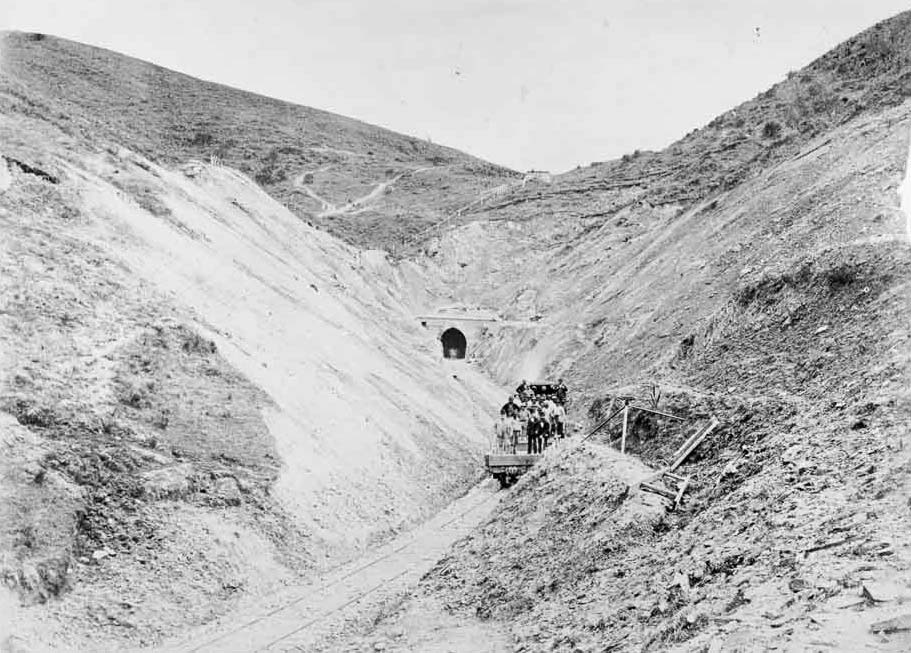
Patrick Dempsey (1845?-10/2/1875) and Thomas Kerr (1839?-10/2/1875) Chain Hills Tunnel

The Chain Hills tunnel was one of two which were dug in the 1870s to connect Dunedin with the Taieri Plain and form part of what was initially known as the Clutha Railway.  It is now, after a long process, soon to be part of a cycle trail which will be the most scenic way to enter the city of Dunedin from the south.  Photos of the tunnel as it looks today can be found here.


Railway workers at Chain Hills tunnel | NZHistory, New Zealand history  online
Dunedin portal of the Chain Hills Tunnel. Hocken Library photo.


ACCIDENT AT THE CHAIN HILLS TUNNEL.

TWO MEN KILLED. 

A serious accident happened at the Chain Hills Tunnel this morning, resulting in the instant death of two men employed on the work. The accident happened at the north, or top end of the tunnel, and this side is divided into three shifts (that to which the accident occurred consisting of fifteen men), under the direction of Mr Kerr. From what we could learn, it appears that about seven o’clock this morning Thomas Kerr (foreman), Patrick Dempsey, Geo. Turnage, and Wedlock, and others commenced working on the tunnel, and after they had been so engaged for about an hour, some seven or eight feet of bluestone fell from the roof of the tunnel, covering the four men named. Wedlock and Turnage were the first to be got out, and as both were seriously injured, they were immediately taken to the Hospital; the others must have been instantly killed, for when their bodies were uncovered, life was extinct. Kerr's head was split open from the right eye across the temple, and his neck was broken; Dempsey’s skull was split open about 3in. wide behind the right temple and across the face to the left eye. The upper portion of the head was almost severed from the lower part, and a more complete disfiguration could hardly be imagined, while any attempt at identification of the features would be altogether out of the question. Kerr’s watch, which was broken, had stopped at five minutes past eight. Kerr was a married and his wife and seven children reside at Fairfield, close by, and his eldest daughter was working within a very short distance of the scene of the accident. He was about forty years of age, had been fourteen years in the district, had been working at the tunnel for about twelve mouths and was greatly respected. Dempsey was about thirty years of age. In his purse was found a ticket for admission to the hospital, bearing his name. 

William F. Pattison, who was in charge of the shift, saw the stone after it fell, and uncovered the men at the risk of his own life, as the stone continued falling after they were got out. The tunnel was timbered within five feet of where the men were killed, and bricked to within twenty feet; this would be about seven chains from the mouth of the tunnel. Sergeant-Major Bevan, from Dunedin, was almost immediately on the spot, and had the bodies removed to Jenkins’s Rose, Shamrock, and Thistle Hotel where an inquest will probably be held to-morrow. The saddest part of he affair is that Dempsey, Wedlock, and Turnage only went to the works for the first time an hour before the accident occurred, and all had been thoroughly enjoying themselves at a ball held at Green Island on the previous night. About sixty men are now working in the tunnel and after the accident work was immediately suspended. On making inquiries at the Hospital this afternoon, we learned from the injured men that no warning was given of the ground falling. Wedlock has his right leg broken, Turnage both legs broken, one being a compound fracture. He is besides very much cut and bruised about the head.  -Evening Star, 10/2/1875.


Telegrams

Dunedin, Feb. 11. It was stated at the Hospital this morning that Fredk. Turnage and Thos. Wedlock, who were seriously injured by the fall of seven or eight feet of bluestone from the roof of the Chain Hills tunnel on the Clutha line, were getting on as well as can be expected under the circumstances. Wedlock has his right leg broken; Turnage’s legs are broken, one being a compound fracture, and he has also several severe cuts on the head. It is expected that Wedlock will soon recover, but the same favourable hopes are not entertained as regards Turnage. An inquest on the bodies of Thomas Kerr and Patrick Dempsey will be held at Green Island at two o’clock to-day. Kerr’s head was split-open from the right eye across the temple, and his neck was broken. Dempsey’s skull was split open about three inches wide, and the upper part of the head was almost severed from the lower. Dempsey, Wedlock, and Turnage went to work only an hour before the accident occurred, and all three had been enjoying themselves at a ball at Green Island on the previous evening.   -Lyttelton Tinmes, 12/2/1875.


Telegrams

Dunedin, Feb. 12. An inquest was held at Green Island yesterday touching the death of Thomas Kerr and Patrick Dempsey, killed by a fall of stone the previous day at the Chain Hills tunnel. From the evidence of Mr W. F. Patterson, miners Dempsey and Turridge were two of four strange men who went to work at the tunnel on Wednesday. At 8 am. that day witness heard a noise as from a blast and proceeded to the spot. Turridge had just been extricated from the stone, Wedlock had a rock on his leg. It was removed with crowbars. Dempsey's head was smashed, and Kerr was covered with rock. While witness had Kerr in his arms a fresh fall of earth took place, separating them and again burying Kerr. No warning was received that the ground was weak, nor was anything suspicious observed. It was the business of the men to ascertain whether the ground was safe. Mr A. J. Smythe, agent for Messrs Brogden, said he had entrusted the control of the work to Kerr, who was an experienced miner, and instructions were given that all possible care should be taken to guard against accidents. He had suggested to Kerr on the previous week that it would be more economical to adopt the top heading. The Coroner said the fact of no accident having previously occurred was a proof that considerable care was taken. The occurrence was evidently one of pure accident. A verdict of accidental death was returned.  -Star, 13/2/1875.


The unfortunate men, Thomas Kerr and Peter Dempsey, who were killed at the Chain Hills tunnel on Wednesday, were buried yesterday at the Green Island Cemetery. The Rev. Mr Watt read the funeral service. The funeral was attended by a large number of relatives and friends of the deceased men, and nearly all the men employed about the tunnel. A movement is on foot for the relief of Kerr's family.  -Otago Daily Times, 13/2/1875.


Peter Dempsey was not buried at Green Island, but in Dunedin's Southern Cemetery.  Thomas Kerr's widow, Janet, was buried beside him 47 years after her husband's death, in 1922.


It will be seen from an announcement elsewhere that an entertainment, consisting of a concert and dance, is to take place at the Temperance Hall on Thursday week. The entertainment is to be held with a view of aiding a labourer named George Turnage, who was crippled for life at the Chain Hills tunnel some few months ago, and who has just left the Hospital. There will be a well selected programme, and performers who are favourites with Dunedin audiences. These recommendations, together with the charitable object for which the concert is to be given, and the attractions of a dance, should be sufficient to draw a good house. The Artillery Band have given their patronage, and will play selections. Mr John Moran, on account of the entertainment being for a charitable object, has cheerfully given his valuable services, though, he has to leave the Province on the following day.  -Otago Daily Times, 13/6/1875.


Headstone2
Green Island Cemetery.  DCC photo.


Headstone1
The grave of Peter Dempsey, Southern Cemetery, Dunedin. DCC photo.