Thursday, 14 June 2018

57775 Trooper Alexander Watt, 9/6/1891-14/7/1918.


Alexander Watt was a farmer from Wendon Valley, Southland and enlisted in the New Zealand Mounted Rifles in July of 1917.  His ship, the  "Tofua" left Wellington that November and Alexander disembarked with his Regiment at Suez.  A few months later, in March 1918, he was in hospital with measles.  He was out of action for two months and then joined the 8th (South Canterbury) Squadron of the Canterbury Regiment of the NZ Mounted Rifles.  The Squadron almost immediately moved to the Desert Corps School of Instruction at Richon le Zion.  On July 10, Alexander and his Squadron rejoined the Mounted Rifles Brigade in the Jordan Valley.

The "New Zealand History" website has this to say about the day Alexander was killed, in the timeline of the Canterbury Mounted Rifles:

  • 14th – The CMR moves to ‘Wax Post’ at 1 p.m. to help the 1st Australian Light Horse Brigade repel an attack by a German battalion on Wadi el Auja. The regiment moves back to its bivouac at Ain ed Duk at 4.30 a.m. One man has been killed and five have been wounded.
Alexander was buried in the military cemetery in Jericho.


Andersons Bay Cemetery, Photo Allan Steel

Thursday, 7 June 2018

13986 Private John Reid, 5/4/1880-8/6/1918.

Mrs Reid, of Kami Street, Mataura, was notified a fortnight ago that her husband, Private John Reid, had been admitted to hospital with influenza, and the news of his death which occurred on June 8 at Walton-on-Thames Hospital arrived on Tuesday. Private Reid was the eldest son of Mr and Mrs James Reid, who are much-respected residents of Mataura. He was born there in 1880 and educated at the Mataura School subsequently learning the bootmaking trade, being associated with his father in the well known business of J. Reid and Sons. At one time deceased was employed by Mr Kingsland, Invercargill, and he also worked for a time at Dunedin. He was a member of the Mataura Town Band, Football, Athletic and Angling Clubs. Private Reid left with the 14th Reinforcements, and was for some time sergeant in charge of one of the military bootshops in England. Last March he was sent to France and was there for six weeks. He was married in 1901 and is survived by his widow and four children, the youngest being about two years of age.  -Mataura Ensign, 14/6/1918.


John Reid enlisted in March, 1916 and left New Zealand after the usual three months of training.  At the end of November, 1916, John was admitted to Codford Hospital, near the NZ camp on Salisbury Plain, to be treated for venereal disease.  This is the first occurrence of the two shameful letters - "VD" - I've seen so far on a soldier's records.  By many authorities, venereal disease was regarded as a self-inflicted wound which rendered a soldier unfit for duty.  Some VD hospitals were not unlike military prisons.  John was discharged to the Base Depot a couple of weeks later.

Codford Hospital, image from Te Ara the Encyclopedia of New Zealand


Originally enlisted in the Otago Infantry Regiment, John was transferred to the Canterbury Regiment in September of 1917 and made a temporary Sergeant the next month.  In March of 1918 he joined the army in France but only for a couple of months before he was admitted to hospital with Spanish flu on May 28th.  Influenza became pneumonia, John's official cause of death.

Major McKenzie Gibson writes from Oaklands Park Hospital, Weybridge, Surrey, to Mrs John Reid, Kana Street, Mataura: ‘‘You will ere this have received the news of the death of your late husband, Sergeant John Reid. Please accept the sincere sympathy of all here who were associated with him. The nursing sisters spoke of him as a good patient, always cheerful and thoughtful for others and never tired of speaking of his wife and children away in far New Zealand. His death was very sudden none of us thought of it in his case. His illness was not such as to place him on the seriously ill list, and only 7 on the Friday evening he was sitting up and chatting cheerily. The doctor who was in the hospital when the change came went to him immediately, bur nothing could be done, and he passed away peacefully at 5.30 on Saturday morning. On Tuesday I had the mournful privilege of reading the burial service at Brookwood Cemetery, where his remains were laid to rest in the ground specially set apart for those of our brave lads who have given themselves for King and Empire. He was accorded a full military funeral. Beautiful wreaths were sent by the hospital staff, nursing staff and the High Commissioner for New Zealand." Nurse Edna Pengally (sister in charge of the Oaklands Park Hospital) also wrote in sympathetic terms to Mrs Reid.  -Mataura Ensign, 7/8/1918.


"That’s the way I’ll serve all such —— — as you, who destroy my property." - Nicholas McDonald, 1852-28/2/1874.

Nicholas McDonald was born in Scotland and worked for the railways.  He was also one of a group of young men who were referred to in the language of the day as "larrikins."  They were a great nuisance to the sober citizens of Green Island but the penalty for larrikinism was not death at the time and the actions of the publican who killed him brought consequences.

The inhabitants of Green Island were thrown into a state of excitement on Saturday evening by the perpetration of what appears to have been a deliberate murder. It appears that a number of parties had been drinking at Patrick Long's Kaikorai Hotel during the evening. One of the men named McSweeney seems to have got much the worse of drink, and, at the request of his wife, another man named Nicholas McDonald endeavored to get him to go home. He got him outside, and immediately thereafter McDonald was struck and knocked down by a friend of Long's named Harry O'Kane, who then went inside the hotel. McDonald followed him and knocked at the door, trying to gain admittance. The report of a revolver was heard within a few minutes at the rear of the hotel, and immediately thereafter Long appeared with the weapon in his hand, and remarking to some one standing beside McDonald, "I will protect my premises, if no other man will," fired at McDonald, who fell and shortly expired. The bullet had penetrated the head just over the right eye. Long was arrested an hour afterwards by Constable Anderson. He denied having fired the shot, or having been outside his hotel that evening...An inquest was held upon the body yesterday afternoon. It is believed the deceased has two sisters about Invercargill. His sad end has caused quite a gloom over the district.
-Bruce Herald, 3/3/1874

"Who met an untimely end" Green Island Cemetery

McDonald's killer, Patrick Long, was a 35 year old Irishman.  He was charged with Willful Murder and appeared in the Dunedin Court on February 28.

The story which unfolded in the court was a simple one.  McDonald and a friend were drinking on a Saturday night.  They into Long's Kaikorai Hotel and asked for drinks.  They were served but made a nuisance of themselves and so were thrown out of the bar.  One of Long's friends then rushed out into the street and assaulted McDonald.  The two young men weren't happy about the situation and began to beat at the hotel door with their fists - and then with lumps of rock, thrown from the front of the hotel.  Then Long walked down the side of the hotel with a pistol in his hand and fired.

"That’s the way I’ll serve all such —— — as you, who destroy my property.’’ Long was reported as saying after firing the pistol.

The issue of larrikinism was raised at Long's trial during the examination of witness James Lowry, a fireman at the Green Island meat preserving works: "...did you ever hear of a harrow belonging to a Mr Johnson being pulled across the road one night by some of your acquaintances?"

" — No."

"Do you not know that the man keeps a loaded gun for fear of the Mandersons, the McLoughlins, and the Spences ?"

" — I beg you will excuse me."

"Well, for fear of the Green Island larrikins? Did you not know as a fact that Mr Allan’s buggy was thrown down one night and smashed to pieces by your brother and these other parties?"

" — No."

"Did you ever hear that they waylaid at night a man whom they mistook for Mr Allan, and very nearly killed him before they found out he was not Mr Allan?"

" — No."

"Did Allan ever tell you he keeps a loaded gun in his possession?"

" — I never spoke to him in my life."

"Would you be astonished to learn that he does keep a gun to shoot any person with who injures his property — especially the Green Island larrikins?"

" — He is a fool. (Laughter.) Nobody ever injured me." 

"No, because you are a Spence, and are among the privileged class."

" — I am very happy to hear it." (Laughter.)

"I ask you again; Do you not know that Green Island is the most larrikin district in the Province?"

" — I can’t say that..."

Long's defence was that he had fired the shot from his pistol but that he did so to disperse the crowd in front of his hotel.  The nature of the crowd and the nature of those Green Islanders described as larrikins was made plain to the jury, as was the sterling character, previously devoid of violence, of Mr Patrick Long.  The jury, after two hours' deliberation, and having previously asked the judge about what leeway there was in their verdict, declared Long not guilty of murder but guilty of manslaughter.

Coming up for sentence, Long was asked if he had anything to say before sentence was passed.  He thanked the jury for their "kind manner and patience" then went on to say: "The next what I shall say is, as my dying declaration — supposing I was on the scaffold, and the rope round my neck, and it was my last word...(His Honour: "No language like that should be used. The verdict does not entail that.")...I did not shoot at him with intent to kill, or at any other man with intent to kill. I shot over that crowd of people, in order to frighten them — in order that I might not be killed myself, and to disperse them. The malice that seems to be borne between me and that deceased man — that this Court is led to believe so — I never had any, and I don't think he had any occasion to bear malice to me."

Patrick Long was sentenced to five years' penal servitude.

The licence of the Kaikorai Hotel, sold by Long to a Mr James Hyndman was contested by the police when it was applied for under its new owner's name.  Witnesses described it as a disgrace and the principle cause of the rowdyism of Green Island.  A great deal of drunkenness and indecent exposure were caused by its patrons.  (Indecent exposure at that time included public urination.)  The licence was refused.

Refusal was not an insurmountable barrier to Mr Hyndman - he was in court before the end of 1874, charged with supplying liquor without a licence.  A threat made outside the court before the trial to one of the prosecution witnesses was taken by the judge as an admission of guilt.

The Hotel was offered for sale early in 1875.  The new owner, Lewis Marshall, was granted a liquor licence in June, 1875.  Its next owner, a year later, had his application refused.  The hotel's licence was granted or not through the years - it seems to have been trading in 1939.


Green Island Cemetery

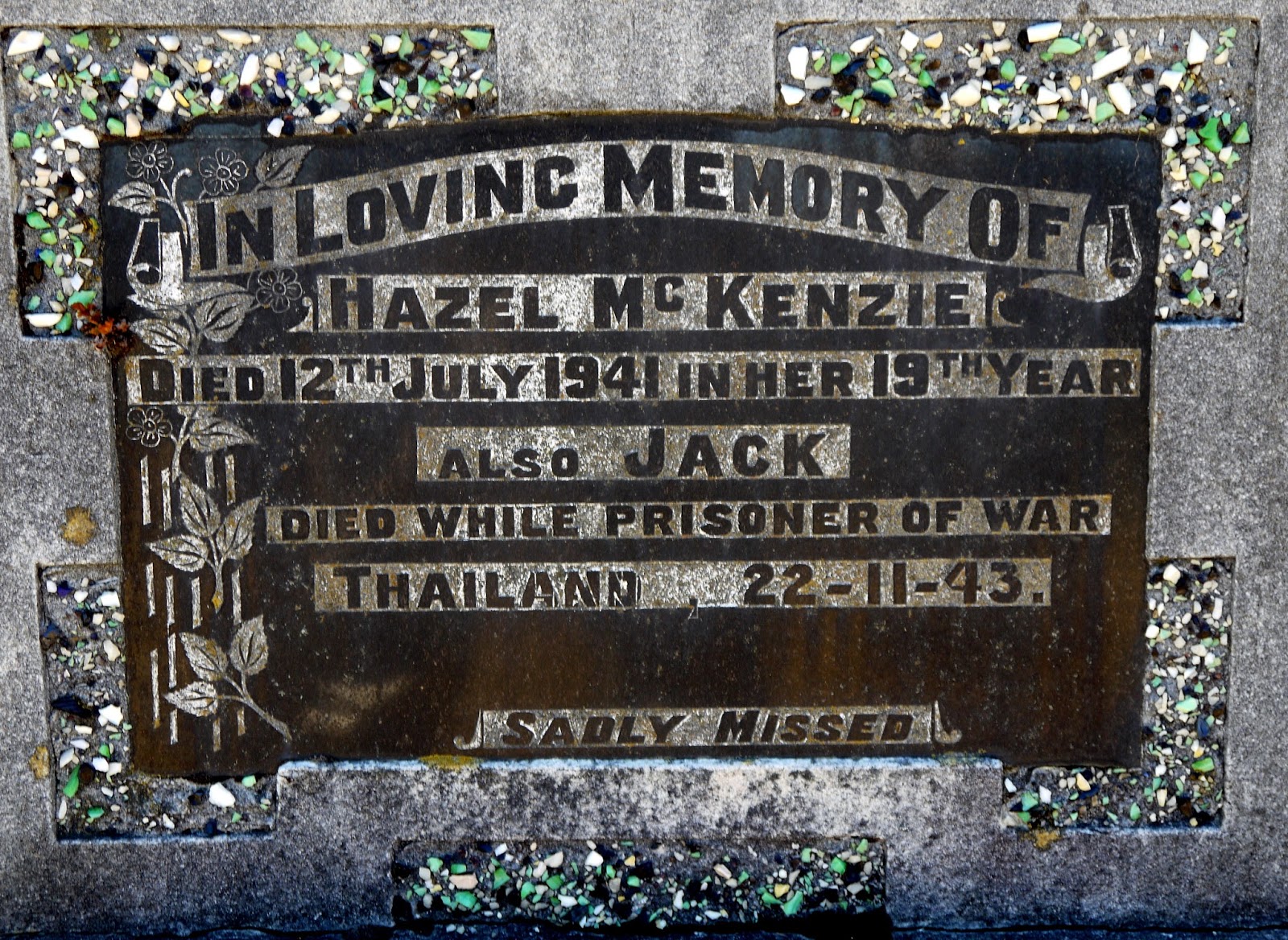
13601 Private Jack Forrest Mckenzie POW, Thailand, 1906-22/11/1943.


In Dunedin's Andersons Bay Cemetery is a stone with a few names and a brief epitaph for an absent family member.  Jack Forrest McKenzie was born in Dunedin and was a Private in the Federated Malay States Volunteer Force, a Territorials-type force which was mobilised in 1941 to defend the Malayan Peninsula against the invading Japanese forces.  Jack's unit was part of the Line of Communications Brigade and it is likely they never made contact with the enemy.  But they were part of the Army and, as such, became prisoners of war when they disbanded in December 1941.  When the Japanese decided to build a railway through Thailand to support their drive west through Burma towards India Jack was one of the prisoners who were used as slave labour on the project.   It was brutally hard work under punishing conditions with starvation rations.


I can find no cause of death for Jack.  The most common one for those men was starvation or exhaustion.  Sometimes they were beaten to death by guards for minor infringements or disobedience.  Some slowly succumbed to vitamin deficiency or tropical diseases.


Jack is buried with other victims of the Burma Railway in Chungkai Cemetery, Thailand.  He was 37 years old.
From the NZ War Graves Project


Sunday, 27 May 2018

Bransgrove of the Transvaal - 1190 Henry Edward Bransgrove, 1874-16/1/1908.

In Dunedin's Northern Cemetery is a grave whose stone I had passed by several times before, visiting to find a different grave, I noticed its inscription.

In loving memory of Henry Edward Bransgrove, Died in South Africa 4th Aug, 1908. Aged 35 years. 
Severely wounded in Boer and Zulu Wars, Interred here 16th Jan 1909


"Severely wounded in Boer and Zulu Wars" was an intriguing piece of history but there turned out to be much more to the story of Henry (or Harry) Bransgrove.  Henry Bransgrove, I found, was involved in the ill-fated "Jameson Raid" - an attempt on the part of some renegade Imperialists to free the ill-treated gold diggers of the Transvaal and bring democracy to a region which had none.

Well, it did have some democracy, but the original inhabitants of the Transvaal (well, the original white inhabitants) were the only ones allowed to vote.  Well, the men were at least.

The Transvaalers were part of the Great Trek of Dutch South Africans to escape British rule and rules.  They established their republic in the northern part of South Africa and settled down to farm there.  Then someone found gold and the area was soon swarming with foreigners.

The foreigners, aka "Uitlanders," weren't such a great problem in themselves.  The gold rush brought higher demand for what the farmers could spare.  But they soon outnumbered the Boers and started to agitate for political rights. 

The Transvaal government loosened its rules around voting, allowing men to vote if they had lived in Transvaal for four years.  For some, however, that was not enough.  For some others, it was an immense injustice that the gold of the Transvaal was in Boer territory and not that of its rightful owner - the British Empire.  To the man who had spent his life in the cause of making the world better (as he saw it) by making more of it British - Cecil Rhodes - it was an intolerable situation.

The Jameson Raid was a simple plan - stir up internal unrest, send troops in to restore order, eventually organise a plebescite and annexation.  To be more precise, a group of British miners would seize the armoury at Pretoria and elements of the Matabele Mounted Police plus volunteers (about 600 in all) would cross the border, under the command of Leander Starr Jameson - the Administrator General of the Chartered Company for Matabeleland (of which Rhodes was the Chairman).

But it failed in the first stage.  The group of Uitlanders in the Transvaal took too long to decide on their support for the coup and what the post-coup government would be like and, to help make up their mind, the troops were sent in anyway.  Some telegraph lines were cut - including the one which could have called them back when things were looking bad - but not the ones which alerted the Transvaal government to the invasion force.  They were defeated and taken prisoner after a five day incursion.

Harry Bransgrove's part in the Jameson raid is difficult to work out.  His 1908 obituary notes that he took part and also notes that he was present at Johannesburg when it was a collection of tin sheds.  Perhaps he was part of the raiding force due to his knowledge of the area.

Arrest of the Jameson Raid


Mark Twain on Cecil Rhodes:  I admire him, I frankly confess it; and when his time comes I shall buy a piece of the rope for a keepsake.
Following the Equator
In 1899 the uneasy truce between Boer and Briton was broken again with the beginning of the conflict officially known as the Second Boer War.  Harry enlisted in the South African Light Horse, a unit made up mostly of Uitlanders.  He was at the Battle of Colenso, a failed attempt to relieve the besieged town of Ladysmith.  It was a very British defeat, its embarrassment covered by a small and glorious crop of Victoria Crosses.  Harry was wounded.

Harry also served with the Australian Commonwealth Horse, a unit which was raised in 1902.  Perhaps it was his military experience which suited him for the unit of new soldiers, perhaps he was chosen due to his father's Tasmanian origin.  Perhaps his wound meant that a training role was best for him at the time.

Harry returned briefly to his home town of Dunedin in 1906, having been in South Africa since 1892.  He then returned and served in the Transvaal Mounted Rifles in the suppression of what was called the "Bambatha Rebellion" - the resistance of a local chief to a poll tax imposed on his people by the British. This was very much a war in the "Blackadder" style, as exemplified by his trench-bound reminiscence of pre-war campaigning: "Well, you see, George, I did like it, back in the old days when the prerequisite of a British campaign was that the enemy should under no circumstances carry guns - even spears made us think twice.  The kind of people we liked to fight we two feet tall and armed with dry grass."

The warriors of the Bambatha weren't armed with dry grass but neither did they have any guns.  It was a short campaign.  Harry was wounded by an assegai thrust and "his sufferings...were intense, and were made greater by the fact that he had to pass through several field hospitals before he reached the base." - Otago Witness. 12/8/1908.

The Transvaal Mounted Rifles, 1906.

Harry underwent an operation at Durban which saved his life.  Chief Bambatha kaMancinza's fate was - depending on which story you believe - beheading on the battlefield or escape.  The centenary of his demise saw him named a national hero by the South African government and commemorated by a street name and a stamp.

The result of Harry's life-saving operation in Durban was not permanent.  He died at the Kensington Sanatorium in Johannesburg in 1908 and was buried in Dunedin's Northern Cemetery the following year.

PERSONAL ITEMS

Advice has been received by cable of the death of Mr Henry Edward Bransgrove, son of Mr William Bransgrove, of Dunedin. The deceased, who passed away in the Kensington Sanatorium, Johannesburg, on the 4th inst., spent a considerable time in South Africa. In 1906 he returned to Dunedin on a visit after 14 years of adventurous life in the Transvaal. He was in Johannesburg when it was but a mining camp, and he saw it grow into a city of magnificent buildings like Melbourne. Mr Bransgrove participated in the Jameson raid, and when the Boer war broke out he joined the South African Light Horee, and was twice wounded — once at Colenso under the late General Buller, and, as a member of the Transvaal Mounted Rifles, he was engaged in a conflict with the natives, receiving an assegai wound at Iusuzi, where he had a thrilling experience. His sufferings on the latter occasion were intense, and were made greater by the fact that he had to pass through several field hospitals before he reached the base hospital at Durban, where an operation was performed that saved his life. Mr Bransgrove had an interest in a diamond mine on the Rand, and he also possessed a farm of some 2000 acres in Uganda.  -Evening Star, 7/8/1908.


Wednesday, 23 May 2018

42555 Private John McNeill, 5/7/1880-18/5/1918.


John McNeill grew up in Fairfield, Dunedin a son of Scottish parents.  He joined the Otago Infantry Regiment.  He was a coal miner, working in Christie's mine on Saddle Hill, and physical strength might have made up for his relatively advanced age on enlisting.

He was admitted to hospital in France on September the 18, 1917, suffering from "enteritis" - an inflammation of the intestine which is often caused by insanitary conditions affecting food and water - just the kind of conditions to be expected and guarded against in trench warfare.  His condition did not improve and on January 10th, 1918 he was in the hospital at Walton-on-Thames.  The New Zealand newspapers reported his admission, described as "not severe."

On the 17th of May he was placed on the "seriously ill" list - the next day he was dead.  He died of an abscess in his liver.  It's possible that the cause of his death went undiagnosed and was revealed by autopsy.


Green Island Cemetery.

54249 Rifleman Stanley Strong, 25/7/1896-20/5/1918.


"Rifleman Stanley Robert Strong (reported died from wounds on May 20), was the eldest son of Mr Robert Strong, 42 Bay View road, Dunedin, and was 21 years of age. He was educated at the Alexandra, Musselburgh, and Otago Boys' High School. He entered the firm of W. Scoular and Co., and was employed by them until he went to Trentham. He entered Trentham in January 1917, and left New Zealand with the 24th Reinforcements on April 20. He reached France early in October and saw active service there. His parents received word three months ago that he was transferred to the Signallers, and he remained in that branch of the service till his death."  -Otago Daily Times, 12/6/1918.

Stanley Strong died from multiple wounds, according to his official record.  He died from wounds to his "eye, hand, legs" - three short words that hide a world of pain.  No details can be found in the Rifle Brigade's official history of the action in which Stanley was wounded.  His personal record shows that he was wounded, evacuated and died.


"Nobly fighting, Nobly fell" is the brief epitaph attached to his death notice in the newspapers.


Alexandra Cemetery