LOCAL AND GENERAL.
Girls are coming to the front, if we may judge from the junior scholarship and honours list of the New Zealand University. Of the 59 competitors who have been placed, 40 are boys and 19 girls. If this represents anything like the proportion of boys and girls who went up for examination, the girls seem to have numbered about 33 per cent.; and it is creditable to them that they should have carried off 50 per cent. of the scholarships — that is, four out of the eight open to the schools of the colony. Of the 19 girls who have a place on the honours list, seven are from the Otago Girls' High School; all the candidates who attempted the examination from this school having obtained good places on the list. Two girls from this school, Marion White and Catherine Moss, have won respectively the third and fifth scholarship; whilst Barbara Watt, another pupil of the school, stands third on the list of those who, failing to win scholarships, have yet obtained more than 1500 marks. The other Dunedin girls whose names appear in the houour list are Florence Muir, Elizabeth Gellatly, Jane Kinder, and Jane McNab. Marion White, the winner of the third scholarship, received her primary school education in the Milton District High School. At this school she obtained a board scholarship, which carried her on to the Otago Girls' High School, where she has studied for the last two years. -Otago Witness, 3/2/1888.

UNIVERSITY INTELLIGENCE. (excerpt)
The following Otago students have passed: — M. A (with honors). — Miss Marion White, first-class honors in mental science. -Evening Star, 27/2/1892.
"Mental Science" is the term used at the time for the study of psychology.
LECTURES.
A LECTURE on ‘Tennyson’s Women’ will be delivered by Miss MARION S. W. WHITE M.A., in St Paul’s Schoolroom on SATURDAY EVENING, August 6th, at 8 o’clock, with Tennyson’s Songs by Misses Tresseder, Muir, and Nellie Stevenson, Messrs Hopcraft, Salmond, Martin, and F. L. Jones.
A. Wilson, Esq., M.A., in the chair. Tickets, 1s 6d, at Begg’s and Horsburgh's. -Evening Star, 2/8/1892.
As showing the success which is attending the higher education of women in this community, it is worthy of being recorded that one of the successful students of the Otago University, Miss Marion S. W. White, M.A., delivered an able lecture, on the evening of the 6th inst., on "Tennyson's Women." The chair was occupied by Mr Alexander Wilson, M.A., rector of the Girls' High School, and there was a crowded attendance. Miss White's lecture was able and scholarly, and in her introductory remarks she dwelt with some force on the great change which during the present century had come over the relative social positions of the sexes. Miss White passed in review the women characters in "The Idylls of the King," "The Princess," "Gareth and Lynette," and the poet laureate's other well-known works, and deeply interested her audience. -Otago Daily Times, 9/8/1892.
THE SONGS OF BURNS.
At the Choral Hall last evening, under the patronage of the Burns Club and in aid of St Andrews Manse bazaar fund, Miss Marion S. W White, M.A. delivered, before a fairly numerous audience, a lecture on "The Songs of Burns." The Rev. Rutherford Waddell presided.
Miss White prefaced an interesting and able lecture by remarking that anybody who took Burns as a subject laid himself or herself open to two serious objections, the first of which was that everything had been already said about Burns not once but a hundred times and the second was almost the opposite - that many people did not like Burns. The second objection, Miss White said, emboldened her to ignore the first, which, however, she immediately proceeded to dispose of, as she showed by her lecture that however much has been said about the national poet of Scotland, it was possible still to deal with the subject in a fresh and attractive light To the life and character of Burns the lecturer made only an incidental reference, remarking that in him self control was wanting, and that the power to act as his moral and religious nature prompted him was not present. The bulk of the lecture was devoted to a thoughtful discussion of the poet's songs, many of which she recited. It is not for every person to pronounce Scotch correctly, and it will perhaps not be regarded as hypercritical if we say that Miss White is not one of those who possess the gift; but for all that her reading of the songs was pretty and effective. She was frequently interrupted during the lecture by demonstrations of approbation, and when she sat down the applause was hearty and prolonged.
The Chairman, at the conclusion of the lecture expressed the thanks of his congregation to Miss White for preparing her lecture and delivering it that evening. She had not only the heart to appreciate the poet, but she had also an excellent method of expressing her sentiments and thoughts regarding him. The speaker fears that Scotch was becoming a dead language, and he found that amongst the young colonials there were many who did not understand it and did not care for it. He was a Scotchman himself - that was, perhaps, his misfortune rather than his fault - but he had an intense sympathy with Burns, and it was very gratifying to him to see a distinguished student of the Otago University giving such an appreciative lecture upon Burns' songs.
Incidental to the lecture, Miss H D Matheson sang "Aye, wakin' O," Miss L Tresseder "o wert thou in the cauld blast" (for which she received an encore), Miss Alice Grey "My heart is sair" (a portion of which, in response to the demands of the audience, she had to repeat), Mr J. H. Nimmo "Scots wha hae," Mr A. Walker "My love is like a red, red, rose," and Mr A. Wright "My Nannie's awa." The duet "Ye banks and braes" was sung by Misses A. Cooper and M. Owen, and an encore had to be granted, while a double quartet of male voices received encores for their renderings of "Wullie brewed a peck o' malt" and "Duncan Gray." The singing of "Auld lang syne" appropriately concluded the programme, for the musical portion of which Miss Lily Cameron acted as accompaniste. -Otago Daily Times, 12/10/1892.
A Milton Lassie. — We are delighted to welcome back among us, albeit only for a time, our talented young townswoman, Miss Marion White, M.A., who has been gaining laurels down North as a lecturer, her theme being the poetry of Robert Burns. Miss White will lecture in Milton, and we can assure our readers there is a treat in store for them. The Dunedin press speaks in the highest terms of praise of her entertainment, which comprises music and singing, as well as oratory. As Miss White is a "Milton High School girl" Tokomairiro generally ought to rally to her support when she faces her audience in St. George's Hall next month. -Bruce Herald, 18/10/1892.
THREE MONTHS' RELIEVING.
(Specially Written for the Witness Christmas number of 1893.)
By MARION S. W. WHITE,
It was a wild night on the Gray Ranges. The wind, sweeping across the tussocked slopes in furious gusts, drove before it the keen rain, and twisted the meek shrubs and lashed the yellow tufts of snowgrass, as if furious that it had no worthier object for its wrath. No star was visible, and the moon, buried somewhere behind the hurrying masses of black cloud, was too young as yet to have more than the faintest influence on the stormy darkness. The hills sloped down abruptly to the river, which, swollen with the rains, roared and thundered over its rocky bed with that ominous and uncanny rise and fall of sound that fascinates the night listener. A narrow bridle track led over the hills, and was apparently continued down the precipitous slope to the river. But the rider who had last made use of it dismounted at the top of the incline, and, instead of beginning the descent, leaned with one hand on her horse's neck and listened to the noise of the river. For her the roar down there in the darkness bad a very real and human terror. She had never been here before. She knew nothing about the depth or danger of the stream. But she did know that it had to be crossed before she could reach shelter. Her horse was a hired one, and she had doubts of its powers. Her riding habit was soaked; her little close riding cap was dripping upon her white cheeks and broad eyelids. She could feel the cold rain against her head, through cap and veil and coiled-up hair. Her feet were numb, and the small hand on the horse's neck was almost lifeless.
"It's well you aren't inclined to run away, old Spider," the girl said, with a pat to the wet neck, "for I shouldn't be able to hold you in with these hands."
Spider had no intention of running away. But possibly he wished that he had had, instead of a light and gentle stranger, one of his own familiar rough-handed riders, who would have sworn at him and held his head up, and rattled him home to stable and supper, instead of standing and patting him in the bitter wind and rain. He moved restlessly, and pawed the narrow path, looking sideways at his perplexed companion. "We can't go back," she said, "15 miles against this storm. We can't stay here and be turned into pillars of ice, like Lot's wife. If we go on we must cross that river. And it roars like ten thousand lions for their prey. I wonder if you have crossed it before, and if you can swim, old Spider; for I can't. Come, then; I'll lead you down."
She took the bridle, and began to step carefully down the slippery track, the horse picking his way behind her. Soon the bordering of their way changed from tussocks to bush, and the girl clung to manuka and mappo as the horse slipped and slid and struggled down. The darkness in the gorge was intense, and the sound of the water grew so close as they descended that the girl expected momentarily to feel the cold flood round her feet. The noise surrounded and stunned her. She lost that half of her courage which had proceeded from a want of realisation of the danger; and as she clambered on — now dragging her horse, now dragged by him, with her habit tangling in the tree stumps, and the wild brambles pulling above at her cap and hair like elfish hands — Dorothy Graeme thought one or two unspoken prayers of characteristic simplicity and earnestness. "Help me not to be afraid, and comfort Jack if I am drowned."
At last, and yet suddenly, she found herself trembling on the river bank, and peering through the rain at the strange, black moving thing that lay across her path. She tried to judge of its width, but it was so dark that she could not distinguish river from bank. Dorothy felt a sudden weakness, and put her hand up to shut out the incessant noise and the moving darkness. But Spider pricked his ears, shook himself, and sniffed at the water with the cheerful alacrity of a good horse who sees only a trifling and familiar obstacle between himself and his supper. Dorothy seized on the omen, shook the rain from her hair, and decided that the bugbear was a mere creek, perhaps not up to the horse's knee. She tried girths and bridle, mounted from a stone, and felt Spider splash cautiously but firmly into the stream.
It was deep, and the current was strong. They were carried down with it, but the horse kept his feet. The water rose to his girths, and Dorothy's long habit, caught in the flow, almost dragged her from the saddle. She gathered it up hastily, and spoke cheerily to the horse and patted his neck. He stepped strongly, but the river grew deeper at each step — deeper and deeper, till she dipped her right hand in it to the wrist. She felt the horse gather himself together with a strain. Then the ground went from under his feet, and Dorothy, clinging to mane and pommel, shrieked a desperate "Save me!" to the wind and rain. But she was not drowning. Spider had got out of his depth, and was swimming for his life. In a moment she saw the outline of the bank. The next, something seemed to rise from the river and push her by both shoulders from the saddle. She fell face downwards without a cry, grasped at a projection with the grip of desperation, and heard in the same instant the sound of the horse's hoofs as he struggled up the rocky bank, and left his rider to die. She was only 19; she did not fear death, but to die thus terribly in the black water and the storm all alone! She screamed aloud to God. A human voice answered her through the rush and dash of rain and river. Presently she heard the words:
"Keep quite still, and you'll be safe in half a minute."
A hand touched her, an arm was put round her.
"Now, loose your hold of the root. Lean on me. You feel the bottom? Hold my hands — we're safe!
They were safe. Dorothy lay — very weak, but quite conscious — on the wet rock, and a man was chafing her hands by the light of a lantern, while Spider stood dripping and trembling beside them.
As her rescuer looked anxiously at Dorothy's face she smiled back faintly and half raised her head.
"You're better?" he asked, smiling too. "You had a very cold bath. I wish I could offer you my coat, but it is as wet as the river."
"Thank you," said Dorothy very weakly, but smiling again. "I'll soon be better. Are we very far from shelter?"
"Not half a mile. There's a farmhouse at the top of this hill. I could easily carry you up." "Oh, I can ride," Dorothy said, "if you will help me to mount."
The stranger looked dubious, but he helped her to rise with care, and lifted her into the saddle. Dorothy was weaker than she knew, and it needed all the care of her companion to keep her safely there. The rain was still heavy, but they were sheltered from the wind, and as Spider climbed stiffly up the long hill Dorothy felt through all her physical discomfort a sense of protection and security that shortened the halfmile surprisingly.
"I should not have come alone," Dorothy said in apology for her weight against the arm that supported her; "I am the relieving teacher appointed to Gany School, and arrived in Rainville to-day with the coach. There was no one to meet me, so I borrowed poor Spider and set out to ride. It seemed to get dark and stormy very suddenly." "It did indeed," said her companion; and his voice had an anxious intensity of feeling that arrested Dorothy through all her own preoccupation. She said nothing for a minute, trying to find some words wherein to utter her thanks. But while she hesitated the lights of a house streamed out a few feet farther on, and the barking of half a dozen dogs brought out a man and a whip to ascertain the reason of the disturbance. Dorothy's companion did not call him, but helped her hastily down, knocked loudly at the door, and as steps were heard coming along the passage, turned, with a hasty "Good night!" and strode away into the darkness.
The relieving teacher at Gany had been for a week in the enjoyment of her new dignities, when on a Friday afternoon she opened the door of her little schoolroom, and watched the children stream out into the mild autumn sunlight. They smiled at her as they went past, for they liked the new schoolmistress. She moved about after they were gone, putting away a book or two, and picking up a withered flower or a dropped slate-pencil here and there. There was a cup of hollyhocks and sweet-peas standing on her desk. She lifted it and buried her little straight nose in the fragrant pink blossoms. Then she locked the desk, and stood for a minute looking out on the grassy clearing and the path that wound through it and disappeared in the bush. In a few moments she would go into her own bare little house, and prepare her solitary cup of tea and cut her slice of bread-and-butter. Then she would walk perhaps a little way through the bush or over the hills, and gather some fresh ferns and wild daisies. Returning, she would prepare certain notes and lessons for to-morrow, write a letter or two, read a few pages of her novel, lock up her house, and go to bed. To-morrow would be as to-day, and each after day as tomorrow. Dorothy smiled pensively, contemplating the story of her three months. "I won't have much to tell Jack," she said. The thought of Jack brought up the swift colour, though she was all alone. It did not bring a happy smile with it. Dorothy knitted her white brows in a vexing perplexity over that name. She was to decide now, in these three months of absence and loneliness, about Jack. She had promised to decide. She would surely find out, when she was so far away from him, whether or not — whether or not. She beat her pink finger-tips upon the dim little pane in impatience. She had known Jack all her life. How could she find out — whether or not? And yet, Jack loved her so! Why would boys love people so, and be so desperately in earnest?
She turned from the window in a little pet at life and lovers, and went out into the afternoon sunshine. She did not care for tea just now. She would walk across the hill, and taste the clear, mild air.
When one person climbs a hill from one side and another person climbs it from the opposite one, there is a strong probability that they will meet at the top. So it came to pass that Dorothy, standing with bright cheeks at the summit of her hill, came face to face with someone she had seen before.
"Oh, I am so glad!" she said, and held out a soft hand to her saviour of a week ago. "Why are you so glad?" he asked, just touching the hand, and looking down on the face, with its brilliant smile and its great eyes.
"Because I have wanted so much to thank you, though I can't do it as I should." The eloquent grey eyes pleaded for the helpless tongue. "You saved me from drowning, and I never saw you again to say a word of thanks."
"Perhaps after all it is I who should say the words of thanks," the stranger said, smiling with a strangely melancholy sweetness at the eager face. "But supposing it otherwise, I shall be a thousand times repaid if you will talk to me a little."
Dorothy looked with some wonder at the man who uttered words of such unusual courtesy on the bare hills of Gany. His face, she decided, was no contradiction to his easy grace of speech — a delicate, refined face, worn as it seemed with thought or care, and intensely melancholy in repose; two dark, enigmatic eyes, with a steadfast attentiveness of gaze that yet had not the faintest trace of impertinence. Dorothy was frank and fearless by nature and by training, but she felt a sudden inexplicable failure of her courage before the grave regard of these sad eyes. She wished, without any reason for it, that she could guess at his age. Was he 30, 40? It didn't matter.
"I'm afraid I can't talk very well unless you will tell me your name," Dorothy said, with first her open eyes and then her downcast eyelids to atone for the abruptness of the request.
"My name is Kenneth Austin," her companion said; "and your poor servant ever." he added smiling, and bowing to the dainty picture before him. Dorothy rejoined with a courtesy and a "Sir, my good friend!" like a queen of fair maids, as she was.
So they walked together over the barren hills, and talked together under the smiling autumn sky. They spoke of books, of men, and places. Austin had seen much and read and reflected more. But it was not the store of information and thought that every word revealed which fascinated Dorothy. It was the subtle, perfect sympathy of this soul with her own. She spoke from her heart. Fancies and dreams that she had never before put into words came now to her tongue clothed in delicate speech. Something in her companion's deep eyes and sombre voice drew forth all that was bright, earnest, noble, or fantastic in the girl's full, fluent inward life. She had always lived among intelligent people. Often she had talked with men of learning and culture; but she had never felt before this exquisite communion of spirit with spirit when all barriers seemed melted away, and her intellect was free to speak its own language. Her eyes shone like stars, and her clear soul came to their windows to look upon this other chance-met fellow soul with whom it found so much in common.
A strange walk and talk it seemed. Later, when they had parted in the shadow of the schoolhouse, Dorothy had come down from her golden exaltation to the chillier present. Austin had not talked of himself so far as the events of his own history went. She know nothing more of his kin or possessions now than she had known when he called to her from the bank of the Gany. But how fine a soul! she thought, clasping her hands anew, and remembering the simplicity, the generosity, the nobility of all this man's views. Were there many such here among the farmers and shepherds, whose children came daily in their heavy boots or bare brown feet to school? She would think better of all human beings, she fancied, because this stranger had so lofty and so pure a mind.
She fell to wondering whether her old friends at home would understand her appreciation. Jack, for instance — what would Jack say? She had a letter from him lying on the table. She read it again and threw it down impatiently. It seemed so trite, so petty, so raw and boyish after that grave voice. Then she picked it up again, with tears, and kissed it. Jack loved her, after all; and there are so few people in the world who love us! She would answer the letter to-morrow, and say only that the stranger who had saved her life was intelligent, perhaps, and kind-hearted. Jack would not mind that — poor old jealous Jack, who clouded down whenever she bowed to anyone else on the street.
The matrons of Gany, with the best intentions in the world, were not able, owing to long distances, numerous children, and many domestic duties, to keep a very careful eye on the movements or their teacher. But the children, tumbling about the hills and scrambling through the bush after school hours, not unfrequently saw Miss Graeme employed, only with more dignity, in much the same pursuit. Sometimes she was alone; but now and then someone accompanied her and carried the ferns and berries that she valued. For their talk together on the hill above the school was not their last. Their last! Would their last talk come some day? Dorothy found the thought of it aching strangely, constantly in her heart. She had only three weeks longer to stay. How the days had flown! How soon she must leave the little tranquil school, and the cool bush, and the wild hills, and her free, solitary life!
And she would never go back to quite the life she had left; for she must write to Jack, and tell him whether or not. Tomorrow she would write. To-night the sky was wild and the wind stormy. She would go out and walk a little — walk away the strange fever of regret and grief which the thought of her departure woke. She went out and climbed the hill, as she had done two months ago, struggling against the wind with a certain defiant pleasure. She looked back across there two months to the girl that climbed the hill then. She felt so much older now, so much wiser and larger in her views; and that must be because she had talked now and then to Kenneth Austin. How much he had taught her and shown her, and how soon she was going away!
She walked over the hill to the shelter of a huge rock, and stood, hidden from the wind, beside it. Someone who had been watching her came too. Kenneth Austin smiled his melancholy smile at the young, bright-eyed friend, who flushed so softly at his coming.
They had often met thus — the world-worn, sombre man and the clear-eyed girl. What tie bound them to each other, of trust, and pity, and admiration, neither knew, but to-day it was to be broken. Austin's face was pale and strange. Dorothy felt, with her quick instinct, that something was to be said or done that would end or alter their friendship. She did not speak.
"I have been watching for you," said Austin, very gently. "I must tell you something to-day. I have always known I must tell it, since that night when you smiled on the rock."
"Yes," Dorothy said, unsteadily.
"You are very lovely, and your eyes have a light in them from Heaven above. I think sometimes that you must have come from Heaven to make me confess my sin and save my soul."
Dorothy's eyes spoke only.
"You have been good to me and sweet, and my life since you came has been paradise. Paradise with a serpent, though," he said, with a kind of bitter laugh; "the serpent of my sin."
"Tell me of it," Dorothy said, with her sweet voice and her clear eyes of pity to help the bitter confession.
"Do you know why I live in a hut in the bush and have neither friend nor brother to turn to? I was wicked; I gambled away my chances in this world and the next. I broke my father's heart, and wore out the patience of God's angels. They left me alone, and I — I forged a cheque, and another man suffers the punishment for it to this day. I hide here from the shame and the agony of my cowardice. But that night — the night you came — when the wind blew and the river roared, and the trees strained and creaked in the storm, ten thousand fiends rose up and cursed me for my crime, and I saw the face of that man in prison as I see yours now. When the clock struck 9 I took up my lantern and walked to the river, and I was walking straight in when you called."
Involuntarily Dorothy clasped the arm that had saved her with her two hands as if to draw him back from his dark fate. He looked down at the hands on his sleeve, and then at the true eyes raised to his. "What must I do?"
"You must take his place and set him free."
Her own voice sounded like a stranger's in her ears. "And I will never see you again?" "How long will it be?"
"Ten years. But I am a dying man now. I will not live it through."
"Oh, pray to God! — to God. There is no one to help us on earth!"
"I will pray. I am not afraid of God now, since I have seen you. The angels have your eyes when they plead with God for us."
"And if you live — if you come back — we will meet?"
"We will meet sooner. I cannot live two years with this heart....Then I will say good-bye."
"Must you go now?"
"Now. May God love you, my sister, my good angel."
"And you, my brother, my friend."
They kissed each other solemnly, with tears. Then a gust of sudden fury drove round the rock, and Dorothy was alone.
"What good did it do, Jack?" she said, years after, telling of that meeting and parting, when the daisies were white on Kenneth Austin's grave.
"It saved a soul, I think," said Jack. "When girls are like my Dorothy, the lost see to walk straight by the whiteness of their lives." -Otago Witness, 21/12/1893.
THE WOMAN BOOM.
By Marion S. W. White, M.A.
"The subject for discussion to-day," said the President of the Fish and Fly Discussion Society, "is the Woman Boom,"
There was a dead silence.
"The — I don't think I quite caught the title," Millicent said at last in a faint voice.
"The Woman Boom," repeated the President firmly. Three members of the society, and Freddie, rose to their feet. "Will you excuse me, I had forgotten an engage..."
But the President waved them back to their places with an inexorable hand.
"It is of no use," she said, and when she spoke in that tone nobody dared to resist her. "We must discuss it. We have done 'The Future of New Zealand,' the 'Coming Australian Novelist,' 'Spiritualism,' 'Theosophy,' and 'Our Neighbours' Faults.' The other great subject of the day is the Woman Boom, and if we neglect it we are shirking a duty. Freddie, sit down."
Freddie's enemies say that he is "harmless," but his friends indignantly deny the accusation. He is admitted to the discussions of the society chiefly because he won't go away and fish. The society has another fine feature besides Freddie. Although everyone is bound to discuss, nobody is ever compelled to have an opinion, or to arrive at a conclusion. So that its arguments do not flow in keen, clear streams, but drop like dews from the eaves of a thatched cottage.
"If you are going to discuss Woman with a capital letter," said Freddie very decidedly, "I have an engagement. Woman with a small 'w,' " he added, looking pathetically round upon the society, "is an angel; but woman with a capital is a bore. All I ask is, has this one a capital?"
"We shall discuss her with a small letter," said the President placably. Freddie heavy a sigh of relief and sank back upon the grass. The society had just finished a spirited cray-fishing competition. They were now sitting or lying about the bank of the stream, waiting for the billy to boil. By the laws of the society all discussions had to take place in the open air, because, as the President fondly believed, the smells of manuka and the songs of tuis destroy prejudice and promote generous views of life.
"First," said the President, "we shall take definitions. Millicent, what is the Woman Boom?"
"It is the effort," said Millicent, "that women are making under the guidance of a few fanatics to usurp all the duties and privileges of men. On paper it is a collection of all the tedious and unprofitable questions ever invented. In tram cars and railway trains it is the strong-minded woman with the bagful of tracts on the franchise. In the atmosphere it is a frightful fuss."
"Your definitions are all hostile," said the President. "Mary, it is your turn."
"The Woman Boom," said Mary, "is a nickname given in contempt by smallminded and ignorant people to the noble efforts women in our day are making towards enlightenment, freedom, and a larger ideal of living. Its leaders are brave women who face in a good cause the prejudice, apathy, and insult of their own sex and the brutal hostility of the other."
"Doris, give your definition," said the President.
"It is dress reform, isn't it? and cycling and smoking cigarettes on the balcony, and wearing tailor-made frocks, with those dear neckties that suit Millicent so well." Thus Doris, and poked out her foot to admire its instep.
"Freddie, define the Woman Boom."
"Woman — the female of the human race," said Freddie, quoting his dictionary. "boom — to roll, to roar, as cannon, thunder, &c. Woman Boom, the rolling and roaring of the female of the human race. What's the matter, Mary?"
"Women are not whales," Mary said with great scorn; "besides, dictionary definitions are lazy. You must make one yourself. Make a metaphor."
"The Woman Boom," said Freddie promptly, "is fuss. And fuss is the smoke of the factory where progress is manufactured. It is like other smoke — very unwholesome and spoils the scenery, but can't be helped."
"Your grammar is loose, Freddie, but your sentiments do you credit," said the President approvingly.
"Now I shall give you my definition. The Woman Boom is the latest and most dangerous phase of class feeling. We see the working of class feeling between the rich and poor, between employers and labourers, and between the white and the dark races. Now the Woman Boom is the introduction of this hostile and bitter sentiment between man and woman. The literature of the Woman Boom always treats men as a class, and women as a class. Some authors praise women and blame men. Others deify men and defame women. But you will find this principle of disunion and antagonism in all the writing on both sides. Mary, dear, push a stick against the billy lid to see if it is shaking. If it is, that means that the water is boiling. If not, come back and say something."
The billy was not boiling, and Mary spoke, leaning against a broad leaf tree and looking very much in earnest.
"I think," she said, "that if people would look at the conditions of a woman's life fairly, without being prejudiced in their views by their fastidious taste and dislike of load noises" (here she glanced at Millicent), "they would see that women are unfairly treated. They are trammelled by conventions all their lives. If they are single, their lives are narrow and dreary, and they are sneered at for not having captured husbands; if they are married, they are often household drudges, bound to their kitchens and nurseries, with no time for books, or for anything higher than a gossip over a new dress." (Here Mary's eye fell on Doris, who, however, is not married.) "I honour and applaud the efforts that are being made towards equality and a free field for men and women alike."
The President knitted her brows.
"When you talk of household drudgery," she began, "I often wonder what picture you have in your mind of a man's daily work. Your husband kisses you in the morning. I beg your pardon, dears — I mean he will kiss you, and goes to work. You begin to dust the dining room (although certainly that should be done before breakfast) and to make the pudding and darn the socks; and you sigh and envy men their freedom. But where are the men all day?" The President here made a rhetorical pause, but no one venturing to account for the absent husbands, she resumed: "They are working in factories — candle factories, jam factories perhaps, or standing behind counters pulling down the same two dozen rolls of tweed, silk, calico, nun's veiling, and delaine hour after hour and day after day, for the same 20 types of customers to look at and sniff over; or they sit in offices and add up figures on pain of dismissal if they forget what they ought to carry; or they plough, or harrow, or mend sod fence, or ride after droves of bullocks at three miles an hour in the dust and the wind. I don't say, remember, that dusting the room or making the salad is exciting or ennobling. But I think most people, if they thought it over, would rather do that than many of the things men do. Freddie, wake up!"
"Freddie woke with a start. "That's what I say," he remarked cordially; "and as for old maids, the nicest people I know in the world, except four, are old maids."
"Nobody spoke of old maids," said the President calmly, "but since you are awake, say something about the heroines of the Woman Boom Books."
Freddie made a grimace. "I don't mind reading about them," he said cautiously, trying to keep the emphasis from falling on the fourth word. "Could you fall in love with them?" "No, unless there was nobody there out of the other books."
"You pay them a high compliment." murmured Mary.
"They have bad tempers mostly," said Freddie, with a yawn, "and bad manners. I'll tell you now," he added with more animation, "what I don't like about them. What relation should you say Woman, with a capital, is to Man, with a capital?"
"His sister," said Doris,
"Closer than that."
"His mother."
"Yes. The Universal Woman is the Universal Man's mother. And if her son has all those faults the new authoress accuses him of, she should forgive him and love him as our mothers do. She shouldn't howl at him and show him up as if he was somebody else's little boy."
"I think," said Millicent, "the reason why I dislike this subject so much is that it is ruining literature. We have good novelists still, but we never get a good novel. The moment that the New Woman is introduced, either in fun or in earnest, she ruins the book. Poetry is dead."
"That follows naturally from my definition," said the President. "The Woman Boom is a wedge inserted between man and woman — there is Freddie asleep again — and such a division is as antagonistic to poetry as the amputation of a leg. The secret of poetry is that it has the power of seeing everything in its entirety. The poet sees a man and a woman as one perfect creature. Their two souls together form the soul of humanity. The woman boomers see a man and a woman as representatives of two opposing classes, requiring to be armed against each other. Good gracious they are all asleep."
"No, I am not," said Doris; "I have just remembered something that often puzzles me when I hear people talking. There is an argument, isn't there, that women are inferior to men in various faculties because they have never been educated like men - because their mothers were ignorant, they are ignorant?"
"It is quite true," said Mary. "To be born a woman is to be born under the weight of the thousand disadvantages which have been heaped upon our sex for centuries."
"But," objected Doris, "this is what puzzles me. A boy and a girl might be twins. The boy might take after his mother and the girl after her father. Then would the boy inherit all the disadvantages from his mother and the girl all the advantages from her father? Suppose the father to be very clever and learned, or very inventive, or sensible, or musical, wouldn't the girl get the best chance of having a brilliant future?"
"Education would ruin her chance," said Mary, dodging the original question very sweetly.
"Ah, but I am thinking only of heredity just now," Doris exclaimed; "every girl is the daughter of her mother and her father, and every boy is the son of his father and his mother. Will anyone explain to me how the centuries of oppression can affect the one more than the other? It always seems to me that they start quite fair when they are babies at any rate."
"The billy is boiling," announced Mary.
"Well," said the President, "I wish to say something before we make tea. Mary, you spoke of a want of freedom and of trammels and conventions weighing upon women. Now, I wish you all this year to test how many of these trammels are real, and how many exist only in the writings of the woman boomers. I do not say that women are free everywhere, but I do say that in our own country there are no restrictions placed upon a woman but such as rest on every human being — the restrictions of timidity and incapacity. What profession is closed to a New Zealand woman?"
"Politics," said Mary boldly.
The President shook her head. "Parliament is closed to us at this moment," she said, "but everyone knows that if three women could be found in the two islands with a genius for statesmanship they would be admitted to the House within the year. I say again there are no conventions against us but such as we ourselves subscribe to; and so there need not be any smoke from our progress factory unless we really like smoke."
"And I think," went on the President, "that we should all try not to drive in that wedge of disunion any deeper. Women are often unhappy and discontented, and their lives are narrow and their ambitions cramped. But all those conditions rest upon men too, although there has not as yet been a special man boom to wail over them. Women, as a sex, have ugly faults; but only women, as individuals, will ever cure them. Here come the men with a trout. Freddie, quick, the frying pan. Mary, the butter."
"We have not come to any conclusions, have we?" asked Millicent.
"No one ever does on this subject," said the President composedly, spooning butter into the pan. "And no one acquainted with the society would expect, it on any subject." added Mary, unpacking the cups. -Otago Witness, 17/1/1895.
Educational
MISS MARION S. W. WHITE, M.A., University Coach and Private Tutor. Special terms for pupil teachers. — Address care of J. L. Salmond, architect, 27 Rattray Street. -Otago Daily Times, 30/1/1895.
LITERATURE CLASS.
— Second Quarter Opens May 8, at 3 p.m., Mrs Wilkie's Rooms, Stuart street. Books, "Our Mutual Friend" and "Twelfth Night." Fee, One Guinea. — Marion S. W. White, M. A. -Otago Daily Times, 7/5/1895.
NATURAL MAGIC.
(Written for the Otago Witness Christmas Number of 1895.)
By MARION S. W. WHITE, M.A.
We do not keep half-holidays on the station for every trifle — royal birthdays and other national anniversaries do not disturb the even tenor of our way; but when the news is brought up to the homestead That "Dick Springer is at the hut," joy thrills in every breast, and everybody decides upon having pressing business that day in the neighbourhood of the stockyard. For Dick Springer is the horsebreaker, the Bland Holt, Brough and Boucicault, and Wild West Shew of the back settlements, whom not to know, by report at least, argues thyself unknown; and whom not to see argues thyself some form of pitiful simpleton.
So all the rabbiters, shepherds, and stockmen who can by any means shirk their legitimate occupations, together with the governess, the children, and the visitors, secure reserved seats on the stockyard fence, and take an observation of Dick Springer while the horses are brought in. He is half-French, half-English by extraction, but colonial born and bred. He is of middle height, thin, fair-complexioned, and active-looking, with that indefinable alert finish to his voice and features which is gained only by intercourse with horses. He carries a long stockwhip, and places some thongs, straps, and ropes in the corner of the yard under the cow-bail.
Here come the horses, cantering down the flat, in front of the cow man's old black mare and the manager's big, bad-tempered chestnut. There are a dozen of them, all fresh from the hills, and almost as ignorant of humanity and its trammels as the wild horses of a Mexican prairie. They stare and snort disdain at the fences and faces, but with a few flickings of the whip and a few shouts, three of their number are selected for manipulation, and the rest are left outside in the paddock to moralise until their own turn comes.
Of the three, one is a dark bay colt, with an anxious, honest face, like a good country boy who has lost himself in town; the second a longtailed cream filly, with a "dark rolling e'e," like Annie Laurie's; and the third a sullen young draught, who doesn't mean to be broken in if he can help it. The filly and the draught are shut up in a narrow side wing of the yard, and the bay is left alone to face his trainer.
For the first 20 minutes Dick Springer does nothing but stand in the middle of the yard cracking his stockwhip, as if he were practising to himself. The colt, who takes every sound for the crack of doom, rushes from side to tide, seeking escape and finding none. His coat is shining wet, and his eyes are protruding with terror. When he stops after a frantic rush the horsebreaker shouts at him, and he makes another rush in the other direction, until at last he is blind, and stupid, and giddy with despair. Then the horsebreaker, laying aside the whip, takes up a long manuka wattle, and approaches the colt, chanting "Wo-ho the Pet! wo-ho the Pet!" in a curious sort of sing-song that goes up in the middle and down at the end, and has all the accent on the "ho." At first the Pet moves off, but in a dizzy, uncertain way, and very soon he has allowed the horsebreaker to touch him with the tip of his wattle. From the moment when he submits to that touch the colt is a changed animal. Very soon he is allowing Dick Springer to rub his back up and down with the stick, to the soothing music of "Wo-ho the Pet!" Presently the stick is laid aside, and the colt is being tickled on the face and neck with a bunch of tussock grass. He enjoys this, and stands like a pet lamb, with his head down, to be caressed. Gradually the touch of a human hand is substituted for the tussock, and the horsebreaker stands petting and rubbing the poor frightened "new boy," and consoling him with the most endearing epithets. But while Dick Springer calls the colt his lamb and his darling, he is artlessly fastening round his neck a halter with a long rope attached. Then he pulls his ears, rubs his protruding face muscles, claps him on the back, creeps under him, handles his legs, and makes him lift his feet. After this, whatever sufferings and terrors Dick may inflict upon him, the colt is always willing to be loved and petted again.
Up to this point the colt's sufferings have been purely mental. But now comes the three-legged dance. The trainer straps up each of his four legs in turn, and drives him round and round the yard. The colt staggers and plunges, mad with fright, while his two comrades in the side wing paw and snort with indignant sympathy. Sometimes, in sheer despair, the colt lies down to die, but he is immediately petted, patted, and chanted to until he gets up and faces life again. After this severe experience is over his expression is one of mingled reproach and resignation, and he accepts endearments as one prophetically foreseeing horrors.
Dick Springer straps a girth round the colt, and substitutes a head halter for the neck halter; then he jumps on the colt's back over the tail, like a clown. The colt bucks. The rider says, "Wo-ho the Pet!" with friendly encouragement, and guides the colt, who is blind with excitement, away from the fence rails and bail posts. The colt's performance is so powerful and so genuine that we retire from the front row of the dress circle and take our observations from a very safe distance. The whole yard has turned into a colt and his rider, who are everywhere at once; we had never dreamt that a horse had so much of the kangaroo in bis unregenerate nature. However, pig-jumping and kicking both fail to move the serenity of that weight on the colt's back, and at last he lies down in the dust and tries to roll it off. Then it gets off of its own accord, pets, flatters, and caresses as before, and turns the colt into the stableyard, invested with a saddle, a bridle, and a crupper, all equally abhorrent to a freeborn taste.
The little filly takes her turn next. She begins like a demon, but yields sooner, than either of the others to the chant and the caressing. When the three are girthed and bitted they will allow no one to go near them except their trainer, and him they come to meet like affectionate dogs.
It takes Dick Springer three days to break in a horse to saddle and harness. To-morrow he will ride the colt up and down the paddocks. He will tie sheepskins to its tail, dangle white rags to its rein, open and shut umbrellas on its back, and otherwise prepare it in advance for all the frights and starts of an active equine career. Incidentally he will teach it to come at a whistle or a snap of the fingers, and to follow, unled, like a dog. On the third day he will drive it in harness, submitting it to every variety of fright that experienced ingenuity can suggest, and after that the colt is broken in. The process is a brief condensation of all the miseries, terrors, and agonies a horse can suffer, inflicted with the tenderest hand and voice in the world, and all, like Petruchio's taming of his shrew, "under name of perfect love."
After these experiences the horse is genuinely "broken in," requiring only that care and attention which all young animals demand to be perfectly reliable. Dick Springer is not vain of his achievement, but after witnessing it I incline to think there's something more than natural in it if philosophy could find it out. -Otago Witness, 19/12/1895.
MISS MARION S. W. WHITE, M.A.,
RESUMED TEACHING, February 4, No. 3 Bellevue terrace, George street. Pupils prepared for University, Civil Service, and Teachers' Examinations. -Otago Daily Times, 8/2/1896.
Educational.
THE LADIES' LITERATURE CLASS
will REOPEN WEDNESDAY, February 26, at 3 o'clock, at 3 Bellevue Terrace, George street. Fee, One Guinea. Books: "The Woman in White," "Vailima Letters," and "Two Gentlemen of Verona." MARION S. W. WHITE, M.A. -Otago Daily Times, 25/2/1896.
ABOVE THE MOSQUITOES.
By Marion S. W. White, M.A.
It was somebody's chance remark that mosquitoes cannot live more than 2000ft above the sea-level which first suggested to us the advisability of climbing Mount Waiapehu. For weeks the mosquitoes had been our inseparable companions. They slept with us, ate with as, went swimming with as, played tennis with us, accompanied us to garden parties, picnics, and morning calls. We went to visit Maori Pahs, and before the Maori cur could bark a welcome or the lady of the house collect her English for a salutation, we saw the mosquito rising politely to receive us. We drove to a circus performance, and beheld in the lion's cage and on the performing pony's back the familiar form of our attendant fly. We came at last to believe of the mosquitoes what Kipling remarks of something else:
Take 'old o' the wings o' the mornin',
And flop round the earth till you're dead —
But you won't get away from the tune that they play.
So that, when we heard the above remark, we said we should go 2000ft above sea-level and try. One of those accurate people who delight in dashing human hopes, then asserted that, to his certain knowledge mosquitoes were to be found up to a height of four thousand feet above sea-level. But everyone admitted that, there could not be mosquitoes on the top of Waiapehu. It was generally allowed that no one, except surveyors, who did not count, had ever performed the ascent. Wild cattle were known to roam over the ridges. Wild horses, the descendants of a shipment which had swum ashore 20 years ago from a vessel wrecked on the West Coast, were supposed to inhabit a clearing somewhere near the top. Goat, pig, pigeon, eel, duck, kaka, and other game were picturesquely described as tumbling over each other.
The man who wasn't going to tried vainly to discourage us.
"How are you going to keep your meat fresh for a week?"
We laughed at the idea.
"We are not going to carry coals to Newcastle. The bush is alive with game. We shan't take any meat."
"How will you manage when you get lost?"
"We shan't get lost. We have a compass."
This man was particular in inquiring how long we expected to be away. We told him 10 days at the utmost. He reckoned up the date and put it down in his notebook.
"Then I'll start the relief expedition on the 9th of the month," he said gravely. He then wished us good-bye with a chastened pathos in his manner that might have thrown a shadow over timid hearts. But the mosquitoes were particularly active that evening, and our resolution was iron.
The exact height of Waiapehu is given in the geography books, and may be found there by inquiring friends. But, lest they should incline to make light of our achievement, I would remind them that people who write geographies do not climb the mountains they speak of so glibly. If they did the heights of some peaks would soon be doubled.
We left the town of Levin on a Monday morning, a band of gallant hearts, wellordered, calm, and brave. Our motto was Nelson's, "Waiapahu, or Westminster Abbey!" Our leader carried a gun, our sub-leader a rifle, the boy, or gamin (Pronounced deservedly game 'un), bore a fieldglass and a billhook; while among the remaining four of us were distributed billies, baskets, and pieces of mosquito-netting. Two horses bore our heavier baggage to the first camping ground.
I well remember the sensations with which we rested at noon beneath a blossoming rata, and ate our first open-air meal. How the elastic spirit, wearied of the luxuries of pampered civilisation, gloried in its privations, and summoned all its Spartan qualities to meet the hardy toils and meagre fare of pioneer life! We ate cold ham, duck, meat pies, fruit tarts with cream, egg sandwiches, biscuits, plum pudding, and Madeira cake, and, concluding our humble meal with a few bananas and nuts and pineapple, we flung ourselves for half an hour's repose upon the soft grass, and gazed through the tree tops at the glowing sky. It is significant of the spirit which animated our party that not a wish was expressed to turn back — not a whisper of discontent or disaffection was breathed by any one of us. Although we were more than an hour's tramp from home, and had entered the bush which clothes Waiapehu almost to the top, no one hinted at fear. It was thought, however, in view of the inroads made at a single meal upon our stores, that a little more food would be wanted for a 10 days' sojourn. So our leader borrowed 12lb of biscuits from a bushman's hut in the neighbourhood. The bushman himself was not at home, so that no needless time was wasted in negotiations. As soon as the swags wore apportioned and rolled up, we set forth again upon the trail, leaving the horses to find their way home alone. Our leader now intimated that the next part of our journey lay up, or rather in, the Waimakaru River.
"But won't we get our feet wet?" I asked. The river is from 1ft to 10ft deep, and contains very large eels. "Ye-es, you'll get them a little damp," said the leader, stepping in. We got them very damp indeed; so damp, that we may now regard ourselves as living refutations of all those theories which tend to confirm a connection between wet feet and rheumatism, coughs, colds, bronchitis, catarrh, pleurisy, and tuberculosis. The five or six millions of mosquitoes who had so far formed our guard of honour now went home, after courteously introducing us to five or six millions of their relatives, who received us warmly and accompanied us up the river. These mosquitoes had never before tasted human blood, but they had evidently heard about it, and we judged by their conduct that they liked it very much. They were less noisy than their civilised brethren, but much more industrious, single-minded, and sociable,
There was very beautiful scenery up the river, but there were several obstacles to our enjoyment of it. My general impression is that we were in a deep gorge between two densely-wooded spurs, which ascended perpendicularly from the stream, and afforded shelter to wild boars. The stream itself flowed over a bed of slippery stones on which I repeatedly slipped and hurt myself; under fallen logs, which I climbed over with difficulty, or crawled beneath with great discomfort. Every now and then the river paused to form a deep clear pool, with an eel crawling over the bottom; or narrowed into a rapid torrent, in which I lost portion of my swag. The beautiful rata, which no lay of patriotic poet shall ever again persuade me to adore after finding that it is a despicable parasite, clung to the hillside; and the strip of blue sky above our beads looked down through a mist of mosquitoes.
River-wading is not hilarious work, and but for the gamin we might have been considered a very serious party. However, this child whistled all the music-hall ballads that ever were said or sung, always giving himself a double encore for "Where did you get that hat?" till we distinctly heard the tuis and mokies in the bush responding to each other with the same larrikin air. The dogs looked wistfully at the silent guns, and seemed to be reflecting on their chances of a supper. But we had not yet reached the happy hunting grounds where the game "had to be kicked out of your way." A pigeon — no, I retract the pigeon; I believe they are protected — a wild fowl of small dimensions fell to our gun, and was grilled on a stick a la Maori for tea. But judging from the fact that the gamin and I ate half of it to give us an appetite for the meal, I don't think the dogs could have got much.
We lay round the camp fire and so did the mosquitoes. We sang songs; so did they. We recited Bulletin poetry; they called their friends to listen, and these came in their multitudes out of the dark forest, till every head was circled with a nimbus of gauzy wings and active legs. Then we applied to them a few well-selected adjectives and retired to the interior of our mosquito net; so did they. We remained awake all night; so did they. But whereas we arose at dawn, jaded, demoralised, and bumpy, they arose fresh, cheerful, and eager for the labours of the day. We may not love the mosquito, but we cannot help respecting him.
We waded for another day up the river, and lived through another night of anguish on its bank, and at breakfast on the third day our leader announced that we should soon now begin the ascent of Waiapahu. Begin the ascent! We dared not look in each other's faces lest we should read our own thought there; we wanted to go home.
The gamin spoke: "I think one day is the best length for a picnic," he said artlessly; "if it's too long you get tired of it."
We told him it was weak and base to cherish such thoughts, and demoralising to the party to express them.
Next day was spent in exploring for the route to the summit. We explored on biscuits. The mosquitoes explored with us. We saw pig-tracks, and shot a huia, but wherever the game was we might as well have been vegetarians for all the harm we did it. Slashing your upward way through dense bush is fatiguing work; but we had our reward. We reached at last the belt of birch — storm-tossed, starved, and loaded with moss where the mountain wind blows and the mosquito is no more. We looked at each other, pale with joy — and hunger. The peak of Waiapehu reared its friendly head on the right, and we perceived that its ascent from the river was only a matter of a day's climb. We also found the tracks of a large herd of cattle, and promised the dogs a feast tomorrow.
It was bitter work going down again to the haunts of the unloved. I happened to be walking last of the train on the climb down, and I got the accumulated mosquitoes of everybody else. It was a difficult position to fill with dignity.
Next day we took our blankets, some rice, and the remainder of the bushman's biscuits, and climbed Waiapehu. On its summit, which is covered with snowgrass tussock, and supports a trig very much out of the perpendicular, we pitched our camp. Below the snowgrass lies a belt of dwarf trees, crouching down from the weather; below these the birch, and below the birch the forest of miscellaneous trees, whose Maori names no southern pen can spell. We had one glimpse, and only one, of the plain which lies between the West Coast and the Ruahine Mountains. Lake Horowhenua looked a duck pond, and all the rich bush paddocks beds in a vegetable garden; westward blue sea stretched back to the blue sky, while to the south the dimmer blue of our own island broke the level vision. Before we had time to photograph the picture on our memories, the fog, rolling up over the ridges behind, came sweeping round our eyes and shut out everything but the gray-green tussock and the crooked trig. We gave it 20 hours to lift subsisting temperately on coffee and damper for that length of time. But it was a fog of unusual staying powers, and evidently meant us to lift first. So when damper had lost its novelty, and coffee its existence, we started to return home.
Our damper, I must observe, was made, not in digger style, but in the more picturesque fashion of the Maori. You mix your flour with water, salt, and soda. Take each a sharpened stick, and round one end twist your bit of dough like a furled flag. Fix the other end of the stick in the earth, and then contemplate the spectacle of seven little dampers bending sociably over a clear bed of embers and swelling in friendly rivalry into rolls. When they are cooked take them off the stick, fill the hole it leaves with butter (if you have any), and eat them with a thankful heart. If they are heavy, blame the soda; if they are burnt, blame the fire; if they are raw inside, give them to the dog behind you without attracting the other dog's attention. But never find fault with the man who mixed the dough, because that leads to misunderstanding, and destroys the harmony which should season a dinner of damper, with or without herbs.
When we were wider way again, finding our cut path through the dwarf bush and the fog, Rob, the pig-dog, provided us with a sensation. He retired into a strip of totara which ran up a gully close to our track, and sent out a large black, boar, with the gleaming tusks, bristling hair, and villainous aspect proper to the swine tribe. This animal trotted briskly across the triangle composed of the leader, the sub-leader, and myself, making an ineffectual "rip" at the sub's leg in passing. Before the rifle could be loaded he was under cover again with the three dogs following him through the tangled scrub.
We walked on along the track, listening to the dogs, and waiting for the boar to bail up. At least, I was told afterwards that that was how we were occupied. Personally, I was engaged in thinking about my obituary notice, in case the boar should suddenly appear at my feet, and bail me up. I had just decided that the writer would certainty leave out one of my initials when back a shout came through the fog, and travelled along the line. "Climb trees!" was the brief command. There were no trees to climb, but nobody stopped to argue the point. We got up on the surrounding vegetation to the height of a nursery chair, and waited. The gamin, who occupied a neighbouring perch, reported the fight. "I see him — Roy's got his hind leg. By strike, he is a whopper! Hear him champing his jaws — do you hear him? I say, he's ripped Rob's shoulder near off, the brute! There goes the rifle — he's over — he's not dead — he's going to fire again — hurray! Come on!"
I did not share the gamin's eagerness to be on the spot, because I have heard of wild animals feigning death so as to have a better chance at their enemies; but the sight of somebody with a pork ham in one hand and a pair of tusks in the other, satisfied me that the boar was dead enough for all practical purposes. We camped among the birch, and had grilled pork for tea. Wild cattle "mooed" around us, but the fog had turned into rain, which a high wind drove savagely through the tree-tops, and no hunting was possible. In spite of the boar interlude, we were rather depressed. Rob's wounds were grievous, though he was not the dog to make a fuss over them. The hissing drip of the rain into the camp fire and the roar of the wind through the bush, were hostile to the spirit of jollity. We asked the gamin for a story.
"There was a bloke in Wellington the other day," said the gamin; "he was drivin' an express, and there were some kids there. One o' them says to the bloke, 'Why don't you whip your horse?' and the bloke was a Yorkshireman, you know, and he says, 'My 'oss is a good 'oss. 'E don't need no whip!'"
"Was it the bloke that said that or the kids?" asked the leaderette; "I didn't quite follow it."
The gamin obligingly told it again. "Whose horse did you say it was, Gamin?" asked the sub-leader. "I missed that part."
The gamin told it again. "I see it, all except the bit about the 'oss," said the leader.
The gamin repeated it, and then repeated it again for the English girl.
Then we were ashamed, because the gamin had such honest confidence in our good faith. So we gave him the last inch of damper, and firmly quenched a rising inclination to ask for the story a sixth time.
We dropped down to the river again next morning and resumed wading. The mosquitoes were very happy to welcome us back, but we trekked homeward so rapidly that they had hardly time to express their pleasure ere we were out of sight. The gamin covered himself with renown in an encounter with a second black boar which the dogs aroused on the river bank. It is, perhaps, due to myself to mention that I did not on this occasion feel any tremors for my life, because I was 10ft up a rata, and the boar looked nothing of an acrobat. The gamin, armed with a bill-hook, rushed up to the animal, hampered by the dogs, and slew him in single combat, like any gladiator fighting with wild beasts at Epheseus. It was a scene of gore and glory never to be forgotten, and the gamin, oblivious of hunger, wanted to stay out until he killed another pig.
We had left a depot at our first camp, which, when unearthed, provided us a sumptuous meal, and gave as strength to finish the homeward march. We went up in five days, and came back in 11 hours, which shows, not as some jealous people vulgarly suggest, that we dawdled when we had plenty of cake and marched when we were hungry, but merely that we got into excellent training in a very short time. The relief expedition, disappointed of its prey, is responsible for the slander that we camped all the time at the bushman's hut, but I candidly admit that we are responsible for the biscuits. -Otago Witness, 5/3/1896.
A DISTRESSING SUICIDE.
A WELL-KNOWN YOUNG LADY POISONS HERSELF.
On Saturday evening Miss Marion S. W. White, M.A., who resided with her two sisters in Bellevue Terrace, nearly opposite Knox Church, George street, was found dead in her bed under circumstances which point to the conclusion that she took her own life. In the morning her sisters went by the south express train into the country for a holiday at Berwick, leaving Miss White alone in the house. About half-past 7 p.m., a young man named Statham, whom she was coaching in his studies, called there and found a note under the door knocker addressed to himself. On reading the note he ascertained that the writer desired him to go for Mrs J. Wilkie and a doctor. He accordingly went to Mrs Wilkie and informed her of the contents of the letter. She thereupon sent Dr Macpherson to go to Miss White's house while she proceeded there at once herself. The doctor on arriving at the place found that Mrs Wilkie had been upstairs, and was under the impression that Miss White was very ill, but he saw at a glance that she was dead and had been so for an hour or two. On the chair beside the bed was a small hand mirror and a glass containing a few drops of something in the nature of poison, and it seemed evident that she had drunk whatever had been in the glass. A peculiar circumstance in connection with the affair is that the deceased had apparently made careful preparations for her death. She had taken off her clothing, folded it up, taken the counterpane off the bed, folded that, and then put it over her clothing. She had also covered the washstand over with a white cloth, and had finally, lain down upon the bed with her hair flowing about her shoulders. She was clad in her nightdress, and was covered by a sheet, while her face wore a calm and peaceful expression. There were plenty of poisons in the house, their presence being accounted for by the fact that the deceased studied chemistry. The doctor, however, was of opinion that death resulted from some powerful, quick-acting agent, and not from any of the poisons among the deceased's chemicals. It has transpired that on Saturday about noon the deceased went to a chemist's shop, taking with her an order from a J.P., and purchased an ounce of prussic acid, and the bottle which had contained it was empty. She had before taking the fatal draught written several letters, which were found in her desk. In one letter which was addressed to a medical gentleman in town (Dr Colquhoun) she analysed her mental feelings at the time at which she must have been premeditating the deed, and she stated in it that Fate was pursuing her and she felt that she must die. Another letter, which was addressed to a member of the legal profession, contained explicit instructions as to how her wishes were to be complied with after death, and it also conveyed pathetic farewell messages to some of her friends. The deceased young lady was last seen alive at about 5 o'clock on Saturday evening, when a Mrs Robinson saw her in Mr Miller's grocery shop in George street. Mrs Robinson did not, however, speak to her. Miss White was about 28 years of age at the time of her death, and Dr Colquhoun is of opinion that her letter to him clearly indicated that she was not in her right mind when she wrote it. Deceased had a brilliant educational career. At 13 years of age she won a scholarship at a small school at Circle Hill, near Tokomairiro. She then attended the Dunedin High School, and after being there for two years won a senior scholarship. She subsequently obtained a university scholarship, and in the course of time got her M.A. degree with honours. Her university career being concluded, she devoted herself to teaching and coaching, and her services were much sought after. She was, in fact, overworked — the tuition she gave occupied her day and night, and she denied herself even the usual teacher's holiday on Saturday — and she suffered lately from insomnia. She was latterly in the habit of cycling for the sake of the tonic which the exercise gave her, but it is evident the pressure of work ultimately affected her brain. She was possessed of considerable scholastic gifts and of high literary abilities, and in various contributions she made to the press of this colony she showed a bright and inventive genius Her parents are both dead, but she had four sisters, two of whom she supported by her efforts. -Otago Witness, 24/6/1897.
Deaths.
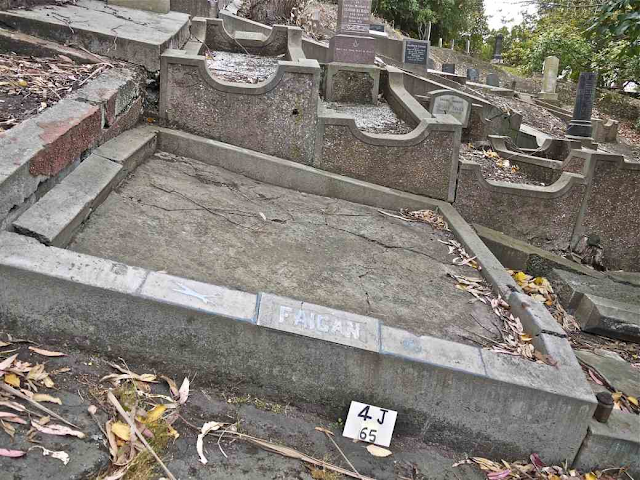
White. — At George street, on Saturday, 19th. inst, Marion S. W. White: aged 27 years. — The FUNERAL will leave her late residence at 2.30 p.m. on WEDNESDAY, 23rd inst., for the Southern Cemetery. Friends will kindly accept this notice. -Evening Star, 22/6/1897.
MISS WHITE'S DEATH.
The sad tidings of the death of Miss Marion S. W. White, M.A., as detailed in our columns on Tuesday, were the topic of much conversation during the day, and general regret was expressed at the demise of a woman of such great talents as Miss White undoubtedly possessed.
On Tuesday morning Mr Carew, district coroner, held an inquest into the circumstances surrounding the death. Mr A. H. Shelton was foreman of the jury. Mr C. M. Mouat watched the proceedings on behalf of the relatives, and Sergeant Gilbert on behalf of the police.
Mrs F. H. Campbell deposed that she last saw Miss White alive about 1.30 on Saturday, at the corner of King and Albany streets. They conversed for about 10 minutes. Miss White looked unusually bright and very well, and was cheerful.
By Mr Mouat: A few weeks ago, on more than one occasion, she complained about her head, and said she did not sleep well. Witness did not know that she took laudanum.
Charles A. Statham, clerk, residing at Mornington, said he knew the deceased. She was assisting him in his studies. His days were Mondays and Thursdays, but Miss White frequently gave him extra lessons, as she did other pupils. On Saturday morning he got a note from her, delivered by hand, to this effect: "Saturday. My dear Mr Statham, — If you can spare a moment, would you mind calling at my place this evening about half-past 7?" In consequence of this, he went to the house about half-past 7 on Saturday. On the door he found a note, tied by the corner to the knocker, addressed to himself, and asking him "to beg Mrs Wilkie to come to me quickly and to bring a doctor." The note was in Miss White's handwriting. Witness knocked twice, and then, noticing the note, he struck a match and found it was addressed to him or to Mr Ernest Guthrie. Witness took the note to the nearest street lamp and read it, and then made inquiries for Mrs Wilkie. He concluded that the lady named would be Mrs Wilkie in Stuart street, and went to her. Mrs Wilkie read the note. She asked witness to get Dr Macpherson, and then went to the house with witness. Mrs Wilkie's son also came. The key was found under the door mat, and Mrs Wilkie and her son entered the house, witness waiting outside for the doctor. The doctor soon came.
By Mr Mouat: The deceased often looked overworked, but never complained to him of pains in the head. She was most liberal in her lessons, giving to pupils double what they were entitled to. Witness always thought Miss White was very jovial. She was looking forward to the illuminations, and on Friday asked him if he would join a party she was getting up for Tuesday.
Eliza Macgregor Wilkie, residing in Stuart street, said she knew the deceased; they were on intimate terms. Witness last saw her alive about two months ago. The parents of the deceased were dead. On Saturday evening Mr Statham showed her a note, in consequence of which she went to deceased's house. She found the key under the door mat. The door was opened, and witness went upstairs to one of the rooms, where she found the deceased lying on a bed in her nightdress, a sheet partly covering her. Witness thought she was breathing. Within five minutes after that the doctor arrived. In the meantime witness had been chafing the deceased's hands. When witness received the note she could not understand why she had been sent for. Deceased had never spoken to her of insomnia, but very often she complained of her head. At the side of the bed there was a chair, on which were placed a small looking-glass, a wineglass, and a handkerchief. Witness did not see a bottle. Witness smelt the wineglass, and detected a smell of spirits — whisky, she thought. There was no smell of almonds.
Dr Macpherson said he knew the deceased slightly. He was called to her house on Saturday evening, and arrived about 8 o'clock. In one of the rooms upstairs he saw the deceased in bed. Mrs Wilkie said she was afraid Miss White was dying. Witness examined the body and used the stethoscope, and came to the conclusion that she had been dead about an hour. The face and hands were cold, but there was no rigor mortis. The face was extremely pale. There was no lividity, and there was no froth or mucus at the mouth, and no smell to indicate poison. There was nothing outwardly to show the cause of death. Witness examined the room, and the only thing he found to indicate that deceased had probably taken something was a wineglass, which stood on a chair within reach of her hand. It contained about 40 drops of a colourless liquid, which had an alcoholic odour. At the bottom of the liquid were some silky-looking crystals. Witness secured this, and sent for the police. He then examined the downstairs part of the house. He found several bottles of poison — some of them strong mineral acids — and a strong solution of ammonia. The deceased, however, had not been poisoned by any of these; they would leave unmistakable signs at the mouth, and death would have taken place slowly. Besides, there would have been other indications. On Sunday witness applied tests for prussic acid to part of the contents of the wineglass, but no trace of that acid was found. Witness could not say there was poison in the glass. There was nothing in the room from which the deceased could have drunk anything except this wineglass. Witness's opinion was that the glass had contained some powerful poison, probably an alkaloid, and it was likely that a spirit had been added to dissolve it. Medically, in the absence of surrounding circumstances, he could not say the cause of death.
By Sergeant Gilbert: Witness had been told that deceased had bought prussic acid on Saturday, and that an empty prussic acid bottle had been found outside containing a few drops. If the deceased had taken the prussic acid downstairs and thrown the bottle out she could not possibly have got upstairs. If prussic acid had been taken its odour would have been noticeable in the room or at the mouth for fully 12 hours afterwards.
Ernest White, manager for Mrs Elder, chemist and druggist, said he had known the deceased for several years. She had students in chemistry. She had occasionally bought mineral acids, ammonia, and preparations for chemical testing from witness. On Saturday she came to the shop about half-past 11, and purchased two 2oz bottles of ammonia and nitric acid, which she took away with her, at the same time asking for an ounce of prussic acid. Witness said he could not supply the prussic acid, as it was a dangerous poison. Miss White replied that she understood its properties, and that she used it in chemical tests for her students. Witness said that if she wished to get the prussic acid she would have to obtain an order for it from a justice of the peace. Miss White then said she had such an order from Mr Pryde, and produced it. Witness then supplied her with the prussic acid in the 1oz bottle produced. She was quite cheerful at the time, and spoke of the coming holidays, expressing a hope that the weather would be fine.
P. G. Pryde, J.P., secretary of the Otago Education Board, said that Miss White called at his office on Saturday, 12th inst., and asked for an order to obtain prussic acid. Witness asked her what she intended to do with it, and she replied she wished it in connection with some experiments in chemistry for her students. She also said she went to witness because he knew her, he knew the work she was doing, he knew the use to which the acid was to be applied, and he was a justice of the peace. Witness then gave the order, being satisfied that the acid was required for experiments. Miss White had been at the office on the 11th to see him, but he was out. He noticed nothing different in her manner when he spoke to her.
Dr Colquhoun was the next witness. He said: Before I give evidence, Mr Coroner, I would like to state that the use of my name in this morning's report of this case was unauthorised by me and contrary to my wish; the reason being that in my experience, and in the experience of all medical men, publicity given to these cases invariably leads to imitative cases. If I had been consulted as to the use of my name I should have objected, and I desire the representatives of the press to notice that I would like that information conveyed to the editors of the journals. If they publish full details they do so knowing that it almost invariably leads to a multiplication of similar cases.
The witness then spoke of his knowledge of the deceased. He was acquainted with her professionally, but it would be nine or ten months since he had conversed with her. On Saturday he received a letter from her, dated Saturday. It was written to him from a scientific point of view of her case. It showed, in the first place, that Miss White contemplated suicide at the time she wrote. She said, for instance: "When I feel lightest hearted, a spirit seems to touch me and remind me I have to die." Further on she said she knew the fate was pending for her, and then: "I never thought the act wicked, only inevitable." Further on: "I could do anything with my mind, I fancied, except make the effort to resist the approaching end." Again: "Fear of extinction, I find, is very strong. That I shall not be myself tomorrow is my dread." Further, the letter gave evidence of state of mind which is common in a person with a suicidal mania, and he had no doubt at all she was suffering from that, judging from the intrinsic evidence of the letter.
By Sergeant Gilbert: There was nothing in the letter to indicate any poison she contemplated taking, but she said in the letter: "At nights, unless I take something to make me sleep, I suffer a good deal."
By the Coroner: The state of mind disclosed was such as would be induced by over-pressure of brainwork, especially if predisposed to it.
Frederick Calvert, solicitor, said the deceased was a personal friend of his. He last spoke to her about 10 days ago, but noticed nothing at all wrong with her. She was always jolly. Recently she said to him that she was getting fagged out, and witness advised her to go for a tour on her bicycle, and she said she wished she could. On Saturday night witness was sent for, and Sergeant Gilbert told him the card produced had been found on Miss White's desk, there being written on it: "Send for Mr Calvert, and give him this desk." Witness went to the deceased's residence, and inside the desk he found a letter addressed to himself, also a number of letters addressed to others. The letter to witness was written in a strain that showed the writer penned it knowing he would get it after she was dead. It also gave him instructions as to various of her affairs. There were expressions in the letter which referred to the fact of death being voluntary. From what witness knew of Miss White, he would say she was in comfortable circumstances financially.
The Coroner produced a note from Professor Black, in which he wrote: "The wineglass handed to me by Constable Daubney contained so very small a trace of liquid — not enough to drop out — that I am not able to identify the constituents except that it is very slightly acid with sulphuric acid. It does not contain prussic acid nor any compound containing strychnine. I have not enough material to test for morphia in a satisfactory way. There is a faint indication of morphia, but not enough to amount to a certainty. I have used up all my material without any satisfactory certain result.
The Jury, after a few minutes' consultation, returned a verdict to the effect that deceased committed suicide by taking poison while in an unsound state of mind, and in answer to the coroner they added that they did not ask for a post mortem examination. -Otago Witness, 24/6/1897.
THIS MORTAL COIL.
Marion White, M.A., of Dunedin, has committed suicide at the age of twenty-eight! How sad such an end is to a life which, at one time, seemed full of promise, only those who knew her can feel. I was one of those, and when she was quite a girl, noticed the quaint originality and pathos of her work. She and I were co-editors of the Otago Girls' High School Magazine, and like some other editors, when "copy" was scarce, used to fill up blank spaces with our own compositions. We printed the first two issues by means of a gelatine-covered tin plate and purple ink, I can't recollect the name of the machine now, but we used to emerge from our little den about nine o'clock with any quantity of ink about us. It was she who hit upon the idea of encouraging the girls to ask questions in our magazine by making up a good many and answering them herself. Much of her writing in those old times was wonderfully clever, and she possessed that keen sense of humour men say is so rare with women.
It seems hard — when originality is almost an unknown quality among our New Zealand writers — that one who undoubtedly possessed it should after a hard struggle against "the arrows of outrageous fortune," give up the fight and write "Failed" against her life. For others, too, she struggled rather than for herself, I should like in my next letter to quote something she wrote in those old school days, when to me, her talent seemed to promise a brilliant career, and in the "glorious lexicon of youth" there seemed "no such word as fail!" Forrest Ross. -Wairarapa Daily Times, 24/6/1897.
Marion's suicide was, and is, a tragedy. I am the first to confess the absence of any ability to discern whether her growing literary talent meant a future place in the history of NZ writing, and how much potential was lost in her death.
I also confess my lack of ability to completely understand what led to her taking her life — but here, for what it is worth, is my guess.
The letter she wrote to Dr Colquhoun, if it still exists — if it were available — would be the key. Marion was, among her many accomplishments, a student of the human mind and it seems she was attempting to analyse herself for the doctor's information. One phrase from the small amount published at the time is telling — the idea that "Fate was pursuing her." This can be interpreted in a number of ways, of course. My guess from the distance of time and understanding is that she felt fated to metaphorically knock on one door after another and to find them always closed to her.
Marion's story after graduation seems to me to be one of trying all she could to develop and use her talents to take her place in the literary and intellectual life of her city and country. The advertisements and reviews of her lectures and literature classes fail to reveal what may have been the most important aspect of them — did they pay?
Marion was undoubtedly making a living using her intellect and academic credentials. She was a "crammer" — preparing students for examinations for entrance to university or the civil service. Possibly, a seemingly endless succession of academic dullards to be trained up just enough for a passing mark. Marion Steven Wilson White may, at only 27 years of age, have seen her future as the endless wasting of her talents on her paying customers, with the occasional published piece of short fiction only an interlude — certainly not paid enough for her to concentrate on creative writing alone. And she was intelligent enough to know that her gender was central to her fate and that things were not about to change in the near future, for all that she was able to vote — but not stand for — the government of her country.
The following opinion shows part of what she was up against:
Echoes of the week
The much-to-be-lamented suicide of Miss Marion White, of Dunedin, is a somewhat mysterious affair, but on the face of it the sad event appears to be largely due to the effects of over-study and excess of brain worry upon a naturally high-strung temperament. Higher education is a very good thing in its way, but it is a physiological problem, of great interest to all who study the physical and mental welfare of our New Zealand young women, whether it is not the exception rather than the rule that the striving for and gaining of high academical honours by women is not calculated to work more evil than good. Here, in Miss White’s case we have an instance of bitter disappointment working upon an already overtaxed brain and an ultra sensitive temperament, and driving the poor sufferer on to self-destruction. In older and more populous countries, like England, where there are more channels open, more opportunities at hand for the remunerative employment of the highly educated woman, Miss White might probably have been able to find fairly paid employment suitable to a woman of her exceptional attainments, but even at Home it is a matter of notoriety that the Newnham and Girton graduates, even when provided with private incomes, find it very difficult to put their hardly earned degrees to profitable use. In Miss White’s case, so the telegrams state, “it is known that for some years she has had a bare struggle tor existence!” Far be it from me to underrate the value of higher education, but it may seriously and reasonably be questioned whether, in many cases, the attainment of the ardently desired degree does not mean for our young women a permanent disappointment, added to, in evil effect, in not a few cases, by the injurious after effects of over mental strain upon a weak physique. -NZ Times, 26/6/1897.
Local and general
Writing to the suicide at Dunedin of Miss Marion White, M. A., the Wellington Post says: — "In this sad death of Miss Marion S. W. White, the growing literature of New Zealand has received one of its severest blows. The deceased lady was one who had educated herself till she obtained her M. A. degree at the Otago University, with honors in English and mental science. She was known as one of the very cleverest of all the women graduates of that University, and she was distinguished by a conspicuous originality of thought. After finishing her course, no other opening being available for her fine talent, she took up the profession of a "coach," with great success. From time to time she contributed to various journals sketches of colonial life that for their insight and unconventionality have not been equalled by any other nativeborn writer. One of these we reprinted from the Otago University Review, and the story, with its hopeless pathos, attracted the widest attention. Its melancholy tone, however, was not her usual style, as most of her stories and articles were distinguished by flashes of the keenest wit and broad touches of humour. It is believed that she was engaged upon a novel of New Zealand life, but it is not known whether that was abandoned before she cut short a life which she regarded as a failure. That so critical and highly original a mind should regard as useless a life so full of promise, is the saddest commentary on her death. -Wanganui Chronicle, 10/7/1897.