Thursday, 3 June 2021

8/228 Private Arthur Thomas Hood, 18/1/1893-6/6/1919.


SOLDIER'S DEATH.

DROWNED NEAR RAKAIA. 

POCKETS FILLED WITH STONES. 

With the pockets of the clothes full of stones, and a kerosene tin filled with stones tied by a wire round the neck, the body of Thomas Arthur Hood, a returned soldier, aged 26 years, was found in an irrigation stream near Rakaia yesterday. 

Hood, who was a single man and the elder son of Mr John Hood, railway ganger, of Edendale, Southland, was a corporal in the Otago Infantry Battalion, of the Main Body. He took part in the Gallipoli landing, and was later wounded in the shoulder, being invalided home about two years ago. Latterly he was working for his uncle, Mr Thomas Hood, Overdale, Rakaia. The deceased spent the night of Thursday, June 5, with Mr James Mead, of Rakaia. Shortly before noon next day he remarked that he was going for a walk, and set off across the paddocks. When he did not return, it was thought that Hood had probably gone on to his uncle's. His friends and relatives missed him from the Ashburton trots, for he was a keen follower of that sport; and when notes had been compared it was found that he had not been seen since June 6. The police were immediately notified, and a search commenced on Saturday. It was continued yesterday, with the result that Messrs Butler, Behemes, and Banks found the body in the channel near Mr Colland's property, about two miles from Rakaia. The deceased's watch, some small change, and a note for his people, were found on the bank. The water at the spot was about 4 feet deep. 

INQUEST OPENED. Before Mr J. Cow, Acting-Coroner, at Bakaia to-day, the inquest on the circumstances of Thomas Arthur Hood's death was opened. Formal evidence of identification was taken, and the inquest adjourned until Friday morning to allow of further inquiries being made.  -Sun, 16/6/1919.


THE Funeral of the late Thomas Arthur Hood will leave the residence of his uncle Arthur Meade, Rakaia, on Wednesday June 18th, at 2. p.m., for the Rakaia Public Cemetery. CHAS. SHANNON.  -Lyttelton Times, 17/6/1919. 


The adjourned inquest concerning the death of Arthur Thomas Hood, a returned soldier, who was found drowned in the Rakaia River on Sunday last, and who had been missing for some days previously, was held at Rakaia to-day. The District Coroner (Sir James Cow) returned a verdict "That deceased committed suicide by drowning while in a state of temporary insanity, brought about by excessive drinking." Mr Cow also expressed strong disapproval at the manner in which the deceased was allowed to wander away, and that no inquiry was made regarding his whereabouts by relations with whom he was staying, and who should have known the state in which he was. It is understood that police proceedings will arise out of evidence given at the inquiry.  -Ashburton Guardian, 20/6/1919.


LICENSEE CHARGED

RAKAIA TRAGEDY RECALLED

About June 5 last a returned soldier named Thomas Arthur Hood disappeared from Rakaia, and his body was subsequently found in the Rakaia Riverbed. As a result of evidence at the inquest, and a statement made to the police by William Cranstoun, Edendake, an information was laid against Peter Galligan, hotelkeeper, Rakaia, with supplying liquor to Thomas Arthur Hood on May 31, while the latter was in a state of intoxication;

The case was heard at Rakaia Court yesterday before Mr T. A. B. Bailey, S.M. Senior-Sergeant Ryan prosecuted, and Mr Cassidy appeared for defendant.

Evidence was given for the prosecution by William Cranstoun, Richard Toppin, and Constable McLellon.

The Magistrate stated that he was not satisfied with the way Cranstoun had given his evidence, which did not agree with the statement he had previously made to the police when he stated that Hood was intoxicated, and had had several drinks in his company. In his evidence he denied all knowledge of this, and stated that he could see the men had a few drinks. As there was not sufficient evidence to convict, the Magistrate dismissed the information, and refused to allow expenses to Cranstoun for atttending the Court. Peter Galligan was then charged with a breach of the War Regulations Anti-Treating Act arising out of the above case, and was convicted and fined 20s with costs.

A similar charge was laid against William Cranstoun and Richard Toppin. 

Mr Cassidy, who appeared for defendants, raised the point that they were boarders, and the Act did not apply to them. The Magistrate stated that it had been shown in evidence that they had had the drinks in the tap room, and that this was a bar within the meaning of the Act. The defendants would be convicted and discharged.   -Ashburton Guardian, 5/9/1919.


Rakaia Cemetery, NZ.


7/295 Sergeant Horace William Yaxley, 1892-11/3/1919.

KAIKOURA

General regret is expressed at the death of Sergeant Horace W. Yaxley, a Main Body man, who died of typhus fever in Alexandria Hospital, on March 11th. The deceased soldier had just recovered from an illness, and was reported Convalescent, but it was later announced that he had contracted a fever and was dangerously ill. The sad news of his death came as a heavy blow to his parents, Mr and Mrs Mark Yaxley, with whom much sympathy is felt.   -Press, 18/3/1919.


Kaikoura Cemetery.

27548 Private James Michie, 3/10/1880-26/8/1918.

James Michie was a brewer's assistant at Dunedin's Speights Brewery when he enlisted in the Otago Infantry Regiment in 1916.  

His military career was not a very dramatic one - he spent 5 days in hospital with scabies in April, 1918, before being killed in a German counter-attack at the French city of Bapaume the following August.  At that stage in the battles of 1918 German resistance to the Allied advance, following the failed German Spring Offensive, was strong and bordering on desperate.  

James changed his will in 1917, having received news of the death of his mother.

The battle of Bapaume was a savage one.  James Michie was one of the many Otago men who fell on August 26th. He lies in the Grevillers British Cemetery in France.


Photo: Otago Witness, 25/9/1918.


Southern Cemetery, Dunedin.


8/1323 Private James Galloway (10/10/1885-8/5/1915) & 58923 Albert Moses (9/11/1877-5/4/1918) Roberts

The Roberts family lived either on Glen Road or Avoca Street - the two streets intersect - in Mornington, Dunedin.

James enlisted in November, 1914, just a few months after war began and was in service in time for the Gallipoli campaign.

The Otago Infantry began its May 6 assault against prepared Turkish positions in reserve.  The assault for the other troops was slow going, advancing over open ground and suffering many casualties from Turkish machine guns.  Then it was the turn of the Otagos, and their losses were heavy too.  James is listed as "wounded and missing," "believed to be killed" - the result of a court of enquiry after the evacuation from Gallipoli.  This indicates that he was seen to fall and did not return with the troops on their retreat but was not seen to die.


Albert Roberts enlisted in May, 1917, and was with the Otago Regiment when the German Army began its last and almost successful offensive in the spring of 1918.  After some time in reserve, and some confused and arduous marching through France, contact was made with the advancing enemy on March 27th.  A few days later they occupied the old British trench line, dug before the Somme offensive of 1916.  The Official History quotes an un-named correspondent to describe the condition of the line after a period of rain: "A sinuous ditch bottomed with mud, and foul with human refuse. There are holes in its sides from which as you lean over there comes a foul breath. Misty, shadowy things are emerging from these side caverns, and moving about in shapeless bulk like bears that shamble and growl. They are the squad." 

The Official History continues: "At 5 o'clock on the morning of April 5th the enemy commenced an artillery bombardment which must rank as one of the heaviest and most sustained the Regiment ever experienced. It extended along the whole Divisional front; and from guns of all calibres shells were poured down over the forward, support and rear positions as far back as Bus-Ies-Artois and Bertrancourt, almost without interruption from early morning until the late afternoon. It furiously searched every known and likely forward position, and in the back areas batteries and villages and roadways were pounded by guns of the heaviest calibres. Its extraordinary depth and intensity indicated an attempt by the enemy to renew the progress which had been so abruptly stayed a few days previously. It was not long before these attacks developed. At 8.15 a.m. reports were received from the 3rd Brigade that the enemy was attacking from the right of the Serre Road to the left boundary south of the Quarries. The attack was beaten off; but when renewed at 10 a.m. the enemy succeeded in capturing a short length of trench east of La Signy Farm, and the Farm itself, the small garrison of three sections of Rifle Brigade troops who comprised this advanced post being overwhelmed. At no other point did the enemy make any progress, and he suffered very severely from our artillery and machine gun fire, his casualties being estimated at 500 killed. Prisoners captured on the front of the left Brigade stated that their ultimate objective was Colincamps, also that many new batteries had been brought up for the attack. At 2 p.m. an attack was made against the right of the Divisional sector, but similarly failed, the only party of Germans who reached our line being taken prisoners. Under cover of this sustained bombardment attacks were launched by the enemy during the day along the whole Army front; but nowhere did he achieve more than very local successes. This may be said to have signalled the termination of the great German drive in the Battle of St. Quentin."

April 5th also signalled the termination of the life of Private Albert Moses Roberts.


Southern Cemetery, Dunedin.


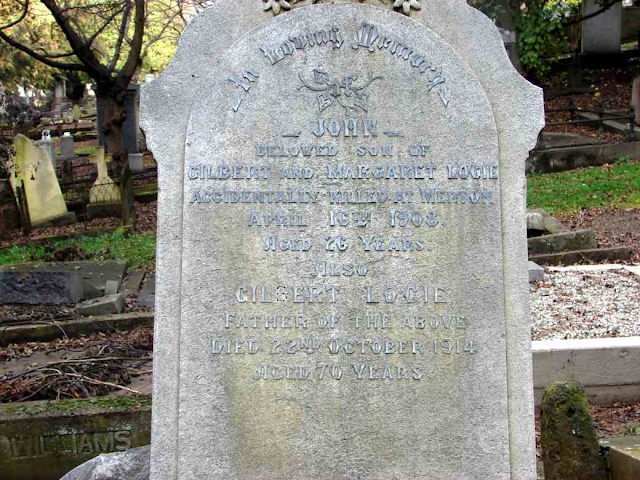
Driver John Logie, 1882-16/4/1908.

A VOLUNTEER KILLED

ON THE RAILWAY [From Our Own Reporter.] PALMERSTON. April 17. 

Last night, when the 9.20 troop tram from Dunedin was between Puketeraki and Merton, a member of B Battery - Gunner John Logie - while crossing from one carriage platform to another, slipped and fell and the guard's van passed over him. The bump was distinctly felt. On reaching Waikouaiti a trolly and a number of men were sent back. Before they reached the body, however, the midnight express had also passed over it, and when discovered by the searchers only a mass of unrecognisable pieces showed where the accident had occurred. The remains were brought on to Waikouaiti. Logie, it is stated, was perfectly sober at the time.   -Evening Star, 18/4/1908.


TRAIN FATALITY.

MEMBER OF B BATTERY KILLED. 

In the course of his account of the Easter manoeuvres, our reporter says; 

— Sadness pervades Battery "B" owing to the awful death of one of their comrades on Thursday night. 

The troop train conveying the battery left Dunedin at 9.20, and when in the vicinity of Merton, Driver J. Logie, in passing from one carriage to the other, was seen by Sergt.-major West to disappear, and the train jolted horribly twice. At Waikouaiti Lieut.-colonel Brigade Surgeon de Lautour went back down the line on a velocipede to render first aid if possible while the ambulance followed by road. The unfortunate man was found cut to pieces. It is also stated that the body was run over by the engine and three carriages of the following train before it could be stopped, but it seems certain that Driver Logie was killed by the train from which he fell. There had been a heavy fall of dew, the stanchions, hand rails, and platforms being slippery. More of the remains were picked up this morning. 

Driver Logie was very highly thought of by his officers and comrades. He worked in the Hillside Workshops, and was a single man, said to have resided with his people in South Dunedin. 

THE INQUEST. Yesterday afternoon an inquest on the body of the deceased was held at the Railway Hotel, Waikouaiti, where the body had been lying since the accident. Mr Thomas Hutchison, S.M., Oamaru, was the presiding coroner, and Mr Arthur Heckler was elected foreman of the jury. Mr J. P. Matheson, traffic inspector, represented the Railway Department. 

John Neil Miller, a member of the B Battery, residing in Dunedin, said he was on the spccial train which left Dunedin about 9.45 on Thursday evening en route for Palmerston to the Easter Volunteer encampment. On leaving Seacliff, where the train stopped for some time, deceased and other members of the company, including witness, who had been standing on the platform, got into a carriage in which were some Otago Hussars, and shortly after, near Puketiraki, Corporal Smith, deceased, and witness, in that order, left for their own carriage. Smith went first and deceased followed. There was no gangway between the two carriages. Smith got across safely. Deceased, in crossing, had to stoop under the rails, at the same time putting his foot on the coupling. He put his hand out to catch the opposite rail, and that was the last witness saw of him. Could not say whether he missed the railing or whether his foot slipped off the coupling. Witness went to the guard's van and informed an official there that a man had fallen off the train. Two officials who were in the van signalled, one on each side of the train, with red lights, but the train did not stop until Waikouaiti was reached. Immediately on reaching Waikouaiti a trolly was procured, and a return made to the scene of the accident. 

Coroner: Was the deceased sober? 

Witness: Undoubtedly, sir. To my certain knowledge he had no drink at all. 

Coroner: Was the train jolting. Witness: Yes. There was a good deal of jolting right through. We were in the second last carriage of a long train. Those in the last carriage heard crunching and jolting just at the time the accident occurred, and concluded that the train was off the line. Witness attributed deceased's fall to the slipping of his foot on the coupling, which was greasy with the mist that was falling. 

Andrew Clarkson, guard, in charge of the train, also gave evidence. 

The Coroner said the jury was anxious to know something as to how the terrible mangling of deceased occurred. Would they want the evidence of the man in the van, who was first approached? 

Mr Matheson: We could not get the brakeman. 

The Coroner said probably the train had swerved just as deceased had his foot on the couplings. 

Mr Matheson: Word was sent from Waikouaiti to Puketiraki to warn the express train, which was following. The driver of that train, he believed, struck the body, which was lying on the rails, and the engine went over it.

The Foreman: Could you not have some means of connecting with the enginedriver of a train. 

Mr Matheson: In this instance the guard was in the centre of the train collecting tickets. If he had been in the guard's van he could have put on the Westinghouse brake and so stopped the train. It would have been a risky procedure, but a capable man could do it. In response to another question, Mr Matheson said every effort was made by the department to have cars fitted with gangways. Out of 1000 cars 500 were so fitted, and every car that went to the shops came out with a gangway fitted. 

A verdict was returned "That the deceased came by his death by falling from the car of a railway train while travelling between Puketiraki and Merton, and being crushed by the train passing over him, and that he came by his death accidentally."  -Otago Daily Times, 18/4/1908.


FUNERAL NOTICE. 

The Friends of Mr GILBERT LOGIE (and Family) are respectfully invited to attend the Funeral of his late SON, JOHN, which will leave his Residence, 23 Brunswick street, Caversham, TO-MORROW (SUNDAY), the 19th inst., at 2.30 p.m. A. J. WYNN & HOPE. Undertakers, 36 St. Andrew street.

U.A.O. DRUIDS. 

The Officers and Brethren of Royal Oak Lodge are hereby requested to attend the Funeral of their late BROTHER, JOHN LOGIE, which will leave his late Residence, 29 Brunswick street, Caversham, TOMORROW (SUNDAY), the 19th inst., at 2.30 p.m. Sister Lodges are cordially invited to attend. WALTER RUTLEDGE, Secretary.  -Otago Daily Times, 18/4/1908.


Southern Cemetery, Dunedin. DCC photo.


John Cavalier, 1840-12/10/1873.


We regret to have to record the death of Mr John Cavalier, formerly employed on this paper, afterwards for some years bookkeeper to the City Company, and, at the time of the unfortunate accident which was so suddenly fatal, acting as collector for the Guardian newspaper. The deceased, who was having some additions made to his residence in Maitland street, happened, on the morning of Friday week, in stepping from his doorway into the garden, to place one foot on a piece of old timber from which a round French nail projected. This penetrated his boot and the ball of the foot to such a depth that great exertion was required to withdraw it. Dr J Reimer then examined and dressed the wound, which progressed favorably until Thursday last, when, on account of the pain which came on, it was thought advisable to lance the foot, which was done, thereby affording some relief. On Friday night, however, the unfortunate gentleman felt a stiffness of the jaws — tetanus had set in — and until about four o’clock yesterday the poor fellow suffered most excruciating agony. Death then, perhaps mercifully, put an end to his sufferings. Deceased was thirty-four years of age, and, by his active business habits and genial manner, had gained general esteem. He has left a widow and four children. Mr Hocken had been called in yesterday morning lo assist Dr. Reimer, but the efforts of both gentlemen were unavailing.  -Evening Star, 13/10/1873.


Southern Cemetery, Dunedin.


Sunday, 23 May 2021

29719 Private James John Bain, 6/10/1895-2/12/1919.


THE PALESTINE ADVANCE.

LONDON, November 2. Egypt official: We hold the position northward of Beersheba, and successfully raided another portion of the enemy front, killing a large number. 

FALLEN MINISTERS. 

'The Times.' AMSTERDAM, November 2. Herr Helfferich and Herr Waldon have resigned from the German Government. 

PRIVATE JAMES BAIN. 

Mrs Bain, of Russell street, has received word that her son, James John Bain, was wounded and gassed in the recent fighting in Flanders. Private Bain left with the 19th Reinforcements. His eldest brother, Second Lieutenant William A. Bain, died of wounds received in the Somme battle 13 months ago, and his younger brother "Bob" is now somewhere in France.  -Evening Star, 3/11/1917.


James Bain was a shepherd on Kyeburn Station when he joined the Otago Infantry Regiment in June, 1916.  He was not a perfect soldier - his conduct sheet has a small number of minor infringements, of the "late on parade," "overstaying leave," "improperly dressed on parade" kind.

James was gassed on October 16th, 1917, during the Battle of Paesschendaele.  The Official History of the Otago Regiment has this to say about that period of time: "There was inconsiderable artillery fire during the night, but on the following day the enemy disclosed activity which increased until the whole of the forward area was swept by an obviously largely augmented artillery strength; while low-flying enemy aeroplanes persistently harassed the trench garrisons. Meantime our own heavy artillery had proceeded with the bombardment of the block house system of the Bellevue Spur. Thus conditions were far from settled, and continued so until the night of the 17th, when the Battalion was relieved and moved back into support on the western slopes of Abraham Heights."

Two weeks later James was in a London hospital and he remained in hospital until he was embarked on the HS "Marama" in April, 1918.  Back in New Zealand, he was discharged as unfit on October 11th.  He died at his family home just over a year later, of tuberculosis.

Many soldiers died of TB during and after the War.  Many were seriously and permanently affected by poison gas - mustard gas, especially. Mustard gas was a sulphur compound which became sulphuric acid when in contact with water - for instance, damp parts of the human body such as the armpits, the groin and the lungs.  It was not designed to kill - a dead soldier was buried; a wounded one had to be carried by as many as four men, through the back lines, and possibly past fresh troops coming up to the front trenches.

There seems to be no direct relationship between the effects of gas and the contraction of tuberculosis.  Damp conditions, close contact with other troops and bad nutrition are more likely contributing factors.


MILITARY FUNERAL. 

Friends of the late Private James John Bain (and family) are respectfully invited to attend his Funeral, which will leave his parents' residence, 74 Russell street, TO-MORROW (Thursday), the 4th inst. at 2.30 p.m., for the Southern Cemetery. ROSS AND KINASTON, Undertakers, 36 St. Andrew street.  -Evening Star, 3/12/1919.

Southern Cemetery, Dunedin. DCC photo.