DEATH.
On November 3rd, at his parents' residence, Kawarau Gorge, after being confined to his bed for two and a half years, William James, the eldest and dearly beloved son of John and Nano Fleming; aged 22 years. R.I.P. -Cromwell Argus, 15/11/1892.
DEATH.
On November 3rd, at his parents' residence, Kawarau Gorge, after being confined to his bed for two and a half years, William James, the eldest and dearly beloved son of John and Nano Fleming; aged 22 years. R.I.P. -Cromwell Argus, 15/11/1892.
In our obituary column to-day appears a notification of the death, of Mr Thomas McWhirter. jun., son of Mr Thomas McWhirter, long and favorably known in this district. The deceased was also well known in North Otago, and news of his death under painful circumstances will be received with regret. The Cromwell Argus reports that the deceased, who lived on the Tarras Station, of which his father is manager, had the misfortune to break his wrist, about a fortnight ago. He came to Cromwell and had the injury attended to, after which he went home, apparently sound and well last week, being troubled with pains in the head and having a swelling in the face, came down to Cromwell again. At midday on Saturday he visited Dr Macknight, who redressed his arm and attended to the swelling of his face, but neither the doctor nor his patient, thought that anything else was the matter. About nightfall the deceased, who was staying at the Commercial Hotel, and had gone to bed, being attended by his mother, became delirious. He became worse, and early on Sunday Drs. Macknight and Morris were called in, and did all they could, but medical skill proved in vain, and at 6.30 deceased passed away, before his father and brother, who had been summoned by telephone, could arrive. The cause of the death was blood poisoning, and the only explanation feasible is that advanced by the deceased, who said that he thought he had been stung on his face by an insect. This is probably the real cause of the blood poisoning, the insect having previously been feeding on some deleterious matter, and inoculating deceased with the poison. Great sympathy is felt on all sides for the bereaved family. The deceased was a young man universally esteemed and respected his many sterling qualities, and the upright manliness of his character. -Ooamaru Mail,28/12/1901.
Obituary. — A couple of deaths in the district created a feeling of pained surprise recently. At Cardrona, Mary Eileen Miller, the eldest daughter of the late Mr Henry Miller, and step-daughter of Mr John Loft, both very old residents, was lately carried away, ulceration of the stomach being the ailment, at the early age of 24 years. When she was barely out of her teens she looked so strong and fresh that one would have thought that a good old age was before her. Mr Thomas McWhirter jun., Tarras, eldest son of the station manager, was loading fencing wire on to a dray, and gave his arm a twist and broke it. He went to Cromwell Hospital at once, but blood-poisoning set in, and he died on Sunday night last. When we read of pathetic cases such as these, of people being taken off in the first bloom of youth, we are apt to think that our advanced nineteenth century civilisation and medical science are not yet perfect, but leave room for plenty of advancement. -Otago Witness, 1/1/1902.
It is our melancholy duty from time to time to chronicle the death of one or other of the residents of the district. This is the saddest part of a journalist’s many varied duties, because the natural regret experienced at the death of an acquaintance or well known resident, is intensified considerably, by the fact that he has to write his obituary notice. At no time since our connection with this journal, have we experienced a deeper sense of regret at having to perform this sad task, than we now do in announcing in these columns the death of Mr Daniel Bell, Wardsman of the Cromwell Hospital, and that because of the circumstances which led to his untimely end. While attending one of the typhoid patients who was being treated in the institution, he contracted the disease, and after a severe illness, he succumbed on Sunday morning. Were it on this account alone, public sympathy would go out freely to his widow, who has nursed him during his illness with indefatigable care and attention; but in addition to this, he earned in conjunction with her the undying gratitude of many a patient, the confidence of the Board in the management of the Hospital, and the social esteem of the residents of the district. He has died in harness, has died young, and may be said to have yielded his life in ministering to the wants of his fellow man. The regret at his death is as widespread as the sympathy which is expressed for his relict. The funeral takes place to-day, leaving the Hospital at 2.30 p.m. -Cromwell Argus, 9/5/1893.
Fatal Dredge Accident.
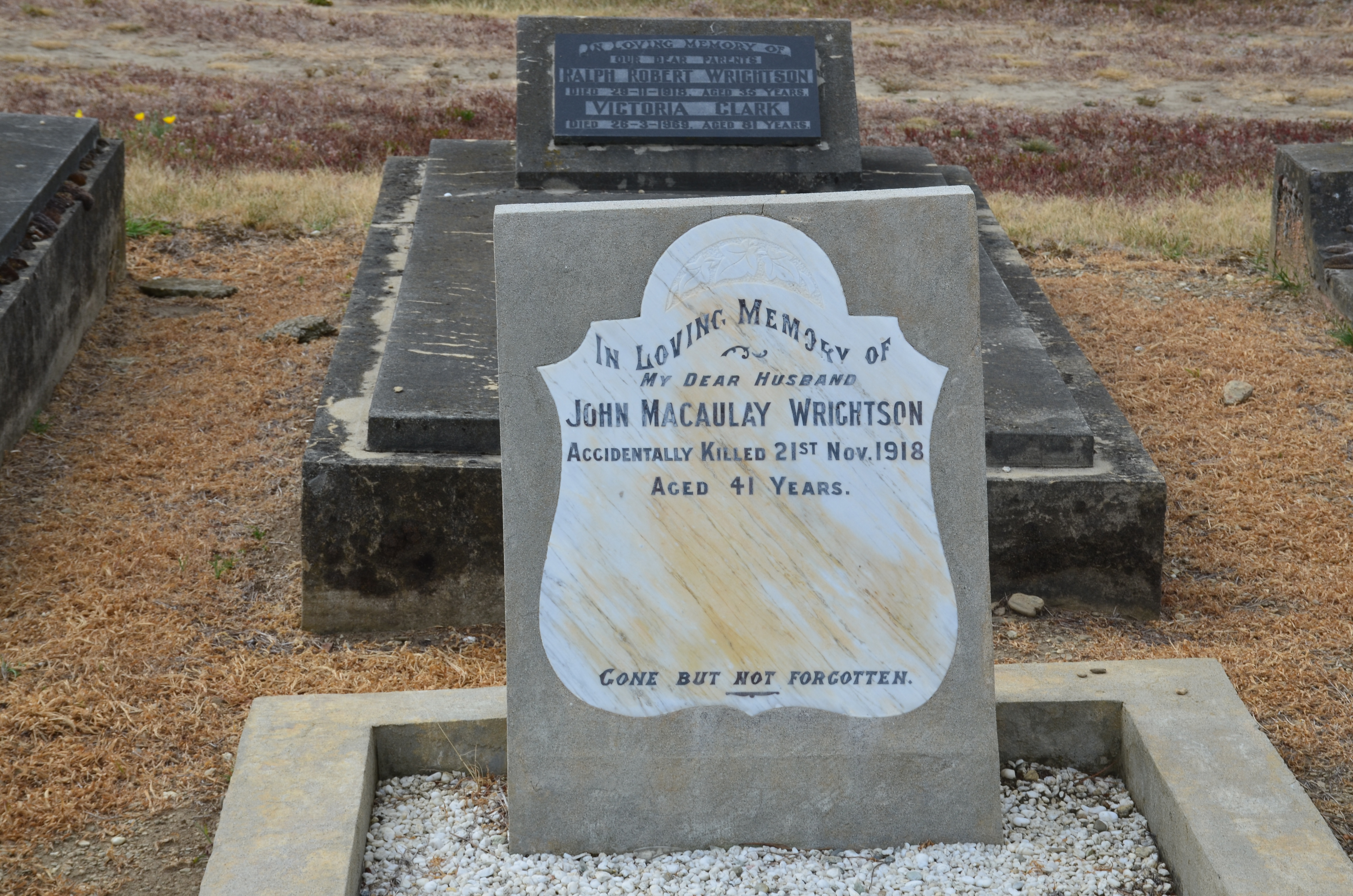
Death at all times is surrounded with sadness and sorrow, but never is grief more widespread than when a young life is unexpectedly cut short. Thus it was when news rapidly spread early on Thursday morning that a fatal accident had occurred on the Shine No II dredge, by which a highly esteemed young resident, Mr John Wrightson, had met his death. Exactly how this happened is a question that cannot be conclusively solved. Reading through the evidence at the inquest, which is herewith detailed in full, the position appears to be that deceased, with his mate, went on the twelve to eight shift on Thursday morning. Everything went well until after 6.30. As usual his mate, the fireman, was carrying out the work of cleaning up prior to being relieved, and was working astern. Going forward to attend to the boiler he failed to find any trace of his mate, and received a great shock on finding his body inside the winch, his clothes and side being entangled in two gear wheels and life extinct. How this came about can only lead to surmise.
The news came as a great shock to the whole town and district, wherein deceased was held in the highest esteem, and it seemed hard that the unfortunate young man, a returned soldier, after having daily faced death on the battlefields of France, was wounded, and returned to his native land to enjoy his due reward in peaceful surroundings, should meet an unexpected death in such a distressing manner. Deceased was a native of the town, a son of Isabella and the late John Wrightson. He was educated at the Cromwell School, and thereafter followed several occupations and for years was employed by a local stonemason, and eventually turned his attention to dredging. Of manly characteristics, and a sterling workman, his services were sought in many walks of life, and he was one who could be depended on to do his duty, and always had the full confidence of his employer. Wherever he engaged in the lighter side of life, he was always looked up to by those associated with him. Of fine physique, he was a sterling forward in Rugby ranks, was also a keen member of the old volunteer forces, and a leading rifle shot. For several years he was a member of the borough council, wherein he did good work. He enlisted with the First Battalion, Rifle Brigade, in 1915, seven other young men going forward the same day. The deceased, in the rank of corporal, was always looked upon as the guiding star of the party, and quickly assumed the appropriate title of "father." He took part in the engagement against the Senussi tribe in December, 1915, and afterwards went with the forces to France. There he was wounded, and from the effects of this and an attack of illness, he was finally invalided home. While in the Homeland he was married, his wife joining him in New Zealand early this year. His death is mourned by a circle of friends far and wide, and to his bereaved wife, in a sense a stranger in a strange land, and the many relations, the deepest sympathy goes out in their sudden and distressing bereavement. To these we join also in extending our sympathy. Among the many messages of condolence was one from the Minister of Mines.
The remains were interred in the New Cemetery on Sunday with military, honors. The cortege was headed by the band, then came the Freemasons, of which deceased was a member, the Territorials and a large body of returned soldiers. The latter acted as pall-bearers and supplied the firing party and the bugler (C. Betts), who sounded the Last Post. The service was conducted by Rev. Rankin, and the Freemasons also performed their last rites. -Cromwell Argus, 25/11/1918.
FATAL ACCIDENT AT CROMWELL.
A distressing accident occurred on the Rise and Shine No. 2 dredge early on Thursday morning by which Mr John Wrightson, about 44 years of age, met his death. He was caught in the wheels of the winch, death being practically instantaneous. He was a native of Cromwell, and a highly-respected resident. He served with the first battalion of the Rifle Brigade in Egypt and France, and returned early in 1917, after being wounded. He was married while in England, and is survived by his wife, who came to Cromwell this year. At the inquest, held at Cromwell on Saturday, before Mr E. Murrell, acting coroner, and a jury of six, the following verdict was returned. — "That the deceased came by his death through being caught in the cog wheels of the winch on the Rise and Shine No. II dredge, there being no conclusive evidence to show how he got there." -Lake County Press, 25/11/1918.
IN MEMORIAM
WRIGHTSON. — In loving memory of John Macaulay Wrightson, dearly beloved husband of Isabella Wrightson, accidentally killed at Cromwell on November 21, 1918. Inserted by his loving wife and, child. -Otago Witness, 23/11/1920.
A distressing ease of suicide occurred at Nevis early on Saturday morning, when a young man named William Torrance took his life by cutting his throat with a razor. The young man, who was employed in Graham and party's claim, slept in the camp with his fellow workmen but as if by a sudden impulse rose hurriedly and committed the act before he could be restrained. The young man, who was a native of Bannockburn, and a son of Mr T. Torrance, served four years and seven months on active service, wherein he was wounded three times and gassed once, and it is surmised the effects of this was responsible for his action. An inquest will be held at Cromwell to day. -Cromwell Argus, 12/1/1920.
Mr Charles Tizard (Cromwell, Otago) has been in Chili for some considerable time, whither he went from New Zealand under engagement to a mining company. He is in London for a while, prior to leaving for West Africa under engagement, to the Ashanti Rivers and Concessions Company. He is occupying his time in London sightseeing. -Otago Daily Times, 10/8/1909.
Obituary.
CHARLES TIZARD — Aged 24 years.
The death on Wednesday last of Charles Frederick William Tizard, at the early age of 24 years, cast quite a gloom over our small community. Deceased, who was the second son of the late W. W. Tizard, was a native of Cromwell, and grew up to be one of our most respected and esteemed young men, and took a keen interest in many local clubs. He was attached to the dredging industry and after following the occupation for a time in his native town received an appointment in South America. From there he proceeded to London and was engaged to go to West Africa, and on the completion of his term returned to Cromwell last October. Unfortunately his health was to a great extent undermined in Africa. A fortnight ago, while in the employ of the 909 company he contracted a serious illness and was removed to the Cromwell hospital, where his condition caused great anxiety, and he passed away on Wednesday evening — cut down in the prime of life. At the funeral in the New Cemetery on Friday a large number paid their last tribute of respect, included in those being many companions of schoolboy days. Amongst the floral tributes were two wreaths from the Cromwell Football Club and band, in both of which deceased was an enthusiastic member. The service at the grave was conducted by the Rev. Fitchett. To his widowed mother, brothers, sisters, and many relations in this district we extend our sympathy in their bereavement. -Cromwell Argus, 5/6/1911.
The death took place in Cromwell on Wednesday last of Charles Tizard, aged 21 years, well-known in football circles, and a native of Cromwell. Towards the end of last year deceased returned from foreign dredging fields, and a fortnight before his death commenced work on the 909 dredge in the Alexandra gorge. Here he contracted malarial fever, a disease he had apparently brought with him from South America, and on the Saturday prior to his death was removed to his home in Cromwell. His death caused quite a gloom over his native town. -Alexandra Herald and Central Otago Gazette, 7/6/1911.
A young man named Charles Tizard, 24 years of age, a son of well-known residents in the Cromwell district, died in the Cromwell Hospital on Thursday from typhoid fever after a few days' illness. He was (says our correspondent) a great favourite, and a fine, steady young fellow. He only returned a few months ago from foreign dredging fields, where he had been for some years. Owing to having contracted fever and ague there, it is supposed that these undermined his constitution considerably. -Otago Witness, 7/6/1911.
Inquest at Cromwell.
The inquest on the body of the late Jno. Towan Hosking, who was killed on the Rising Sun Dredge on Thursday, was held in the Cromwell Courthouse on Friday evening before D. A. Jolly Esq., acting-Coroner, and a jury of six, of whom Mr A Warburton was chosen foreman.
Mr C. Hutton watched the proceedings on behalf of the Rising Sun G. Dr. Co. and Mr E. R. Green, Inspector of Mines, was present on behalf of the Mines Department.
Jno. Clements, Blacksmith, Rising Sun Dredge gave evidence that Hosking was fireman on the dredge and was on shift at the time of the accident. About 2.30. p.m. witness threw the belt off the boring machine, deceased being alongside when he did so. The belt caught on the shaft and got doubled round it. Witness asked Hosking to stop the engine but instead of doing so he went to the belt and tried to catch it as it revolved. There was about 18 inches of a loose loop hanging. Deceased made several attempts to get hold of it and eventually his hand was caught in the loop. He cried out "Oh" and was immediately swung round the shaft, striking witness with his feet as he revolved. Witness ran to the engine to stop the dredge but before he got there Renshaw, the winchman, had got across and done so. Witness then went back and found the body was considerably mangled. Assisted the others to put it in some hessian and carried it into the office.
To the foreman: Thought it was a dangerous thing to meddle with the belt while the engine was going. There was no possibility of getting it off the way he attempted to. Had not seen any one attempt to do the same thing before.
To Mr Green: It was witness's duty to attend to the boring machine and belt. Intended hanging it up out of the way when done with it. Deceased had no right to interfere with the belt. Should think the shaft made from 15 to 20 revolutions before it was stopped. Before the accident took place the machinery and belting were well protected. One of the guards was broken down by deceased's leg striking it.
To Mr Hutton: Anyone could see it was dangerous to touch the belt. Did not tell deceased to do so, only told him to stop the engine. Deceased disobeyed his order by not stopping the engine when told to. Could not understand why he attempted to catch the belt as it was impossible to get it off that way. He must have known the risk he was taking. Deceased had no reason to be near the shaft unless he was oiling and he was not doing so at the time.
To Mr Green: Deceased would have to pass under the shaft on the way to the elevator once or twice a shift when oiling. The shaft was about four feet from the deck. Deceased went voluntarily to the belt to help witness.
To the foreman: The fireman was not expected to assist witness in any way, a man being specially employed for this purpose. Was not likely to go down to the shaft to feel the bearings.
To Mr Green: The shaft could not have caught him at the bearing as it was properly protected.
To Mr Hutton: Was not sure that there was no written order on the dredge prohibiting the men from interfering with the belting while in motion.
Wm. Renshaw, winchman, gave similar evidence as to the manner in which the accident occurred. He immediately stopped the engine and threw the friction out of gear. The shaft probably would make from 12 to 20 revolutions before it stopped. It was travelling about 120 revolutions to the minute. He cut the belt and with the assistance of Bethune took the body down. Deceased was apparently quite dead, both legs being cut off below the knee and the right arm torn away from the shoulder.
To Mr Hutton. There was a written order on the dredge prohibiting the firemen from touching the belting while in motion. The deceased must have have been aware of this order.
Rob. McIntosh, Assistant-Inspector of Mines also gave evidence. He had visited the Rising Sun Dredge on several occasions and always found a reasonable compliance with the regulations. In his opinion the deceased committed a foolhardy act, which in the ordinary working of the dredge it was unnecessary to attempt.
To Mr Hutton. — In his opinion the machinery and plant was not in any way defective.
F. Bradley, Police Constable, gave evidence that deceased was a married man, 36 years of age, residing at Cromwell and had a wife and three children.
The jury returned a verdict. — "That the deceased John Towan Hosking met his death on the Rising Sun Dredge, working on the Clutha River, at Cromwell, on the afternoon of Thursday, 13th July, by being accidentally caught in the belting of the boring machine which was fouled on the screen shaft, and there is nothing in the evidence to show that any blame is attachable to anyone." -Dunstan Times, 17/7/1905.
DEATH
HOSKING. — On the 13th July (accidently killed on the Rising Sun Dredge), John Towan Hosking, dearly beloved husband of Maria Hosking, aged 37 years. Deeply regretted. -Cromwell Argus, 24/7/1905.