Saturday, 20 April 2024

William Godwin, (1844-31/1/1878). "an artist of much promise"


It is with pleasure our readers will learn that William Godwin, the young man who was so seriously hurt on returning from the fire at Newton on Wednesday morning, is progressing very favourably. He is recovering rapidly, and will probably be able to leave the Hospital in a few days. We are requested, however, to remind his friends who may be desirous of seeing him, and congratulating him on his recovery, that they cannot be admitted to see him. In the present stage of his recovery the greatest quietness is necessary, and any undue excitement would hare the effect of at least retarding his progress towards perfect health.   -NZ Herald, 21/1/1878.


The unfortunate man, William Godwin, who was .severely injured by an accident on the morning of the Newton fire, was dying yesterday, and in all probability is now dead. Sub-Inspector Pardy and Captain Fergusson proceeded to the Hospital yesterday to take the poor fellow's depositions, but he was not in a fit state to give any account of the accident. Should he die, an inquest will be held on the remains.  -NZ Herald, 30/1/1878.


The young man William Godwin died a few minutes after eleven o'clock this morning in the Provincial Hospital, after suffering great pain. An inquest will be held on the body to-morrow afternoon, before Dr Goldsbro and a jury.  -NZ Herald, 31/1/1878.


THE FATAL ACCIDENT TO WILLIAM GODWIN.

INQUEST ON THE BODY

An inquest on the body of William Godwin, the young man who was killed through injuries received by the upsetting of the Salvage Corps drag, was held at the Provincial Hospital this afternoon, before Dr. Goldsbro, and a jury, of whom John William Melton was chosen foreman.

The jury proceeded to the dead-house, and examined the body, after which the evidence was taken.

Mr Sub-Inspector Pardy appeared for the police. Dr Philson deposed that the deceased, who was 20 years of age, was brought to the hospital in an unconscious state from the consequences of being overturned in a van. Blood was oozing from the left ear. In a few days he rallied, so that he was able to walk about, but never fully recovered his full mental faculties, and could not remember anything about the van accident. On Friday last he was seized with convulsions, 7 attacks occurring before death. At the post-mortem examination it was found that the squamous portion of the left temporal bone was extensively fractured, and death resulted from inflammation of the brain from physical injury. Dr. Wine gave same similar testimony.  -Auckland Star, 1/2/1878.


THE INQUEST YESTERDAY.—(CONCLUDED.)

The following evidence, in addition to that which appeared in our yesterday's issue, was taken at the inquest on the body of William Godwin, yesterday afternoon: — 

Dr Wine stated that he did not notice any smell of liquor on the deceased when he attended him immediately after the accident. 

John Butler deposed that he was in charge of the Salvage Corps on the morning of the 16th inst., when the fire took place. They started from Auckland about 2.20 a.m., the deceased being one of those in the break, which was drawn by two horses. A man named Gorman was driving. They left the fire about a quarter past six o'clock that morning in the same vehicle, Gorman still driving. They proceeded along Karangahape-road, Svmonds-street, Waterloo Quadrant, Princes-street, and through the Barrack Reserve. They passed the Grammar School in going into Wellesley-street East. The horses were cantering down the road, and in turning into Wellesley-street the driver reduced the speed by putting on the break. The break capsized, and they were all thrown out. He believed it was caused by the wheel catching the break, and canting it over in the turn round the corner, which was too sharp. All of the Corps were more or less injured by the fall. He saw deceased lying on his side close to where the witness fell. He appeared to be insensible. Blood was oozing from his ear. Witness raised him up, and had him removed to the Park Hotel, and called in Dr Wine to see him. The driver at the time of the accident appeared to be sober. Deceased was perfectly sober at the time. 

To a juryman: The reason of their coming round Princes-street, &c, was to drop several persons who had been assisting at the fire, at their homes. 

Edward Gough, painter, gave similar evidence.

Thomas Henry Jones deposed that he was standing at his door in Wellesley-street when the accident occurred. He could not say at what speed the horses were coming. He could not say that Gorman was the worse for liquor. 

James Smith, the owner of the break, said the vehicle might be driven in safety around a corner at the rate of nine or ten miles an hour. It required more room to turn in than an ordinary vehicle. He would have driven himself had he thought that Gorman was unfit to do so. 

Sergeant Clarke deposed that he went to Mr Smith's stable yards at about 20 minutes past 10 o'clock on the morning in question, and saw him drunk. He refused to give any information. 

This was the whole of the evidence, and the jury, after a short deliberation returned a verdict of accidental death, with a rider attached to the effect that the drivers of vehicles should be instructed to use more care in passing dangerous corners. They also requested the coroner to censure the driver. 

Gorman was called into the room, and addressed by the Coroner as follows: James Gorman, I am requested by the jury to say that you have narrowly escaped having to take your trial on the serious charge of manslaughter. Had any person warned or cautioned you as regarded the rate you were driving, and the accident had occurred after, you would certainly be sent to trial on that charge, but the jury has taken a reasonable view of the matter, and although they think you were guilty of recklessness and are not pleased with your subsequent intoxication, you are now cautioned that should you be again guilty of similar conduct this case will go against you, and they desire me to caution you never to be reckless again. You are now discharged.  -Auckland Star, 2/2/1878.


The remains of the young man, William Godwin, cut off in the prime of life by the upsetting of a conveyance, in which he and other members of the Salvage Corps were seated on returning from the recent disastrous fire at Newton, were conveyed to their last resting place yesterday in the Church of England Cemetery. The corpse was followed by nearly six hundred persons, who were desirous of paying their last tribute of respect to the deceased. In the solemn procession we noticed representatives of the Odd Fellows, Fountain of Friendship, and the Foresters (City of Auckland Court), orders to which Mr Godwin belonged; also members of the Fire Brigade, Salvage Corps, Naval Brigade, and Juvenile Foresters. The funeral service of the Church of England was impressively read by the Rev. Dr. Kidd, and the N. G. of the Oddfellows and the C. R. of the Foresters read the services of the order, each casting a sprig of thyme on the coffin as they passed the grave. The deceased was genial-hearted and companionable, and by the exercise of brotherly virtues won many friends; he was, moreover, an artist of much promise, and has left behind him several creditable pictures. He was unmarried, and had no relations in the Colony. His sister is respectably married in California, and his aged father still resides in England.  -Auckland Star, 4/2/1878.


A very handsome monument has just been ejected on the grave of William Godwin in the Church of England cemetery, and it is a worthy memorial to a worthy young man. The masonry work was by Mr Wm. Thomas, stone-mason, of Lorne-street, and the sculpture by Mr John Taylor. The whole comprises a neat headstone and wall, in cast-iron enclosure. The mounted pedestal is of white Tasmanian stone, and on the monument appears a neat inscription, surrounded by a fireman's helmet, belt, pouch, and tomahawk. The inscription runs thus: — "To the memory of William Godwin, died 29th January, 1878, aged 28 years; who died from injuries received by the upsetting of the Underwriters' Fire Patrol and Salvage Corps conveyance, on the morning of the 16th January, 1878. This stone was erected by the members of the above Corps, of which he was a member; also by the Auckland Fire Brigade, to which Corps he formerly belonged; and by his intimate friends of the Oddfellows and Foresters, of which Societies he was an esteemed member."  -Auckland Star, 1/6/1878.


Symonds Street Cemetery, Auckland.

Major William Gordon, (1837-12/2/1879). "won the esteem of all"

DEATH OF MAJOR GORDON.

Major William Gordon, so well known in connection with the Volunteer affairs of the Northern District, died at his residence in Onehunga, yesterday, having been ill since October last. His first military experience was gained while serving as an ensign in the 73rd Highlanders, which regiment he joined is 1854. He served for a time in the Crimean war, and was promoted to the rank of lieutenant in 1858. He occupied the post of adjutant to the 73rd for seven years. He was remarkable for knowledge of military affairs, and during his connection with the Imperial forces was much loved and respected by both the officers and men of the regiment. Having left the Imperial army, he was appointed commander of the Militia and Volunteer forces in this district. Here his talents as a military man were brought into full play, and the result of his experience was soon seen in the increased efficiency of the force he controlled. A strict disciplinarian, he won the esteem of all by his impartial administration of military affairs. He was highly esteemed by both officers and men. On the formation of the Auckland Rifle Brigade he was appointed to the command of that body. About two years ago he retired from the military offices he held in this district, but was appointed Inspector of Volunteers about six months since. Shortly after this appointment, he was attacked by the illness which terminated fatally yesterday. In private life Major Gordon was a thorough gentleman, and greatly respected by all who knew him. The funeral will take place tomorrow, and will, in all probability, be carried out with military honours. A telegram was despatched to Wellington last evening, by Major James Derrom, relative to the subject, a reply to which will be received this morning.  -NZ Herald, 13/2/1879.


FUNERAL OF MAJOR GORDON.

The remains of the lamented Major William Gordon, late commander of the Volunteer forces of the Auckland district, are about to be consigned to the silent grave in the Presbyterian cemetery, as we go to press. The deceased was a gentlemen in manners and culture, and was greatly respected both by officers and members of the Volunteer companies, all of whom were numerously represented in the funeral procession this afternoon. The funeral started from the residence of deceased at Onehunga at 2.30 p.m., followed by near relatives, and some of the leading inhabitants of the village. Everything in connection with the solemn scene was free from display, and as modest as possible, and this simplicity was strictly in accordance with the wish of Major Gordon, who, though a thorough soldier, was utterly averse to anything like ostentation and music at the burial of the dead. The Volunteers mustered at the Drill Shed at half-past 2 p. m. About 250 of all ranks were present, representing Artillery, Engineers, Infantry, and Cadets. Owing to the wish of relatives the band was not to attend, and the corps mustered with side arms only. The column under command of Major Derrom, were formed into fours, and marched to the Presbyterian Cemetery, to receive the corpse in open order.  -Auckland Star, 14/2/1879.


FUNERAL NOTICES

DISTRICT ORDERS. 

Militia and Volunteer Office, Auckland, February 14, 1879. 

The whole of the Volunteer Corps, including Cadets, are requested to Parade in fall dress uniform, with side arms only, at the Drill-shed, THIS (Friday) AFTERNOON, at 2.30 o'clock, to participate in the obsequies of the late Major William Gordon, recently in command of the Auckland Volunteers. 

Interment will take place at the Presbyterian Cemetery, Auckland, at or about 4 o'clock. 

Crape to be worn on the left arm. 

JAS. DERROM, Major Commanding Auckland Volunteer District.

HOBSON CORPS, A.R.V. 

Members of the Company and Band are requested to meet at the Drill-shed THIS DAY (Friday), at 2.30 p.m., to take part in the funeral obsequies of the late Major Gordon, Inspector of Volunteers and Militia. Uniform, with side arms only; crape on left arm. 

By order. JAMES O'BRIEN, Secretary. 

NO. 3 COMPANY, A.R.V.

Members are requested to assemble at the Drill-shed THIS DAY, at 2 30 p.m., to attend the funeral of the late Major Gordon. Uniform: Full Dress, with side arms only; crape to be worn on left arm. 

ARTHUR MORROW. Major N.Z V. Commanding Corps.   -NZ Herald, 14/2/1879.


The demise of Major William Gordon cannot be said to be unexpected, as that gallant and respected officer had been sinking for many months past in the last stages of consumption. Major Gordon was an experienced officer, and had seen considerable service in the Imperial forces, previous to his residence amongst us. He was for several years the commanding officer of the Auckland Militia and Volunteer district, and was deservedly popular with every officer and man in that district. He had recently been appointed inspecting officer of the New Zealand Volunteer Force, but was unable through indisposition to commence his tour of inspection. Major Gordon obtained his first commission in 1854, as ensign in the 73rd Highlanders, and served with that regiment in the Crimean campaign. He obtained his lieutenancy in the same regiment, and was appointed adjutant through ,the superior ability displayed by him in the performance of his military duties. After attaining the rank of captain he retired from the army, and emigrated to this colony. We have not been informed when the funeral of the deceased officer is to take placed which should be notified that arrangements might be made for the attendance of Thames and Auckland officers. Since writing the above, we are informed that Major Murray has received a telegram from Major Derrom, asking if any of the Thames Volunteers could be present at the funeral, which will probably take place to-day. Through the shortness of the notice given Major Murray has been constrained to reply as follows: "Steamer arrangements will prevent us being present I am afraid. Will you please convey to Mrs Gordon the heartfelt sympathy of myself, officers, and members of Thames Volunteers in this her sore bereavement."  -Thames Advertiser, 14/2/1879.


Symonds St Cemetery, Auckland.

Wednesday, 17 April 2024

41229 Squadron Leader Ronald George Wigg, (20/10/1914-4/8/1976). "could not bail out if I wanted to"

Ronald Wigg was born in Auckland and left his insurance job and New Zealand in 1938 to join the Royal Air force.  After training he joined No 65 Squadron at Hornchurch.  After action over France and in the Battle of Britain, Ronald was posted as an instructor in February, 1941.  With a little extra time on his hands, he penned the following letter to friends and family at home.


FIGHTING IN THE AIR

GRAPHIC DESCRIPTION OF “ BLITZ” 

HOW INDIVIDUAL FEELS 

A NEW ZEALANDER’S LETTER 

War in the air from the point of view of the individual fighter is graphically described by Flight-Lieutenant R. G. Wigg, a New Zealander who joined the Royal Air Force some time before the outbreak of the present struggle, in a letter home. He is a broher of Mr G. C. Wigg, of Waihi. 

“I have never fold you much of what happened during the blitz last summer,” writes Flight-Lieutenant Wigg. “You might like to hear about a few of my experiences. The rest of the boys think I am a good target for the Jerry fighters as after a fight I usually come home with several bullet or cannon shell-holes in my machine. Hope my luck holds. The enemy always seem to see me first and the first thing I know is showers of stuff rushing past. Never forget the first Jerry I saw. Was over Dunkirk and a M109 went whistling past with a dirty black cross on its side. Decided than that a war was on. However, about a minute later I looked behind and thought I saw a Spitfire following me. Soon found out my mistake when there were some terrific bangs as cannon shells and bullets hit the machine. This was the time I got some bits of lead in the back of my head. Did quite a bit of damage as the guns would not work nor the brakes or undercraft. What worried me most of all was the hood, which would not open as a cannon shell passed through the fuselage just behind the cockpit, leaving a big jagged hole which would not allow the hood to slide back. Could not bail out if I wanted to. Came back across the Channel, managed to get the wheels down with the emergency gear, but had to land without brakes or flaps. Was worried in case I overshot and ended up in the far fence. However got down safely and had to stay in the cockpit while they hammered the side so that I could get the hood open. 

BATTLING OVER CALAIS 

“A couple of the others came down on the beach north of Calais. One of them found a deserted tank and drove it into Dunkirk and came back with the Navy. Another day I was up with two others and were jumped on by a dozen M109’s. The boys on the ground saw one come back, and, knowing my luck, guessed it was me. I had tracer bullets coming at me by the hundred but only one hit the aircraft. The other two chaps were ‘bopped.’ I came down below the clouds and saw a couple of heaps of burning wreckage. In wartime you get used to the boys being ‘bumped off.’ Surprisingly, it never worries us. Have also been bombed and machine-gunned on the ground. Since we have turned south it has been very quiet compared with the summer months. Unfortunately, we lost our most successful pilot recently. He had a bag of about 15 and was a blood-thirsty chap who always I moaned if he went up and did not have a fight. 

PARCELS APPRECIATED 

“Parcels are always appreciated from home, but hope you do not believe the German propaganda that food is scarce. We are well fed although there is a shortage of such things as chocolate, bacon, silk stockings and a few other items. Am going on leave on the 5th. There is a place over here run by a Lady Frances Ryder and she arranges for colonials (as we are called) to stay with various people all over England and Scotland.”  -Waihi Daily Telegraph, 17/3/1941.


Photo from "Battle of Britain London Monument."

Ronald's reference to having been "bombed and machine-gunned on the ground" was probably an account of the German attack on Manston airfield on August 12, 1940, when German bombs exploded amongst the Squadron's Spitfires during take off. Ronald's plane had its engine stopped by the blast, forcing a rapid landing and evacuation to the nearest bomb shelter.

In January, 1942, he was at Aden, part of an Operational Training Unit, then he joined No. ! (South African) Squadron to take part in the Battle of El Alamein.  In January, 1943, he was flying as a test pilot in North Africa until being posted back to the UK in July, 1945. On August 1, 1945, Ronald was transferred to the RNZAF, being released from the Air Force the following year with the rank of Squadron Leader.

I am indebted to the "All Spitfire Pilots" site for the above information.


Kaikohe Cemetery.

Kenmore Bruce Johnston, (1922-3/5/1941). "promise to be outstanding"

A Meningitis Victim

There died at Kawakawa Hospital last Saturday night Kenmore Bruce Johnston, second son of Mr. and Mrs. Norman Johnston of Mataraua. Ken was only 18 years of age. He arrived home on Wednesday evening having just fulfilled his annual territorial training in Waiouru Camp. He was in his usual good health. 

On Thursday he helped at various occupations about the farm, but on Friday complained of feeling unwell. On Friday night it was realised he was seriously ill, and he was taken to the Kawakawa Hospital on Saturday morning. He died the same night a victim of cerebro-spinal meningitis. 

The funeral, which was private, took place at the Kaikohe cemetery on Monday, the burial service being conducted by the Rev. C. Brierley. The deceased was a general favourite owing to his manly characteristics and calm, keen good sense. He finished his education at the Whangarei High School. He was a good runner and an excellent all round athlete, and gave promise to be outstanding in his chosen occupation as a farmer. The sincere sympathy of the residents of the district go out to Mr. and Mrs. Johnston in their bereavement.  -Northern Advocate, 15/5/1941.


Kaikohe Cemetery.

31128 Private Thomas Spence, (1896-10/9/1916) and 4824 Private Leonard Charles (1889-4/1917) King. ""

CAMP HEALTH REPORT.

ANOTHER DEATH FROM SPINAL MENINGITIS.

(Per Press Association.) WELLINGTON, last night. Private Thomas King, of 3 Company, 20th Reinforcements, who has been seriously ill with cerebro spinal meningitis at the Featherston Military Hospital for some days, died this morning. General Henderson, Director of Medical Services, states that of the other cerebro spinal meningitis cases in the hospital at Featherston on Saturday one was considerably better, while the other, which had only been suspected as cerebro spinal meningitis had proved to be suffering from that complaint. This latter case, however, was not severe. Since then two fresh cerebro spinal meningitis cases had been admitted to the hospital at Featherston, one of which was not severe.  -Poverty Bay Herald, 12/9/1916.


Leonard King joined the Australian Army at Toowoomba in 1915 and was captured by the Germans during the Battle of Bullecourt in 1917.  The Australian National War Memorial describes the General who commanded as having  "aggressive spirit coupled with poor planning."  The two battles for Bullecourt, which gave the Allies little advantage over the enemy, cost Australia 10,000 men. Leonard King died of wounds while a prisoner of war.

ROLL OF HONOUR.

KING — Reported missing since February 1, Leonard Charles King (Australian Forces) eldest son of W. J. King, Ohaeawai, Bay of Islands.  -NZ Herald, 14/4/1917.


Waimate North Cemetery.

Tuesday, 16 April 2024

Catherine Ryder, (1826-24/1/1875). "too vile for the refuge"


Catherine Ryder was charged by the Inspector of Nuisances with neglecting to clean her premises, and also with allowing water supplied by the company to run to waste. For the former offence she was fined 2s, and the latter 1s, together with costs.  -Evening Star, 17/12/1872.


VAGRANCY

Catherine Ryder alias Cameron, and Mary Thomson, were charged with being vagrants, and having no lawful means of support. Sergeant Calder said the accused were prostitutes, and kept a brothel in Pall Mall; they were continually causing disturbances, and at the time of their arrest they were calling out and conducting themselves in a most disgusting manner. The Bench sent them to gaol for a period of three months.  -Otago Daily Times, 12/12/1873.


CITY POLICE COURT.

Thursday, 21st August. (Before His Worship the Mayor, and A. J. Burns, Esq., J.P.) 

DRUNKENNESS. John Hunter was fined 5s. George Alexander, an old offender, was fined 10s, in default, sentenced to 4S hours' imprisonment. 

DISREPUTABLE CHARACTERS. Martha Lorton and Catherine Ryder, two women too vile for the Refuge, were sent to gaol, the former for 48 hours, and Ryder for a fortnight. Emma Lane was sentenced to a month's imprisonment.  -Otago Daily Times, 22/8/1873.


Theft of Jewellery. — Frank Thomas was charged, on the information of Catherine Ryder, a woman of ill-fame, with stealing a gold mounted greenstone brooch and pair of earrings, valued at £4 10s. Prosecutrix stated that accused, in company with two other men, called at her house in Clark street on Saturday evening, and being refused admittance broke eight panes of window-glass, besides doing other damage. She went for the Police, and on returning discovered that a box in her bedroom had been opened, and jewellery articles (produced) extracted therefrom. Witness gave her evidence in a very confused manner. Mr Bathgate: What countrywoman are you? Witness: Scotch. Mr Bathgate: From the Highlands? Witness: From Ross-shire. Mr Bathgate: I suppose you know Gaelic better than English. You can stand down. John Donoghue stated that prisoner gave him the stolen articles to pledge for 10s, adding that they had been given him some time ago. On. taking them to Mrs Davis's pawn shop he heard they had been stolen. John Samuel, pawnbroker, carrying on the business of Mrs Davis, deposed to the last witness bringing the articles to pledge, and on being told they were stolen said they belonged to his wife, but after further questioning, admitted that prisoner had given them to him. Constable Bain apprehended accused in company with Donoghue, when he stated that the jewellery had been given him by a boy named Thomas, but this Thomas denied. The further hearing of the charge was adjourned until next morning, to allow prisoner to call witnesses.  -Otago Daily Times, 22/8/1874.


The name of the woman who fell over the embankment in Clark street yesterday was Catherine Ryder, and not Mary Thomson, as stated by us. Last night she was not expected to live, but to-day is a great deal better.   -Evening Star, 15/1/1875.


Catherine Ryder, who sustained serious injuries by being thrown over an embankment in Clark-street by a man last week, died in the Hospital this morning. The police are unable to find the man. -Evening Post, 21/1/1875.


A married man named John Miller, recently employed at Sparrow and Co.'s Foundry; was arrested yesterday on suspicion of being the person who threw Catherine Ryder down the bank in Clark street. She died from the injuries sustained. A verdict of manslaughter was returned, and £25 reward offered for the arrest of offender. Accused, at the R. M. Court to-day, was remanded until to-morrow, and admitted to bail, himself in £100 and two sureties each of £25.  -Star, 8/2/1875.


RESIDENT MAGISTRATE’S COURT.

Tuesday, February 9. (Before J. Bathgate, Esq., R.M.) 

Drunkenness. — Isabella Oswin alias Kid was fined 20s, with the option of three days imprisonment; David Tuppin L5, or fourteen days’; James Mahon 40s, with a like alternative. On a further charge of habitual drunkenness, Mahon was discharged with a caution. 

Obscene Language. — George Davis, for this offence, was fined L2, in default thirty days’ imprisonment; James Wynyard 20s, or a week.

Maintenance. — John Donnoghue was charged on warrant, by Benj. Britton, master of the Industrial, with disobeying an order made by the Court binding him to pay 2s 6d per week towards the support of his son, an inmate of the Institution. — The case was adjourned for a fortnight to enable defendant to get the order.

Soliciting Prostitution.  Elizabeth Attiwell, charged by Constable Beasley with accosting persons in Princes street, was fined L3: in default one month’s imprisonment. 

Pawn broker’s License. — Robert M. Mark’s application for a pawnbroker’s license for premises situated in Princes street was granted. 

Alleged Manslaughter. — John Miller was on remand, with the murder of Catherine Ryder on January 14. — Inspector Mallard prosecuted and Mr Stout defended. Anne Kenny, charwoman and wife of John Kenny, laborer, said that eight o’clock on the morning of the 14th January she had occasion to go to the house of Mrs Carter in Clark street. She saw Kate Ryder, whose house adjoins Carter’s, sitting at her doorstep, and heard her abusing the accused. Noticing Ryder lift a brick, witness turned away and walked down Clark street to Mr Perry’s house at the foot of the street. After witness had been working at Perry’s some time she looked up at Mrs Ryder s house, which overlooks the yard, and noticed accused move nearer Ryder’s house. Witness continued at her work, and afterwards heard Miss Eager call out that Ryder was killed. Accused’s appearance was now different to what it was on the morning in question. He was now clean shaved, then he had a little hair on his face. Witness did not see accused from the morning of the 14th ult, till yesterday. He was then in the police station along with several prisoners, and she immediately identified him as the man she saw at Carter's. — Detective Shury stated that he had been investigating the case with Constable Henderson. When last witness was taken into the room at the watch house yesterday for the purpose of identifying accused, she looked along the line of prisoners, and pointing to Miller said, “That’s the man who assaulted Ryder."  Constable Henderson, who laid the charge, gave similar evidence. — Mr Gillies, clerk to Sparrow and Co., said that accused had been working for the firm as laborer for some months. He was not working at the time of the alleged occurrence. He was the best working man they had ever had, and was the last person witness would expect to see in the position in which he then was. — Flora Carter said that she was walking along Princes street with Mrs Frederick on the night of February 13, and when near the Octagon they were accosted by accused, who asked them to have a drink. They went with him to the Octagon Hotel, and he told them to go home and he would follow them. They did so, and accused stopped with witness, and Frederick slept on the sofa in the front room. Accused was the first to get out on the following morning, and while lying m bed witness heard Mrs Ryder abusing her. Witness got up shortly afterwards, and heard Ryder abuse accused. The latter said he would throw her over the bank if she did not keep quiet. There is a bank about 5ft from witness's house. Accused caught hold of Ryder, crossed her arms, and threw her on her back. She rolled under the fence over the embankment into Mrs Sutton’s yard. Three other witnesses gave evidence similar to the last witness. The most important evidence was that of a little girl named Lottie Young, who swore most positively that prisoner was the man whom she saw throw Ryder over the fence into Mrs Sutton’s yard. When taken to the police station on Friday, she said, on seeing prisoner, "It's very like him but he has got his whiskers off. Never said, “It’s not him.” 

[Left sitting.]  -Evening star, 9/2/1875.


SUPREME COURT.-CRIMINAL SITTINGS.

Friday, 16th April. [Before His Honour Chief Justice Prendergast.)

MANSLAUGHTER.

John Millar was charged with the manslaughter of Catherine Ryder, on the 14th January last. Accused pleaded Not guilty. Mr Haggitt for the Crown; Mr Stout defended. The facts of the case have been fully reported, but it may be stated that the case :or the Crown was chiefly this: Deceased was a woman of ill fame, residing in Clark street, off Maclaggan street. Prisoner passed the night previous to the committal of the offence in an adjoining house, occupied by a woman named Mora Carter. In the morning, deceased, who appeared to have been drunk, abused Carter and the prisoner, whereupon the prisoner took her by the arms, and threw her down a steep embankment, or threw her so near that she rolled over the bank. Deceased was picked up, bleeding and injured, and died ten days afterwards, from peritonitis, resulting, it was contended, from the fall. The Police took up the matter, but had had considerable difficulty in proving the identification of the prisoner as the person who committed the offence, as he had shaved off a moustache and small beard, which he previously wore. A good deal of evidence was taken on the point of the identification of the prisoner. He was identified by women of the locality as being the man who threw the deceased down. As to the evidence on which the charge was brought to a termination before the case for the Crown was closed, namely, the medical evidence, we give the following: —

Dr A. J. Garland, who made the post mortem on deceased, said that with the exception of injury to the head, there were no external marks on the body. Peritonitis, namely, the inflammation of the abdominal walls, caused the death of the woman. A fall on the stomach from a height of 11 to 12 feet, over a bank, would be likely to produce peritonitis. Peritonitis might be produced without there being external marks or bruises ten days afterwards. 

By Mr Stout: Peritonitis might arise without any known cause. Witness would not positively swear what caused the peritonitis in this case. Peritonitis clearly caused the woman's death. By merely looking at the body witness could not say what caused the peritonitis. He could not swear that the fall of the woman had caused it. It could result from four or five different causes — cold, for instance. If he had been called in to see her, and any reasonable cause were assigned, he should attribute it to the cause assigned. 

Dr Yates, Dr Hulme, and one of the female nurses at the Hospital, gave evidence regarding the symptoms and state of the deceased after her admission. She was treated for peritonitis. 

Dr Yates deposed that a fall as described, would cause peritonitis, and if she fell on a log of wood it would more likely be produced. 

Dr Hulme, on Dr Garland's evidence of the post mortem examination being read over to him, said that the evidence did not account for some of the symptoms. Taking Dr Garland's account to be quite correct, it was a puzzle to: him (Dr Hulme) how certain symptoms could be accounted for. 

Dr Hulme went into the evidence in detail, giving his opinion on the points referred to therein, and said the post mortem examination, as described by Dr Garland, left him in doubt. He (Dr Hulme) could give no positive opinion as to the cause of the peritonitis from which the death of deceased ensued. He then described various causes that, independent of a violent fall, might have caused death.

His Honour, at this stage of the proceedings, said that he did not think Mr Haggitt could carry the case on any further. 

The Foreman of the Jury remarked that the Jury were quite willing to proceed.

Mr Stout remarked that the Foreman appeared to be under a misapprehension. It was not a question of adjournment — it was whether the case should go on.

His Honour: My impression is, gentlemen, that — though of course I do not like to express an opinion— I think it should be withdrawn. 

Mr Haggitt: Is it not a question for the Jury, your Honour?

His Honour: Of course — entirely. 

Mr Stout submitted that the Crown were bound to withdraw the case if the evidence were insufficient. 

His Honour reviewed the medical evidence, and read a great portion of the same. It was, he remarked, shown that there were abscesses on the liver and on the left kidney, and that such an abscess could have produced the peritonitis that caused death. There was no doubt that the deceased had been thrown, and that she was very much bruised and shaken. But for the Jury to bring in a verdict against the accused they would have positively to say that her death was caused by peritonitis resulting from the fall — undoubtedly, they must be quite clear that the peritonitis of which she died was caused by the fall. 

Mr Haggitt pointed out that the abscesses, instead of causing the peritonitis might have resulted from it. 

His Honour said that if they had not had a post mortem examination there would have been a case for the Jury, no doubt. They might have then come to the belief that death had been caused by the fall; but they had the post mortem examination. 

Mr Haggitt: Which apparently was incomplete. He did not know it was incomplete; but it was apparently incomplete. But if in every case where the post mortem was incomplete — and he merely assumed this was so — the prisoner was to escape, in spite of there being other circumstantial .evidence, it would be opening the door to a rather serious state of things.

His Honour pointed out to the Jury that they might assume that the woman received a very violent shaking on. being thrown over; but, to bring in a verdict against the prisoner, they would have to say that death could only have resulted from the fall, while Dr Hulme and Dr Garland testified that that could not be assigned as the sole cause — their evidence showed that death might have resulted from other causes. It was still a question for the Jury whether the peritonitis which caused death was induced by the fall over the bank, and if they so found they could convict. 

Mr Haggitt said if the Jury could attribute the peritonitis to no other cause than the fall over the bank, they were bound to convict.

His Honour: No doubt. 

Mr Haggitt: If your Honour thinks that under the circumstances I ought not to proceed with the case, I 

His Honour said he did not think Mr Haggitt could ask the Jury to convict after hearing the evidence of Dr Hulme. He then read and commented on part of Dr Hulme's evidence. 

Mr Haggitt: Of course, your Honour, I will be entirely guided by the opinion your Honour expresses. Your Honour has simply to direct an acquittal.

His Honour, addressing the Jury, said that to find the prisoner guilty of manslaughter they would have to say that the death of the woman could not have resulted from any other cause than the act of the prisoner — they would have to safely say it caused her death; they would have to say from the medical evidence that the peritonitis could not be attributed to any other cause than the fall. It seemed to him from the medical evidence that they could not attribute, without a reasonable doubt, the peritonitis of which the woman died to be due to the fall. That being so, it seemed to him that they ought to acquit the prisoner. 

The Jury, without leaving the box, at once agreed to a verdict of Not guilty.

His Honour (to the Jury): You understand, as I said over and over again, there can be no question that he was the man that threw her over, in a violent way, and caused the bruises on her head. But, to convict, you would have had to come to an undoubted conclusion that the peritonitis of which she died was the result of the fall, and that you could not find any other cause to which it might be attributable. The prisoner is discharged. 

Millar was thereupon released from, the dock, and The Court adjourned till this morning.  -Otago Daily Times, 17/4/1875.


Catherine Ryder's remains lie in Dunedin's Southern Cemetery, in an unmarked grave.

Sunday, 14 April 2024

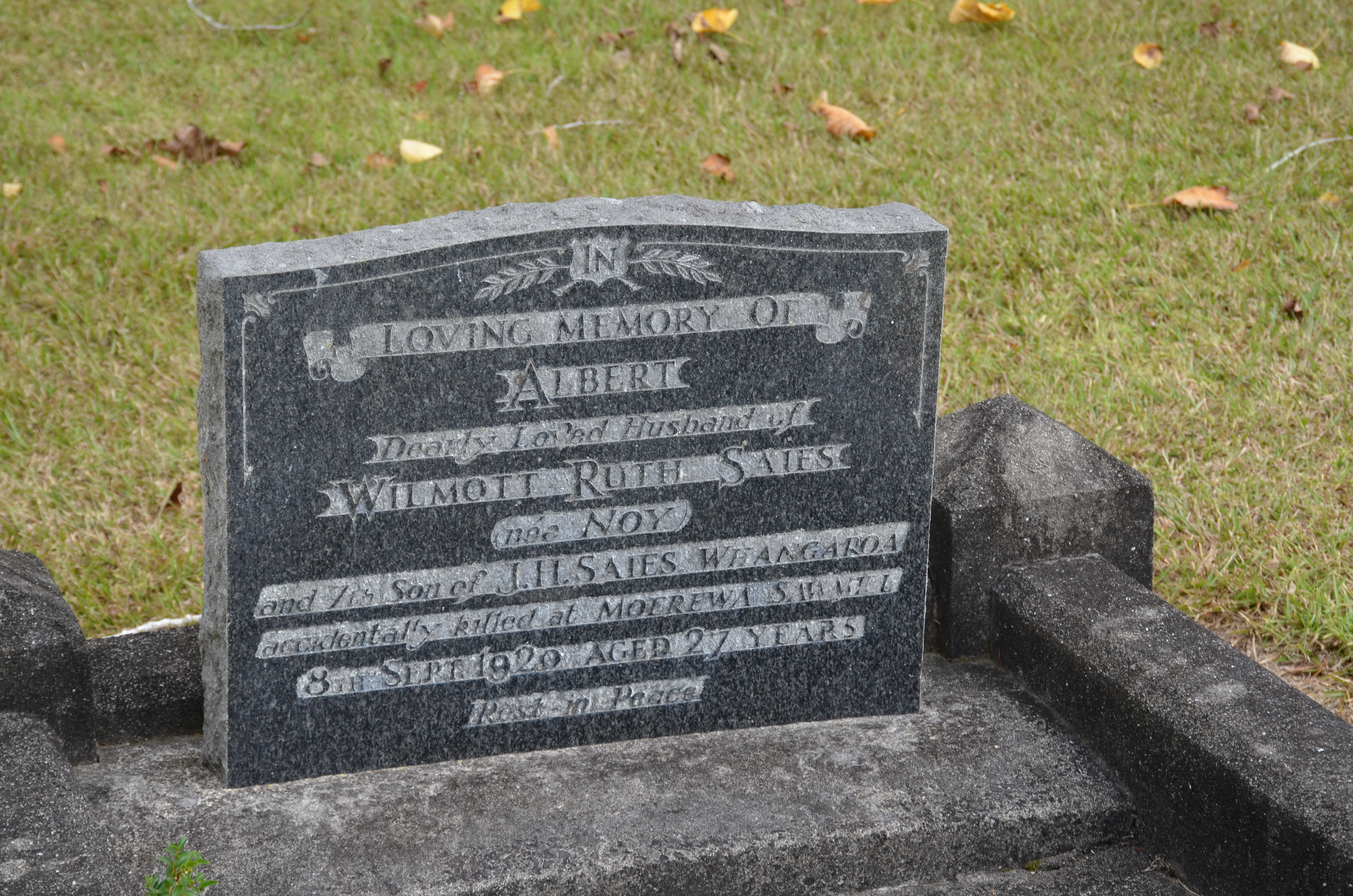
Albert Saies, (12/9/1892-8/9/1920). "caught on top of the saw"


Yesterday afternoon word was received from Kawakawa that an accident had occurred at the Waipuna timber mills, resulting in the death of Albert Farrer, a married man and father of one child. The victim had been working at a tail saw, when a piece of timber had hit him in the chest, causing injuries which resulted in his death. An inquest was held at Kawakawa yesterday afternoon.  -Northern Advocate, 9/9/1920.


THE WAIPUNA TRAGEDY.

A GRIEVOUS INCIDENT,

DEATH INSTANTANEOUS

The inquest held at Waipuna on Thursday last concerning the death of Mr Albert Saies on the preceding day disclosed some very distressing facts. Mr H. C. Blundell was the acting-coroner, and the jury associated with him were Messrs J. W. Jeffcote (foreman), D. M. Sinclair, J. J. Jackson and W. Lowrer.

A brother of the deceased, Frederick Saies, who, is also employed at the mill, said that he was working at the tailing-out when the fatality occurred. A piece of timber caught on top of the saw, was thrown back very forcefully and struck the deceased, who was working at the head of the breast bench. Another millhand, Edward Beasley, said that he observed the deceased put two 9xl pieces of timber on the top of the saw. Afterwards a portion of the timber flew back with such force that it penetrated the deceased's body, the point emerging a foot on the other side. Witness explained that the two 9xl pieces were cut off by the band saw and handed to the breast bench where they were made into 6x2, leaving a piece 3xl at the side. It was as the latter piece which recoiled and killed deceased, whose death was instantaneous.

Similar testimony was given by Albert Ashby, cutting foreman at the mill, who added that he promptly stopped the band-saw when deceased fell, and was present when another worker named Rodgers pulled the piece of timber out of deceased's body. All prescribed precautions had been taken by the Kauri Timber Company to obviate accidents.

After an adjournment to enable the jury to view the scene of the accident, evidence was given by Dr. S. Green, of Kawakawa, who said that he noted a wound on the right side of deceased's chest and a corresponding one on the left side near the shoulder. In the course of its penetration the timber would pass almost directly through the upper part of the heart and the great blood vessels, causing instantaneous death.

The jury returned a verdict of accidental death, no blame being attachable to anyone. 

The funeral of the victim of the mishap took place at Kawakawa on the afternoon of Thursday, the cortege including all the mill staff and a large number of returned soldiers, Mr Saies having been a member of the R.S.A. The deceased, who was 28 years of age, leaves a wife and one child.  -Northern Advocate, 14/9/1920.


Kawakawa Ceetery.