Saturday, 21 May 2022

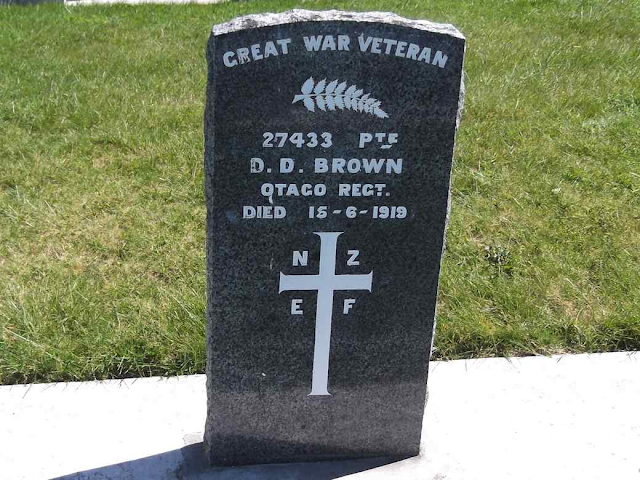
27433 Private Daniel David Brown, 3/10/1878-15/6/1919.

Daniel Brown was a miner living in Palmerston when he volunteered for the Boer War in 1901. His service there is difficult to pin down on account of the numbers of "Troopers Brown" visible in the newspapers of the time.

Daniel might have been the Daniel Brown who was in court for drunkenness in Dunedin in 1912 - he was certainly the private Daniel Brown whose Army record shows, among other offences, "on active service, found after hours in an estaminet," and being caught on the march with liquor in his water bottle and smoking a cigarette - along with insolence to a superior officer, "to the prejudice of good order and military discipline."  He certainly seems to have had a thirst.  He was given Field Punishment No. 2 for the first and forfeited 28 days' pay for the second.

Whatever his qualities as a soldier, he took his time in the line of fire and stopped a bullet in the spine in the Battle of Messines in June, 1917.  The following February he was put on the "Marama" for New Zealand.


PRIVATE BROWN. 

Private D. D. Brown, who was severely wounded in the abdomen in the Messines engagement, is a war veteran, for he volunteered for the Boer war, and participated in the severe fighting at Bothasberg, in which the New Zeaalnders were engaged, fortunately coming through it without injury. He was born at Arrowtown, and was educated there and at Palmerston. After leaving school he went mining and farming with his father, and was thus occupied when he enlisted as a member of the Seventh Contingent for South Africa. Upon receiving his discharge from the army after the return of the New Zealand contingents, he resumed his former civil occupation until the call to arms stirred him, and he enlisted in the Expeditionary Forces for the present war. Leaving New Zealand as a member of the Seventeenth Reinforcements, he arrived in France in December last. His mother, Mrs J Brown, of Melbourne street, South Dunedin, has been informed that he is now a patient in the Walton-on-Thames Hospital.  -Otago Daily Times, 3/7/1917.


The Police Court did not sit until this afternoon, when two men were charged with drunkenness. Daniel David Brown was remanded for seven days for medical treatment. Donald McIntyre was fined 20s or 48 hours.

Jubilation! Celebrate it in Watson's No. 10 Whisky; without a peer; just lovely. [— Advt.]   -Evening Star, 29/11/1918.


INQUESTS.

DEATH IN A SORDID DEN. 

THE OCCUPIER WARNED. 

An inquest into the circumstances of the death of Daniel David Brown was held at the Morgue yesterday morning, before Mr H. Y. Widdowson, coroner. The deceased had been fouud dead on Sunday morning at George Mullin's house, 123 Caroll street, where he had been staying. The police were represented by Senior Seargeant Murray. 

Dr Evans stated that he had examined the body the previous afternoon, and found rigor mortis well marked. The body was fairly well nourished, and there was marked cyanosis of the whole of the face. On the left arm there was the tattoo mark "South Africa, Seventh Reinforcements," and on the right arm the word "Bessie." He made a post mortem examination, and found hemorrhage into the brain. The heart was slightly enlarged with atheroma of the aortic valves. There was well marked cirrhosis of the kidneys and liver. His opinion was that the cause of death was cardiac failure following cirrhosis of the liver. 

To Senior Sergeant Murray: The commonest cause of cirrhosis of the liver was excessive use of alcohol. 

John Alexander Brown (labourer), residing, at 153 Melbourne street, south Dunedin, a brother of deceased, identified the body. His brother was a single man, a labourer, who turned 40 last October. He returned from the war in August, 1917, and was discharged in the following October. He had been living with his married sister, Mrs Alexander, in South Dunedin, but he usually worked in the country. None of his family had seen him on this last visit to town. He was in fair health, but had had to go into Hospital as a result of wounds received at Messines. He had also served in the South African war with the Seventh Reinforcements. He was a pretty heavy drinker at times when he was not in the country. 

George Mullin (bootmaker), living at 123 Carroll etreet, said he was a bachelor living in a one-roomed house. He had known deceased a little over three months, and this was the second time deceased had stayed with him. He came to witness at his house on Friday week. He had half a flask of whisky with him, and looked as if he had had a few drinks. He had stayed with witness since that time, and had been drinking pretty heavily. Witness got deceased six bottles of ale on Friday, and on Saturday he got him 2s worth of brandy. When witness came home early on Saturday evening, deceased was lying on the bed dozing. Witness had brought home a bottle of beer, and gave deceased a drink from it. They both lay together on the single stretcher bed, but during the night deceased shifted and lay across the bed at an angle. On waking at 8 o'clock next morning witness noticed that deceased had not shifted and that his face was black. He went down to a neighbour's place, and told him Brown was dead, and then went and informed the police. 

Cornelius Walsh, 14 years of age, living at 187 Carroll street, said he had been at the house of the last witness (Mullin) about 9 o'clock on Friday evening. He saw deceased and Mullin lying in bed with their clothes on. He saw Brown drink something from a mug. Mullin did not seem to be drunk, but Brown had been vomiting on the bed. On Saturday afternoon witness and others went to see Mullin, but he was not in. They heard Brown groaning on the bed, and apparently he had been sick again. He asked the boys to go for beer for him, but they said they would not.

Constable McCulloch said he knew deceased and the witness Mullin personally. About 9.30 a.m. on Sunday he went to Mullin's house and found Mullin there, and the body of deceased lying across the foot of a stretcher. There was no sign of disturbance about the room. Deceased was lying face down with his head in the bed clothes. He knew deceased was a man given to heavy drinking, and that Mullin permitted his house to be a sort of a rendezvous for dissipation. 

The verdict was in accordance with the medical testimony that deceased died of cardiac failure, following on cirrhosis of the liver. After delivering his verdict, the coroner addressed a few words to the witness Mullin, telling him that it was quite clear from the evidence that he allowed his place to be frequented by people who wanted to dissipate in liquor. He would have to stop that sort of thing. It was disgraceful that he should encourage a man like deceased to drink and lead him on to drink when he should have been back at his work in the country. As a result the man had died of drink. He would have to turn over a new leaf or some steps would have to be taken.  -Otago Daily Times, 17/6/1919.


MILITARY FUNERAL. 

THE Friends of Mrs ISABELLA J. BROWN (and family) are respectfully invited to attend the Funeral of her late SON Private DANIEL DAVID BROWN which will leave 153 Melbourne street, south Dunedin, THIS DAY (TUESDAY) 17th inst., at. 2 o'clock, for the Anderson's Bay Cemetery. 

A. S: ARCHER & CO., Military Funeral Directors.   -Otago Daily Times, 17/6/1919.

Andersons Bay Cemetery, Dunedin. DCC photo.


Sunday, 15 May 2022

Lieutenant Roger Kerkham, 1869-14/12/1902.

FATAL BATHING ACCIDENT

A particularly sad accident, which resulted in the death of Lieutenant Roger Kerkham, of the Dunedin City Rifles, occurred at St, Clair baths yesterday morning. Mr Kerkham, who was a popular officer and an expert swimmer and diver, arranged on the previous evening, with two of his fellow subalterns (lieutenants Jackson and Ussher) that they should go down to the baths in the morning from their camp on the hill at Kew. They went accordingly, and each of them dived into the water twice. Then Mr Kerkham went back for one more plunge before finally coming out. He took a running dive in precisely the same manner as the one before it. His companions are convinced that he did not slip — in fact, deceased said as much himself afterwards. He struck the water at a good angle, but as he went in his knees were bent, and it is supposed that their contact with the water caused his head to tip downwards. At any rate, he did not come to the surface immediately, and for a few moments his companions thought he was remaining under water purposely, until one of them saw him floating slowdy upwards and remaining with his face immersed and blood issuing from a severe scalp wound. Lieutenant Jackson at once brought him into shallow water, and with the assistance of lieutenant Ussher carried him ashore and sent word of the accident to the camp. Deceased was quite conscious and rational, and told his companions that he was afraid he was “done for,” as he had a queer sensation at the back of his neck. On has legs being pinched he felt nothing, and about ten minutes afterwards his arms, too, became paralysed. He told his friends that he was very sorry, as he knew how he would have felt if it had been one of them who had been hurt. When Dr Coughtrey, who had been sent for post haste, arrived he at once attended to the injured man, who said to him: “I fear, doctor, that it’s a case,” and from the first the doctor had no hope that it might be otherwise. After considerably difficulty Dr Coughtrey succeeded in telephoning to the hospital for an ambulance, in which the deceased was taken to that institution. At about noon he became unconscious, and died shortly before 9 p.m, from laceration of the spinal chord. Lieutenant Kerkham was the son of the Rev. A. R. Kerkham, who some years ago was vicar of the Anglican Church, Roslyn, but is now in England. There is a brother in Western Australia, and one a sea captain; while a third some time ago went to India as a missionary, where he died. Lieutenant Kerkham was employed in the office of the National Insurance Company, and was a popular officer in the battalion to which he belonged. The spot from which deceased dived is known as “high rock,” a pillar of concrete standing 5ft from the side of the bath just be behind the bathing boxes. It is 5ft above the edge of the bath, which itself is about 2ft at low-water level, so that the height of the dive would be about 7ft from the take-off, and by measurement the water at its deepest part in the hole abreast of this “high rock ” is 5ft when the tide is coming in, as it was at the time of the accident. This is the third serious accident of this sort that has taken place in these baths, and it is time that the Domain Board saw not only to deepening the bath, but to keeping it deep, and to cutting away some of the pinnacles of rock that are alongside the wall. It would also be a good thing, and consistent with the practice in vogue in other places, to place in the bath gauges by which the depth of the water at various places would he plainly indicated. This morning the water abreast of the low-dive side of the bath was only four feet. Deceased, who arrived in Dunedin with his parents twentythree years ago this month by the New Zealand Company’s sailing vessel Wanganui, will be buried with military honors on Wednesday. 

An inquest was held on the body at the hospital this afternoon before Mr C. C. Graham, coroner, and a jury consisting of six, of whom Mr John Duthie was foreman. Allan Main Jackson, civil engineer, one of those who accompanied deceased to the baths, gave evidence tallying with the facts already stated. Stuart Beauchamp Ussher, insurance clerk, the other volunteer subaltern present at the time of the accident, gave deceased’s age at thirtytwo years, and corroborated the evidence of the previous witness. Dr Coughtrey, who attended deceased, said that when he arrived at the baths there was no bleeding from the scalp wound on the deceased’s head, but that he could see that there was extensive injury to the spinal cord, and bleeding into its membranes, causing complete loss of power and sensation in the lower limbs and almost complete in the upper limbs, together with interference with the respiratory movements. He described how deceased was sent to the hospital, and said he thought all was done that could have been done. He also referred to the previous accidents which had occurred at the baths, and stated that he had heard complaints from bathers as to the jaggedness of the rocks in the baths. Dr Brown, resident surgeon at the hospital, testified that the cause of death was extensive laceration of the upper part of the spinal cord, with subsequent hemorrhage, probably due to striking the head on the bottom of the baths. He noticed no fracture of the skull, but probably one of the vertebra of the neck was fractured. William Farquharson Chisholm, lessee of the baths, said that in his lease there was no agreement as to clearing out the baths, but that he was in the habit of taking steps in that direction. About a month ago he, had cleaned the baths out, and removed all the large stones from the bottom. There never had been any means of indicating the depth of the water. The jury returned a verdict of accidental death (words missing) effect that in all public baths it would be desirable to have the depth of water dearly shown on direction posts placed there for the purpose.   -Evening Star, 15/12/1902.


The funeral of the late Lieutenant Kerkham took place this afternoon, when the remains were conveyed on the gun carriage of the B Battery to the Northern Cemetery. There was a large muster of volunteers and others, the insurance companies being strongly represented. The Garrison Band played the Dead March, and the Dunedin Rifles, to which company deceased belonged, formed the firing party.   -Evening Star, 17/12/1902.


Northern Cemetery, Dunedin.


Captain Robert Tubman, 1871-11/4/1902.


On board the Moura, on the trip down the harbor, Lieutenant Tubman was the recipient of a splendid pair of extremely light field glasses, the metal parts of which were composed of aluminium, the case and strap being of khaki-colored leather. The glasses were presented by the teachers of the George street School and the Committee. Mr A. McLean made the presentation, and Mr Tubman, in replying, said that the present was most apropos, and might, for all they knew, be some day the means of saving life. 


THE BOER WAR.

FOURTH CONTINGENT LETTERS.

A number of letters from members of the fourth contingent have been received by Mr Macdonald, schoolmaster at Ravensbourne, who has. kindly permitted us to make extracts as under: —

Lieutenant Tubman describes Beira as a terrible place. Every other place is a bar, as the hotels are called, and in each bar are from three to 20 girls of every nation under the sun. These bars close at 2 a.m., and are open all Sunday, on which day the shops are also open. On the Saturday before Lieutenant Tubman's letter was penned the Governor of Beira gave a ball to the officers of the contingents.  -Otago Daily Times, 7/8/1900.


LETTERS FROM THE FRONT

A letter from Lieutenant Tubman has been received by Mr J. McPhee, of the George street School, dated August 22, from which we are permitted to make the following extracts: —

Mafeking is a miserable little place from what I saw of it. The whole business of the siege, looking at it from the point of view of the besiegers, must have been boomed and over-rated tremendously; one rush by the Boers, and all would have been over, but they are such cowardly wretches when it comes to a down right willing go. If you could only see the place you would wonder at the importance put upon it, and why it was defended so tenaciously — for no other reason, I suppose, than the principle of the thing. It was not the relief of the place so much as the relief of B. P. (Baden-Powell) and his men that roused the excitement and enthusiasm of the good people of Dunedin, I suppose. Well, we were hurried out of Mafeking in the direction of Zeerust. We have 25,000 men with us, and shortly after we crossed the border we were fired on, but no harm was done to our boys. The following day (the 16th) we got into action, and no doubt you have long ago heard the particulars of it. I was with Captain Fulton, and as soon as we reached the top of a kopje we received a volley that laid one poor chap low, and wounded three others. It was terribly warm work. As soon as they gave us the volley we took cover just on the ridge of a kopje, and settled down to business. My company had to cover Captain Fulton's retreat with the rest of the wounded who were able to get away. I had one close shave. A big Boer aimed point blank at me at about 100 yards. When I saw him aiming I thought it was winter with me, but he fired high and missed (flurried at the bayonet I suppose), the bullet going between the rim of my hat and my ear, it seemed to me by the whiz. Then my turn came, and.l laid him out on the rocks, dead as a stone. After that two of my men and I were cut off for an hour or so, and had to lie low, getting an occasional shot. We killed Snyman and seriously wounded a field cornet. A flag of truce came up in the morning and took their bodies away, and also the rest of the killed and wounded that they could not take away in their flight. Poor Harvey fell on the other side of the kopje from me — shot through the head. He never spoke a word — not even moved. I miss him very much, for he and I, as I told you before, have been chums ever since Forbury Park camp. I never witnessed anything in my life so pathetic as his burial. 

We spent two nights and a day on the kopje — no blankets and very little food. I never felt the cold so much before, and we could not sleep for fear of being surprised. We were all pretty well knocked out, but are well again. The following day we had to retire for some reason or other, leaving our dearly-won position and poor Harvey's body behind. We executed our retirement in good order, but were again fighting all day after reaching Ottoshoop. Thank God, I have not been hit, and I can tell the sight of fellows being dropped by bullets not far from you makes one feel that he don't want any more kopjes to rush, as it certainly means "winter" for some more of us. As far as my men are concerned, only one was scratched. Yesterday I went back to the border with the wounded; we were fired on, but no harm was done. Tell the children that I have not time to write to them just now, and that I got letters from several of them. Glad to say I am well. You might regard this letter as a reply to the children at school, and read it to them. All my clothes are at Mafeking, and what I stand in are almost in rags. You would not know some of us if you saw us for dirt, etc., and general uncouthness. We are on three-quarter rations just now, and when I was at leisure to-day did some naturalist work, and bagged a fowl. I am now waiting and watching it carefully till 5 p.m. I laid the specimen out with a stick. No naturalist ever guarded a unique specimen like I watch that hen. 

Mr J. Waddell Smith, of the High street School has also received a letter from Lieutenant Tubman, but it contains little beyond the news given in the above extracts. Lieutenant Tubman states that so strong was the feeling among the men at Captain Harvey's death that he pities the Boers if ever the men get within reach of them. But they cannot get near the Boers. It exasperates the men to be shot at all day from all quarters, and not see anyone. Lieutenant Tubman writes very strongly about the Boer women fighting with the men. He declares that while none of the men would willingly injure a woman, yet if the latter carry a gun and use it with the men they must expect to be treated by those fighting against them as if they were men.   -Otago Daily Times, 12/10/1900.


Lieutenant Tubman, of the Fourth Contingent, has resigned his position on the staff of the George Street School, in order to take up his permanent residence in South Africa. It is understood that he has been appointed to a lieutenancy in the Rhodesian Field Force.   -Star, 8/12/1900.


PROMOTION OF LIEUTENANT TUBMAN. 

A LETTER FROM THE FRONT. 

A cablegram has been received in town intimating that Lieutenant Tubman, of the fourth contingent, has been promoted to the rank of captain, with an appointment on the staff of Colonel Grey. A private letter received by Mr J. Waddell Smith from Captain Tubman, dated Vontersdorp, April 14, indicates that he had made up his mind to stay and join the seventh contingent. At the date of writing he was in charge of a number of men knocked up, and horses, which needed nursing. Ventersdorp is 32 miles distant from the railway. It is in telegraphic communication with Fotchefhstroom, but the line was cut daily by some of the Boers as soon as it was repaired. Captain Tubman had to provide the escort for the line repairers. The writer says that the aspect of affairs is unchanged. Smuts, De la Bey, and others continue to shift about, but they will not fight. There is conclusive proof that the burgher would surrender if he had a free hand, but he hasn't. The only thing keeping the war going now are the Cape Colony and Bechuanaland rebels, who know they will be punished if they surrender or are caught. The British have been successful all round lately, and the increased activity has made the Boers very shy. Referring to the glorious affair of the 24th March, the writer says it seems almost incredible that so large a capture could be made, and no one seriously hit. When the New Zealanders rode at them the Boers simply abandoned everything. Mention is made of the fact that Lieutenant J. R. Macdonald had gone for a trip to Johannesburg on a week's leave.   -Otago Daily Times, 8/6/1901.


DEATH OF AN OTAGO OFFICER.

CAPTAIN TUBMAN SUCCUMBS TO ENTERIC. 

News was received through the Premier yesterday of the death in the Transvaal on the 11th inst, of Captain R. G. Tubman, of the Seventh Contingent. 

Captain Robert G. Tnbman was the son of Mr Frank Tubman, of Owaka, formerly of Beaumont, and was born in 1871. He was educated at the Beaumont School, but received his training as a pupil teacher at Mornington School under Mr Kyle. He was a student at the Dunedin Training College, and acted for some time as relieving teacher. He was appointed head master of the Moeraki School in 1890. After five years faithful service, desiring to attend the University classes, he, in 1895, applied for and obtained the position of fourth assistant at the George street School, and that position he held when he joined the Fourth Contingent. When at Moeraki Mr Tubman took a great interest in the Maoris there, and did everything possible to assist both young and old, with the result that he wns a general favourite among them, and when he was leaving for Dunedin he wns presented with a greenstone weapon which was greatly prized by the chief who owned it. It was while at Moeraki that Mr Tubman joined the North Otago Mounted Rifles, and he took a keen interest in all that appertained to volunteering. Here also he was married to Miss Bessie Culling, daughter of Mrs Culling, of Hillgrove, but he had the misfortune. to lose his young wife very shortly after removing into town. In the George street School and the University he made many warm friends, and he was greatly esteemed for his kindly disposition and unassuming manner. When he was appointed lieutenant in the Fourth Contingent in recognition of his valuable services in Forbury camp, he was presented by the teachers of Otago with a horse and a pair of field gloves, and the Tailoresees' Union presented him with a second horse. He served with the Fourth Contingent during the whole time they were in South Africa, and was acting-captain for a period of nearly six months. Many of our readers will recall descriptions of the work of that contingent which appeared in our columns from time to time from the pen of Captain Tubman. Finding campaigning agreeing with him, and liking the climate of South Africa, he resigned his position in the George street School, which had been kept open for him and offered for service with the Seventh Contingent. He was accepted and joined the Seventh.on its arrival in South Africa as captain. Shortly after he was sent on a special mission to bring a train with specie from Capetown to Johannesburg, and his success and the attention he gave to details so impressed General Garratt that he appointed him as provost marshal to his column. The latest letters received from Captain Tubman showed that he was in Johannesburg attending the trial of some rebels captured near Klerksdorp. He was then in the best of health and spirits. On the receipt of news yesterday of the death the flag at the George street School was hoisted at half mast and general and sincere regret was felt by all who had known Captain Tubman. The sad news will be a severe blow to his parents, who lost their youngest daughter but a few months ago, and they will have the sympathy of the community generally in this second bereavement.   -Otago Daily Times, 15/4/1902.

Northern Cemetery, Dunedin.


Friday, 13 May 2022

Alice Kelman (nee Reid), 1876-23/5/1906.

The Rector’s report stated that the school (Riverton District High School) was opened on Monday last with an attendance of 257 and yesterday there were 265 present. He recommended that Miss Alice Reid be appointed pupil teacher in lieu of Miss Robinson, resigned. The report was adopted, and the Rector’s recommendation regarding Miss Reid’s appointment given effect to.   -Western Star, 28/1/1891.


In mentioning the successful pupil teachers at the recent examinations, we omitted the name of Miss Alice Reid, of Riverton District High School, who passed the II Class. She has only one more class to go through now.  -Western Star, 22/7/1893.


Another ascent of the Remarkables.

Mr J. A. Reid and bis sister, Miss Alice Reid, of this town, accomplished the ascent of the Remarkabhs on February 28th. Time from Peterson's ferry, Kawarau Falls, to summit, six hours. They had a splendid view from the summit, well repaying the long climb. To the N. E. and west were numerous snow-clad ranges and peaks showing out, prominently especially being the Earnslaw and Mounts Aspiring and Cook. Lake Wanaka was plainly visible — Queenstown, Arrowtown, Lakes Wakatipu and Hayes, the Shotover and Kawarau rivers and surrounding flats forming a pretty foreground, the view to the south was more open — the plains of Southland stretching away to the horizon. Lake Wakatipu lay far below, presenting a continuous view from Kingston to the Greenstone river — a distance of nearly 50 miles. By the aid of a powerful telescope Cromwell and other townships further down the river towards the east could be discerned. The dangers and difficulties of the ascent have been exaggerated, as there is nothing to prevent any ordinarily active person in a fair state of health making the ascent — the only real difficulty being over the last 300 or 400 yards, which is pretty steep rock work, necessitating the use of both hands and feet. The journey from Queenstown occupies 14 or 15 hours. We would advise any parties intending to try tins ascent to get a good description of the route to be followed, as it would save them a lot of time and useless climbing. There are five or six small lakes about an hour's climb from the summit, the largest of them being a quarter of a mile in diameter with deep blue water right to the edge.  -Lake Wakatipu Mail, 15/3/1895.


There were four applications for the position of pupil teacher to the Queenstown School, and the Committee unanimously decided to recommend the appointment of Miss Alice Reid.   -Lake Wakatip Mail, 5/4/1895.


Cantanta and Social (excerpt)

On this occasion too, there was some new local talent in the persons of Miss Alice Reid, who possesses a nice voice, which, with cultivation, will no doubt still further improve.  -Lake Wakatip Mail, 4/9/1896.


EDUCATION BOARD (excerpt)

Miss Alice Reid was appointed mistress of the Round Hill School.    -Western Star, 10/11/1897.


Local and general

An interesting ceremony in connection with the marriage of Miss Alice Reid, eldest daughter of the late Mr George Reid, of Riverton, to Mr William Hay Kelman, of Geraldine, took place on the 5th inst. at Knox Church, Dunedin. A large number of the friends of the bride and bridegroom assembled to witness the ceremony. The bride, attended by her sister and two little cousins carrying bouquets, was given away by her brother. At the close of the ceremony, which was conducted by the Rev. Thos. Neave, formerly of Riverton and now of Kurow, a hymn was sung. Mr Lilly played a march from Lohengrin and Mendelsohn's Wedding March as the bridal party entered and left the church. A number of guests assembled at the house of the bride's mother to greet the newly-wedded couple. The health of the bride and bridegroom was proposed by Mr Neave and responded to by the bridegroom. Other toasts followed. The bride was the recipient of many useful and beautiful gifts. In the course of the afternoon the happy couple left the bride's residence amidst showers of confetti, accompanied by the proverbial old shoes and the heartiest expressions of the good-will and best wishes of all present.  -Western Star, 15/4/1904.


Miss Alice Reid, who has had charge of the public school at Athol for the past two years, was recently made a presentation by the residents on the occasion of her severing her connection with that institution. It took the form of a suitably-inscribed gold bangle and a gold necklet and pearl pendant, which were handed to her at a social given in her honor as a mark of the esteem in which she was held by the donors. We understand that Miss Reid has decided to relinquish school teaching, which being the case, a great loss will be occasioned the Board as Miss Reid had proved herself to be a painstaking and capable teacher.   -Lake Wakatip Mail, 22/7/1904.


In this issue we announce the death of Alice Reid, the beloved wife of Mr W. H. Kelman, of Geraldine. Deceased, who was a daughter of the late Mr George Reid, was a native of Riverton, and taught in the Riverton and Round Hill schools, being a most successful teacher. She had, on account of her health, to give up the profession, and went to live in Dunedin with her mother. Sorrow will be expressed at the demise of one who was held in the highest esteem by residents of this district.  -Western Star, 25/9/1906.

The departure of Alice from Athol in 1904 and her death at her mother's place in 1906 seems to indicate a long illness being the reason for her leaving the school.  My best guess is tuberculosis, the scourge of its day.


Northern Cemetery, Dunedin.

Mary Ann Sinclair, 1896-14/1/1910.

Mary Ann Sinclair, 13 years of age, who lived with her parents in St. David street, Dunedin, complained of a headache about 3 o’clock on Friday afternoon, and lay down on a sofa. Presently she went to her bedroom, where she lay upon her bed without undressing, and, after some time, she was seized with what appeared to be a fit. Her mother, who was attending to her, tried unsuccessfully to get her to swallow some brandy, and sent for Dr Martin, who came at half-past 6 o’clock. By this time, however, the girl was dead. On Saturday morning Mr C. C. Graham conducted an inquest at the house. Dr Martin stated that he had examined the body of the girl, and he had noticed marks indicating an old operation for hydatis. It was ascertained that deceased had suffered from that disease two years ago, and had been operated upon in the Dunedin Hospital. He considered that death was clue to embolism, resulting upon the bursting of a hydatid, of which the condition and situation were such as to cause great trouble at any moment. He considered a post mortem examination unnecessary, and believed that an operation would have done little to relieve the sufferer. The coroner recorded a verdict in accordance with the medical testimony.   -Otago Witness, 19/1/1910.


IN MEMORIAM.

SINCLAIR. — In loving remembrance r)! my dear sister, Mary Ann Sinclair who departed this life on January 11, 1910. Inserted by her loving sister, Lizzie, Mrs A. Doyle, 81, Kingsley Street, Sydenham.  -Lyttelton Times, 14/1/1918.


Northern Cemetery, Dunedin.

Thursday, 12 May 2022

John Harbour, 1870-19/2/1904.


CASUALTIES

A youth named John Harbour, aged about 16 years, and residing in Upper Woodhaugh Valley, had one of his hands caught in some of the machinery at the Woodhaugh Paper Mills, where he is employed, on Friday. Upon his being admitted to theHospital it was found that the hand was somewhat severely crushed, and it will be some time before he will regain the use of it.  -Evening Star, 5/2/1904.


Woodhaugh paper mill, Hocken Library photo.


Paper mill interior, 1913.  Hocken Library photo.


INQUEST.

An inquest was held at the hospital this afternoon touching the death of John Harbour, who died last night from tetanus, following on an injury received at the Woodhaugh Paper Mills on the 5th inst. Mr C. C. Graham, coroner, conducted the inquest, and the foreman of the jury was Mr A. Yates.

Mr W. L. Moore appeared for the relatives of the deceased, and Mr J. B. Lindsay (inspector of factories) watched the case for the department. 

Henry Harbour, father of deceased, gave evidence as to his son, who was thirty-four years of age, having left his home on the morning of the accident, in good health. Deceased had not told witness anything as to the circumstances of the accident.

Dr Hall, house surgeon at the hospital, deposed that on the day in question deceased was brought in suffering from extensive injuries to the forearm and hands. Dr Closs treated the case at once, and the patient made a satisfactory progress fcr the following ten days, when symptoms of lockjaw set in. The forearm was amputated to remove the source of the poison, against which, however, the patient made no headway. He died at 11.30 pm. on the 19th. The cause of death was tetanus, the result of wounds received. 

To Mr Moore: A consultation was held on the morning following the appearance of the symptoms of tetanus, and the arm was removed on the day after that. It would have made no difference had the arm been amputated the same day. It was necessary to watch the case during the period of incubation. 

Michael O'Brien, laborer, Woodhaugh, employed at the mills, deposed thai he knew the deceased, who was also an employee there, his duties being general, but in no way connected with the machinery. Witness saw deceased a few moments after the accident, and held his arm till the engineer arrived and bandaged it, after which deceased was taken to the hospital. Witness did not see how the accident happened, but understood that deceased was cleaning some of the machinery in the vicinity of the rollers. It was part of deceased's duties to wash down the rollers. The machinery was going slow, as it always was at cleaning times. As a rule, deceased was a very careful man, and very steady. 

John Hunter McLaren, engineer and acting manager at the Woodhaugh Paper Mills, said that he was called by one of the workmen on the day in question. The engine had been stopped before he got inside the mill. The rollers were going at about a sixth of their ordinary pace at the time of the accident. Witness rendered first aid to deceased. Deceased told witness that as he was wiping the rollers the rag he was using got caught. He grabbed it, and the arm was dragged in. Had he been cleaning the rollers on the "running out" side nothing could have caught. As it was he risked too much, and cleaned on the "running in" side.

To Mr Moore: They looked upon deceased as a good and careful workman. Mr Lindsay said that there was no reason to suppose that the machinery was left in an unguarded condition. After the coroner had reviewed the evidence, the jury brought in a verdict that death was due to tetanus, the result of injuries accidentally received, no blame being attachable to anyone.  -Evening Star, 20/2/1904.


Northern Cemetery, Dunedin.

Thomas (1879-3/8/1911) and Agnes (1883-3/8/1911) Colehan.

SAD TRAGEDY.

MAN AND WIFE FOUND DEAD. 

RESULT OF GUN-SHOTS. 

(By Telegraph: — Press Association.) Dunedin, August 4. A very sad tragedy occurred at Tuapeka West last evening, between 5 and half-past 5o'clock. It happened in a house belonging to Thomas Colehan, situated on what is known as the Balclutha Borough Endowment, towards the lower end of Tuapeka West Settlement, and a short distance from the Kononi Post Office. About half-past 5 one of Colehan's employees named Cowie came to the house for tea, and not noticing any signs of life had a look round, and discovered Colehan and his wife lying dead in the sitting-room. Mrs. Colehan was lying on her back on the floor with her head on the sofa, and a wound in her left temple, while Colehan was lying alongside with his head resting on his wife's breast, with a pea-rifle between his legs, his right hand on, tho trigger, and a wound on his right temple.

So far as can be ascertained the last to see the couple alive was a neighbour named Mrs. Johnston, who was in the house with them from 3 till 5 o'clock, She says she had no suspicion of anything being wrong, as both Colehan and his wife were, so far as she knew, on the best of terms. 

Colehan was about 31 or 32 years of age, and his wife, who was formerly Miss Ritchie, was about 25 years. They were married about a year ago. Colehan came from Waitati before settling at Tuapeka West, his mother having been for some years proprietress of the wellknown Saratoga Hotel.

It is alleged that Colehan, when the worse of liquor, was given to fits of temper, and it is feared that when in one of these fits he committed the deed.  -Dominion, 5/8/1911.


THE TUAPEKA WEST TRAGEDY.

THE INQUEST. 

The inquest held at Tuapeka West on Saturday to inquire into the circumstances attending the death of Thomas Patrick Colehan and his wife Agnes Colehan was conducted by Mr T. Pilling, J.P., acting coroner, and a jury of six, of whom Mr H. Cameron, J.P., was foreman. Evidence was first taken in regard to the 

— Death of Mrs Colehan, — 

and evidence of identification was called by Sergeant Higgins, who had charge of the inquiry. 

Dr Sutherland, on examining the body of Mrs Colehan, found a wound on the left side of the head in front of the upper part of the ear. The wound was such as would be caused by a .22 bore rifle, which must have been 2yds or 3yds away from deceased when fired, as there were no powder marks around the wound. The wound penetrated through the skull into the brain cavity, the bullet traversing in a horizontal direction along the base of the skull. Death must have ensued in a very short time — if not instantaneously. There were no other visible marks of injury to the body. There was no probability, from the peculiar nature of the wound and the absence of powder-marking in the locality of the wound, that the wound had been self-inflicted. 

Margaret Johnston (housekeeper to Mr John Stanton, one of the nearest neighbors) paid Mrs Colehan a visit about 3.30 o'clock in the afternoon of the tragedy, leaving about 5 o'clock. She stayed in the kitchen while in the house with Mrs Colehan. Colehan was in the front roum, reading a newspaper, when witness entered the house, and he remained there all the time. She saw nothing unusual or peculiar about either Colehan or his wife. Mrs Colehan was cheerful and in good spirits, and she and her husband appeared to be on the very best terms. Witness saw no signs of drink about Colehan while she was in the house. She knew that Colehan had a rifle, but did not see him handling it during her stay in the house. 

To a juror: There was no disagreement between Colehan and his wife while witness was in the house. Mrs Golehan made afternoon tea and asked her husband if he would have a cup, but he declined.

John Thomas Cowie, a farm hand in Colehan's employ, deposed that on the morning of the day on which the tragedy occurred he was at work on a fence not far from the house, and was assisted by Colehan. They went for dinner about noon. Witness had his dinner in the kitchen with Mrs Colehan. Colehan stayed in the front room, and came into the kitchen for his dinner just as witness was leaving the table. It was about quarter to one when witness left the house, and he did not return till about quarter to six for his tea. When he came to the kitchen to get a towel for a wash he found the door was partly open. Looking round he caught sight of Colehan's and Mrs Colehan's body on the floor. He called to his fellow farm servant (Michael Fahey) to strike a light. There was no life in either body. Mrs Colehan was lying on her back, with her head partly on the sofa, and there was a wound, from which blood was oozing, on the left temple. Colehan's body was lying on its back alongside that of his wife, with his head on her breast, and between his legs there was a pea rifle, with the muzzle upward towards the seat, and the right hand over the breech part of the rifle, with the thumb pressing on the trigger. Deceased's left hand was resting on his chest. There was a wound, from which blood flowed, on the right temple. When at work at the fence in the morning he noticed nothing unusual about Colehan, who was cheerful and in good health, and there was on sign of liquor about him. Colehan kept liquor in the house, and took a drop occasionally. He was a very quiet man, and appeared to get on well with his wife. Replying to the acting coroner, witness said that when Colehan came into the kitchen for his dinner he said nothing to his wife, nor did witness think anything arose between them to cause strained relationship. 

Constable Coppell, who reached the scene of the tragedy on the Thursday night about 10 o'clock, deposed that there was a newspaper on the kitchen table, on which there were a number of blood spots, from which he judged that Mrs Colehan was leaning over the table reading the paper when she was shot from the doorway of the front room leading into the kitchen. Witness examined the breech of the rifle taken from between the. legs of the deceased Thomas Colehan, and found that it contained an empty cartridge shell, and another empty cartridge shell was picked up in the front room. In deceased's waistcoat pocket witness found two loaded cartridges, and on the mantle-piece in the front room was a box containing several .22 cartridges. Witness searched the house carefully, but could find no notes or writing of any kind in explanation of the committal of the tragedy. He found jug and glass on the table in the sitting room; the jug contained about a teaspoonful of whisky. There was also a quantity of whisky in a jar in the bedroom off the sitting room. There was nothing to indicate a struggle on the part of either of the deceased. From the position of the bodies and the surrounding circumstances it looked to witness as if Colehan had first shot his wife and then lain beside her and ended his own life. At the close of the evidence bearing upon Mrs Colehan's death, the jury agreed to defer their finding until the conclusion of the evidence bearing upon the 

—Death of Thomas Colehan.— 

It was further agreed, as there had been proof of the identification of the body, only to hear one witness— viz., Dr Sutherland — accepting as material, where applicable, the depositions which had been tendered in Mrs Colehan's inquiry. Dr Sutherland deposed that in his examination of Thomas Colohan's body he found a small wound in front of the upper part of the ear on the right side. The size of the wound corresponded with that which would be produced by a rifle bullet of .22 calibre. Death must have been instantaneous. If the rifle (as stated by the witness Cowie) was found enclosed in Colehan's right hand, with the thumb on the trigger, then he (Dr Sutherland) was quite satisfied, from the position and appearance of the wound, that the wound was self-inflicted with a rifle bullet. He had heard the opinion expressed by Constable Coppell that it was very probable Mrs Colehan was leaning over the table reading a paper at the time she was shot, and it was manifest to witness that the entrance mark of the bullet on the skull and the line it traversed would justify the assumption that the shot was fired from the doorway of the front room. 

After the acting coroner had briefly reviewed the evidence the jury deliberated for a few minutes, and then returned a verdict in the case of Agnes Colehan (as indicated in our Saturday's issue) that she met her death from a rifle shot inflicted by her husband when apparently in a state of unsound mind; and in the case of Thomas Colehan that he met his death by a rifle shot self-inflicted when he was apparently in a state of unsound mind.  -Evening Star, 7/8/1911.


Northern Cemetery, Dunedin.