Tuesday, 19 September 2023

John MacNamara, 1840-6/10/1893. "his skull was fractured"


A painful accident befell John MacNamara, manager of Hyde and Co.'s dredge at Clyde, at 11 o'clock on Saturday morning. Through the handle of a hand-winch suddenly revolving and striking him on the top of the head, his skull was fractured. He was removed to the Dunstan Hospital, where Dr Hyde removed a portion of the skull.  -Otago Daily Times, 2/10/1893.


Dredging on the Molyneux River is evidently continuing a payable venture, judging by the reported returns from the various dredges at work. Between Clyde and Alexandra there are no less than five dredges at work, and all of these are apparently on payable gold, the returns from Mr Gard's two dredges being of an exceptionally satisfactory amount at each week's wash-up. About a fortnight ago a sad and fatal accident occurred on board the Clyde dredge, when John MacNamara, a miner and shareholder in the dredge, sustained a fracture of the skull, from which he died in the hospital on Friday evening last, consciousness never once having returned to him since the moment of the accident until his release from suffering. It would seem that the unfortunate man had occasion to attend to the winch, and in performing the necessary work the machinery must have got beyond his control, when the handle of the winch, flying round, struck the poor fellow on the head, resulting in the injuries just described. The funeral, which took place on Saturday, was numerously attended by the people of this and other districts, where MacNamara had made many friends for himself through his genial and inoffensive demeanour towards young and old who knew him.   -Otago Witness, 12/10/1893.

Clyde Cemetery.


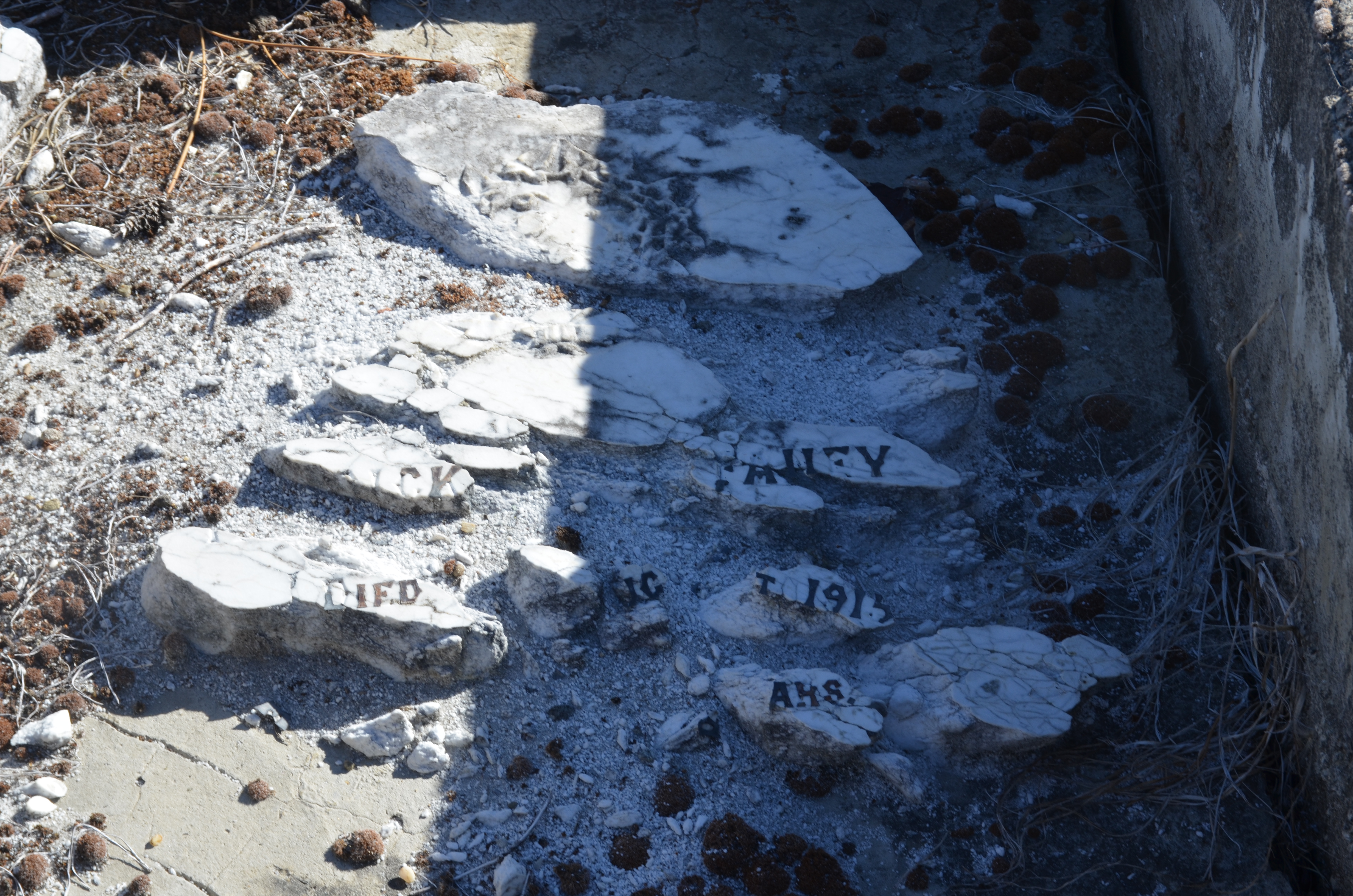
Patrick John Fahey, (1848-17/8/1915). "accidental burning of his tent"

Telegrams.

BY TELEGRAPH PRESS ASSOCIATION. 

Dunedin, This day. Patrick Fahey, single, 57, employed at the Ida Valley irrigation works, died in the Clyde Hospital yesterday from burns caused by his tent catching fire.  -Woodville Examiner, 18/8/1915.


INQUEST.

An inquest on the body of Patrick John Fahey was held at the Dunstan Hospital on Wednesday last, before Mr R. J. Mitchell, Acting-coroner, and a jury of six, of whom Mr John Smart was chosen foreman. 

Evidence was given by Alfred Quigley, Timothy Dwyer, George Rivers and Dr Thomas. The evidence showed that deceased had been put to bed (in a tent at Halliday’s Flat) in a drunken state, and shortly afterwards the tent was found to be in flames. The deceased was rescued from the fire, but was severely burned. Dr Gladstone was sent for and the deceased was taken to the hospital at Clyde, where he died. 

The jury returned the following verdict: — "That the deceased Patrick John Fahey came by his death through burns received by the accidental burning of his tent, the deceased being under the influence of liquor at the time.”  -Dunstan Times, 23/8/1915.


Clyde Cemetery.


Catherine Bethel MacGinnis, 1877-13/8/1896. "a general favourite"


In the midst of life we are in death was prominently brought before us yesterday afternoon, when news reached us of the death of Miss Catherine Macginnis, the beloved daughter of Mrs MacGinnes of Earnscleugh Flat. We understand that the deceased had been laid up for the past fortnight, first of all with an attack of pleurisy, after which inflamation set in, and for the past few days she had been very ill, but the end came yesterday forenoon at a little after 12 o'clock, when she passed quietly away without any struggle or pain. Miss Catherine MacGinnis was educated at the Alexandra school, and had a large circle of friends both in Clyde and Alexandra. She was a very nice dispositioned, girl, and a general favorite with old and young. We are sure the whole district will heartily sympathise and grieve with Mrs MacGinnis and family in their sad loss. As the family have had a great deal of sickness during the past 18 months and just seemed to be all recovering, it makes it all the harder to bear to see one so young cut down, and a promising young life suddenly cut short at the early age of 18. We offer our deepest sympathy to the family in their sorrow. The funeral will take place an Sunday afternoon.  -Dunstan Times, 14/8/1896.


At the Roman Catholic church, Alexandra, last Sunday morning. The Rev. Father Hunt spoke very feelingly on the death of Miss Catherine MacGinnis. The deceased had grown up among the members of the congregation of this church and was beloved by all for her bright and genial disposition. She was also a member of the choir for some years and the 'De profundis' was sung by the members in memoriam. Great sympathy is felt for her mother, brothers and sisters in their sad affliction.  -Dunstan Times, 21/8/1896.


Clyde Cemetery.


49913 Private Joseph Augustine MacGinnis, 24/5/1883-30/3/1918. "every man fell"


Joseph MacGinnis, a farmer from the Earnscleugh area, had unsuccessfully volunteered for the Army when he was called up in February 1917.  He asked the Military Service Board for time to get his harvest in and square things up and was given it.

After arriving in France, he was assigned the the 2nd Battalion of the Auckland Infantry Regiment, and would have been with them when they withstood - but only just - the high point of the German attack which was part of their Spring offensive.  


On March 30, the 2nd Aucklands made a surprise attack on German positions, as described in their Official History: "Lying in front of the New Zealand line, and in some parts dominating it, was the ridge and farmhouse of La Signy. Possession of this would very greatly improve the strength of the line, and would drive the enemy everywhere into the valley, leaving him in such a position that a general assault on his part would be very much hampered by the lack of a suitable jumping-off point. It was resolved to take La Signy and to entrust 2/Auckland with the task. The attack was planned as a pure surprise, and was to take place at 2 p.m. on the afternoon of March 30th. There was no preliminary artillery bombardment, but at zero hour a shrapnel barrage went down on the Hun line, and at the same moment the infantry leaped from the trenches, deployed out and went straight forward. The Hun sentries were evidently extremely careless, and fearing nothing, stood down and kept their heads below the parapet when the shelling commenced. It was the most impossible and most improbable time for an attack to take place. The greater part of the trench garrison were asleep in their dugouts. Some were writing home on British Y.M.C.A. paper. They were in great numbers — the trench was packed with them. Machine-guns were mounted every few yards. So sure, so confident were the Huns, in their own strength, in their feeling of certainty that their opponents would remain entirely on the defensive, that the idea of a surprise attack over that two hundred yards of level grass field never entered their heads. The Aucklanders were half way across before they were seen. They were on the parapet of the German trench before the machine-gun crews could reach their weapons. The 3rd Company, on the right, and the Waikatos on the left, went straight in with rifle, bayonet and bomb. Many of the enemy were killed actually in the trench. Many more were shot down as they endeavoured to escape. Numbers of them surrendered. In two places only was there strong opposition. Right in the centre of the position, at the end of Southern Avenue, an enemy strong point held out. A platoon of the Waikatos, advancing up the sap, found the enemy on the alert. For a moment the whole line of them were exposed to the direct fire of an enemy gunner. Fourteen fell — every man shot through the head. Two or three more were wounded, including Captain McFarland. The attack here was held up until Colonel Allen, in response to an urgent message, came up to the spot, and with him the trench mortar officer, Captain Morgan, who with all speed brought one of his guns into play. This played havoc with the Huns, who speedily surrendered. On the extreme right, by the Serre road, another post still held out, but a bombing party of the 3rd Company under Sergeant Buckthought quickly reduced it, while the Colonel and the Padre looked on. This established touch with 1/Wellington on the right."

The Battalion lost altogether 130 men killed or wounded in the attack on March 30. Joseph MacGinnis was in the Waikato platoon and is likely one of the victims of the "enemy gunner."


FOR THE EMPIRE'S CAUSE

IN MEMORIAM

MacGINNIS. — In sad and loving memory of our dear brother, Joseph Augustine MacGinnis, and his brave comrades of the 16th Waikato Company, who were killed in action at La Signy Farm, France, on March 30, 1918. 

Sacred heart of Jesus have mercy, on their souls. 

And these have paid, paid the immortal gold 

Of their great youth in splendid sacrifice. 

— Inserted by his loving sisters and brothers. 

MacGINNIS. — In loving memory of our dear brother, Joseph Augustine MacGinnis, who was killed in action in France on March 30, 1918.

As long as life and memory last 

We will remember thee. 

— Inserted by his loving brother and sister-in-law, M. P. and B. MacGinnis. 


IN THE EMPIRE'S CAUSE

IN MEMORIAM

MacGINNIS. — In loving memory of Private Joseph A. MacGinnis, who was killed on March 30, 1918. — Inserted by his loving brother and sister-in-law, M. P. and B. MacGinnis, Earnscleugh. R.I.P. 

MacGINNIS. — In fond and loving memory of our dear brother, Joseph Augustine MacGinnis (late of Earnscleugh), who was killed in action at La Signey Farm, France, on March 30, 1918. — R.I.P. 

There is one link death cannot sever, 

Fond remembrance lasts forever. 

— Inserted by his loving sisters and brothers.   -Otago Witness, 6/4/1920.


Clyde Cemetery.


Mary Teresa Percy, 1898-9/12/1923. "bright and happy"

OBITUARY.

The distressingly sad and sudden death of Mrs Stuart Percy, of Clyde, which took place at midnight last, caused a gloom over the whole township. Only yesterday morning Mrs Percy, apparently in her usual good health, attended divine service, and afterwards visited friends. Here a sudden illness overtook her, and Dr Turnbull was summoned. Reordered her removal to the hospital, where an operation was performed, Drs Turnbull, Harrison and Shore being in attendance. Of a bright and happy disposition, Mrs Percy was a general favourite, and we are sure that to her sorrowing husband and little boy and to her parents (Mr and Mrs M. Kelliher) and brothers the heartfelt sympathy of all sections of the community is extended. May be who tempers the wind to the shorn lamb be with them in their great grief. 

The funeral takes place to-morrow at 4 p.m.  -Dunstan Times, 10/12/1923.


Deaths

PERCY. — At the Dunstan Hospital, on Sunday, December 9, Mary Teresa, beloved wife of Stuart Percy. and daughter of Michael and Mary Keliher; aged 25 years. R.I.P. S


MR STUART PERCY (Clyde, Otago Central) wishes to express his appreciation and Thanks to all those kind friends who sent messages of sympathy and floral tributes in his recent sad bereavement.  -Otago Daily Times, 29/12/1923.


Clyde Cemetery.


8/1725 Private Ernest Davis, 11/10/1894-9/8/1915. "a fine cheerful mate"

THE ROLL OF HONOR

Private Ernest Davis reported missing on August 10th and now believed to have been killed, was a native of Clyde and a general favourite wherever he went. His was a quiet, unassuming and kindly disposition, and it is not surprising to hear that he was popular with his soldier mates. Writing to Mrs Davis, Private B Appleton (an old Alexandra boy, who enlisted from Clyde) says: — I understand how you must feel about dear old Ernie. I led that I have lost the best pal I had with me from our own district as we stuck together all the time and I found Ernie to be a fine cheerful mate no matter what was doing. After we joined our own regiment on the peninsular things went along steadily until the beginning of August, when there was a big attack and we had a pretty warm time of it. The first night we started for the Turks positions about 9.30 and things were too busy to see who was next to you but just at dawn Ernie and I came together on the top of a steep ridge. We were both pleased to see each other but had to keep going until we got to a higher ridge in front. There was an awful racket all the way and how we got there makes me wonder. Things quitened somewhat as we got into position, and could get a better chance to defend ourselves. Here Ernie and I got together again. It was Saturday morning and how proud we felt to be among the boys on a ridge we had looked at so long from our old position. We were dead beat and our water bottles empty but too excited to think of anything. We got orders to dig in as fast as possible as we had not much cover and the Turks who were in good positions a bit further away which they had made in readiness kept sniping at us. We got some water and rations up and hung on till Sunday night when orders came to advance to a place on our right front. We got there without firing at all as it was dark and we could hear the Turks talking not far away. There men came up quite close as we were all lying with our rifles ready and not making a sound and were not seen. It was a painful suspense but the order to fire came, and what a volley we poured out. Not a Turk reached our lines, so we knew how our firing took effect. Some of us were ordered out to the right to extend the line so I did not see Ernie again, as he was not among the number that went out. Monday found us with our shallow trenches dug as we had not much time at night to dig as the Turks kept attacking. The result was that many of our boys were hit Monday morning while we were trying to dig deeper down. On Monday after dark some home regiments the 10th Manchester I think came up to relieve us and all our boys went back to the reserve for a spell, and we needed it. It was then that I missed many of my mates Ernie among them and how I did feel it. The Turks attacked very heavily on Monday night about 11 30 after the Tommies took over our places and managed to force them back to another trench that they had taken the first night. We all felt bad about it, but could do nothing as the Turks had brought up so many men. That is all I know of the affair and it is hard for me to write to you, but for Ernie's sake I feel that I must give you all the information I cam You will see that he always did his duty and was as good a comrade as a man could wish to have. I am sorry for not writing sooner but I was too ill tor a long time and only wrote a few lines to my Mother at times. I was sent away from the peninsula about August 16lh with fever and was at Malta for a time, and I am getting well again and expect to go out again before long. 1 hope this war is soon over. I do not wish to be hard but it is my duty to tell you that it is my firm belief that dear Ernie was killed that Sunday night I mentioned.  -Dunstan Times, 14/2/1916.


The Defence Authorities have notified Mrs Davis, of Clyde that (after exhaustive inquires) her son, Ernest Davis, reported missing on August 9th last, is now believed to have been killed. Poor Ernest, he, like many other brave lads, has made the great sacrifice, and given his life for his country, He was a general favourite locally, and as a mark of respect to his memory, the Town Hall flag was flown yesterday.  -Dunstan Times, 3/4/1916.

Ernest's Army record contains the words "reasonable to assume killed in action" as the result of a Court of Enquiry in Egypt after the evacuation from Gallipoli.


Clyde Cemetery.


24302 Major David Sutherland Columb, 1886-5/2/1921. "upright character and cheery nature"


David Columb worked as an insurance clerk before the Great War and was a Captain in the local Territorials.  He was promoted to Temporary Major for the first time in December, 1914, when the Wellington Regiment was making up its numbers to replace those who were in Samoa.  He left the country with the 17th Reinforcements in 1916.

He served in the Wellingtons until the end of the war, being made Temporary Major again in 1918, after his superior office was wounded in one of the battles that took place after the Germans' failed spring offensive.


The friends of Mr D. S. Columb, of 199 Church Street, will regret to hear that he has been ordered into a private hospital in Dunedin, and that his case is considered to be very serious. Mr Columb had only recently been appointed local manager of the Australian Mutual Provident Society here. Mrs Columb was beginning to be well known in local musical circles. Their friends will hope that their fears may not be realised and that a speedy recovery will follow the proposed operation. Mr Columb passed through the whole of the war unscathed.  -Manawatu Times, 11/12/1920.


PERSONAL PARAGRAPHS.

The latest news from Mrs Columb, In Dunedin, is that her husband is not making any progress towards recovery. His condition is such as to necessitate the constant attendance of a nurse.  -Manawatu Times, 10/1/1921.


OBITUARY.

The many friends of Mr D. S. Columb will regret to learn of his death, which took place on Saturday last. The deceased was the youngest son of Mr Chas. Columb, of Ross street, Roslyn. He was a native of Dunedin, and was educated at the Christian Brothers’ School. On leaving school he joined the staff of the A.M.P. Society, and at the time of his death he occupied the position of district manager at Palmerston North. He was long associated with the Cadet and the Territorial movement in Wellington, and in 1916 he joined the Seventeenth Reinforcements, and proceeded to France as O.C. of the Pakeha’s draft. After serving continuously till the end of the war, he returned to New Zealand in May, 1919. He was promoted to the rank of major after the last battle fought by his battalion in France. His upright character and cheery nature endeared the deceased officer to all. Mr Columb was married to the youngest daughter of the late W. J. Hall, of Craigton, Belleknowes.  -Otago Daily Times, 7/2/1921.

A brief note on David Columb's Army record shows that he died of a cancer on his abdominal wall.