Wednesday, 23 May 2018

54249 Rifleman Stanley Strong, 25/7/1896-20/5/1918.


"Rifleman Stanley Robert Strong (reported died from wounds on May 20), was the eldest son of Mr Robert Strong, 42 Bay View road, Dunedin, and was 21 years of age. He was educated at the Alexandra, Musselburgh, and Otago Boys' High School. He entered the firm of W. Scoular and Co., and was employed by them until he went to Trentham. He entered Trentham in January 1917, and left New Zealand with the 24th Reinforcements on April 20. He reached France early in October and saw active service there. His parents received word three months ago that he was transferred to the Signallers, and he remained in that branch of the service till his death."  -Otago Daily Times, 12/6/1918.

Stanley Strong died from multiple wounds, according to his official record.  He died from wounds to his "eye, hand, legs" - three short words that hide a world of pain.  No details can be found in the Rifle Brigade's official history of the action in which Stanley was wounded.  His personal record shows that he was wounded, evacuated and died.


"Nobly fighting, Nobly fell" is the brief epitaph attached to his death notice in the newspapers.


Alexandra Cemetery
                                    

Thursday, 26 April 2018

Finding the gravestone last for a change. Adam Blackwood, 1833-4/5/1894.

On a hillside on the edge of Dunedin's urban area is a long-abandoned farmhouse site.  I found it a few days ago on my phone - a rectangle of what looked like a long overgrown hedge, the right colour for pinus radiata or macrocarpa.  (Those are the common New Zealand names for what are known in California as the Monterey pine and Monterey cyprus.)


A quick look at my copy of a large 2 inches = 1 mile map from the 1920s confirmed a building site at the end of the road and a fence or wall shown where the rectangle of trees is found.  It's a little strange - this particular map usually has names attached to the farms it shows.


A look online at the local Council's webmap showing property boundaries and rights of way gave me a name for the road - Blackwood Road.  So perhaps it's Blackwood's farm at the end of it.  Council records also gave me a likely address where I can ask for access permission.  I went for a look last Tuesday.


Having gained permission - and some advice on road condition, I opened the gate and drove down Blackwood Rd...


...over a creek with a little mud, then up the rutted clay track.


From here I climbed a gate and walked, up a grassy lane between two fences.  A ditch on one side looked like it had been dug a long time ago.

Round Hill, with the Dunedin suburb of Roslyn behind.

On entering the rectangle of trees I soon saw this.  A small platform dug out of the slope of the hill.  It was the only artifact I was able to find within the rectangle.  A large portion of it is covered with thick gorse so perhaps there's something there.


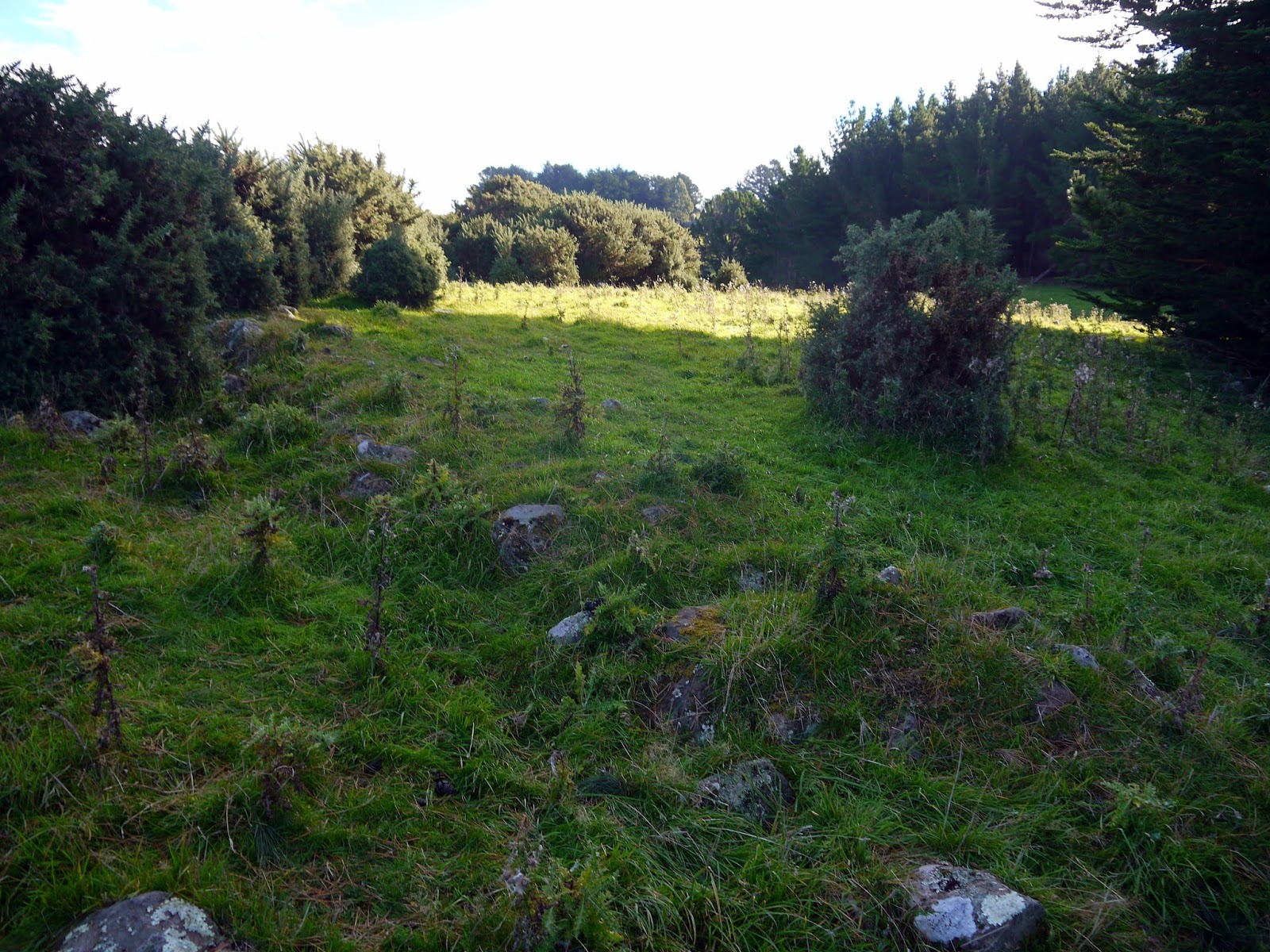
At the uphill, western end of the rectangle it looked like the trees had grown on the line of an old stone wall which had been gradually brought down by stock.


Dunedin City from beside the farm site.

Near the SW corner of the trees, what looks like a collapsed stone wall with ditch beside.  


Continuation of the possible wall and trench parallel to the southern line of the rectangle.


I moved back down the hillside on the line of the northern row of trees.


Below the lowest, eastern line of trees I found a continuation of Blackwood Rd.  I followed this through younger plantation pine, escorted by local fantails.  I'd not remembered that the Council webmap showed this continuation of the road.  I followed it through the pines and onto steep pasture, where it petered out.


Back home, I looked online for traces of the Blackwood family.  This was one of the first I found, from 1894.


   Again courtesy of the local Council's site, I found Adam's grave here.  Unlike most of Dunedin's main cemeteries, the Northern has no collection of photos attached to its grave listings.  So I went to find Adam's grave, hoping it had a stone and legible inscription.  And here it was, "Adam Blackwood, father of above."


Wednesday, 25 April 2018

32745 Private James Gilbert Taylor, 1/10/1875-26/4/1918.

James Taylor had an unusual death for a Great War soldier.  He died at home, on Cutten Street in South Dunedin, with his wife Annie beside him.  He was 42 years old.

"Private James Gilbert Taylor was buried with military honors this afternoon. He enlisted in the 16th Reinforcements, and in camp contracted an illness which ultimately brought about his death. The Rev. R. Fairmaid conducted the service at the residence in Cutten street. Major Fleming and Captain Myers represented the military. The deceased leaves a wife and two children. .He was at one time in business as a butcher in Dunedin, and was afterwards employed at the freezing works at Burnside."  -Evening Star, 30/4/1918.


Annie was laid to rest beside James in 1930.

Thursday, 19 April 2018

Alexandra Mathieson, "Lady Surgeon" 1900-12/1/1929.

"Whatever women do, they must do twice as well as men to be thought half as good. Luckily, this is not difficult." - Charlotte Whitton.

Alexandra Mathieson must have been such a woman.  Born a twin in 1900, she was a hospital surgeon when she died.  A bottle of carbolic acid (aka phenol) broke and she died of the chemical burns.  Its usefulness as a killer of germs did for her.

Her death was a tragedy in many more ways than the merely personal.  It must have been an easily avoidable accident.  And Dr Alexandra, though unsung by any publication I've been able to find, must have been a beacon for the hopes of the women of New Zealand.

It's a real shame that Alexandra's entry on the DCC "Cemeteries Search" website has her occupation listed as "Spinster," presumably because she wasn't married.  She deserves much better than that.


FATALITY IN HOSPITAL. 
DR MATHIESON’S DEATH. 
SPLASHED WITH CARBOLIC ACID. 
(Per United Press Association.) GORE, January 12. A sad accident resulting in the death of Dr A. Mathieson, resident lady medical officer of the Gore Hospital, occurred at that institution at 11.15 o’clock this morning. Dr Mathieson was working with carbolic acid when by some means the bottle was smashed. The acid was splashed over her body and face and immediately began its deadly work. Dr  Mathieson also suffered severely from shock and in a short while became unconscious. Dr Lillie was immediately called in and resuscitation efforts were continued for three hours. These efforts were of no avail. Dr Mathieson slowly sank and death occurred, between 1.50 and 2 o’clock this afternoon. Dr Mathieson came to the Gore Hospital from Dunedin some four or five months ago, and proved herself a very popular and efficient officer.
Dr Alexandra Mathieson was a daughter of the late Inspector W. Mathieson, of the police force. She acted as house surgeon in the Dunedin Hospital for some time before she went to Gore.   - Otago Daily Times, 14/1/1929.

Southern Cemetery, Dunedin.


OBITUARY
THE LATE DR. MATHIESON. 
"The late Dr. Alexandra Carson Mathieson, who died at Gore Hospital on Sunday, as the result of an accident, was a twin daughter of the late William Mathieson, Superintendent of Police, who died at Dunedin some two years ago. Dr. Mathieson, who was 28 years of age, received her education at the Mornington Public School and the Otago Girls' High School. She subsequently attended the Medical School at the Otago University, and in 1927 graduated M.B., Ch.B. Early last year she was appointed medical officer at the Gore Hospital, prior to that having acted as house surgeon at the Dunedin Hospital. She was an efficient officer and was popular with the patients and staff. Dr. Mathieson is survived by her mother, who resides at Moriiington, Dunedin, her elder sister, who is married to Mr W. W. Millar, Invercargill, and her twin sister, Annie, who is unmarried, and lives with her mother.  The Press, 15/1/1929.

Albert Vernon Campbell of HMS Neptune

HMS Neptune was a 1930s vintage light cruiser crewed mostly by New Zealanders and South Africans.  It was of the same class as the HMS (later HMNZS) Achilles and was part of the the Royal Navy's Mediterranean Fleet.


Neptune took part in the Navy's first engagement in the Mediterranean since Napoleonic times, the inconclusive Battle of Calabria in July of 1940.  Neptune took some damage and inflicted some, too.  The ship's next action was the First Battle of Sirte, in December, 1941, which was also a draw.  Neptune's next action, off the coast of Libya, was its last.  Leading a force of cruisers on the night of December 19-20 to intercept an Italian convoy bound for North Africa, Neptune struck two mines, one of which damaged the bow.  Reversing at full steam out of the minefield, Neptune hit a third mine which blew off the propellors, leaving the ship dead in the water.  

Two of the escorting destroyers were sent into the minefield to try and tow Neptune out.  One hit a mine and began to drift.  The other was signalled to retreat.  Neptune then hit a fourth mine and capsized, killing 737 crew members.  Thirty men survived the sinking, but weren't picked up by the rest of the force.  When their float was spotted by an Italian torpedo boat five days later, Neptune had only one survivor.  As might be expected, it is unknown exactly when Albert Vernon Campbell died.  He was one of the 150 New Zealanders who died with their ship.

Southern Cemetery, Dunedin.


Albert Campbell was a manufacturing chemist who joined the New Zealand Division of the Royal Navy.  He died in a disaster which was the greatest loss of life in New Zealand naval history.

HMS Neptune, Imperial War Museum photo. © IWM (FL 2929)

At the time of writing, the wreck of the HMS Neptune has been found by the Royal Navy survey ship HMS Enterprise.  The exact position of the wreck has not been revealed but it lies in deep water, outside the 12 mile Libyan territorial limit.

My thanks to The Neptune Association for this and other information.

The Steamer Basin, Otago Harbour


Tuesday, 17 April 2018

53291 Private Robert William Weir, 21/4/1887-18/4/1918.

Gimmerburn Cemetery.

"Dick" Weir was born in Naseby and grew up on the farm named Eden Bank in the Gimmerburn area. He worked as a motor mechanic in the Naseby area, not far to the south of his birthplace.  He was called up early in 1917 and appealed to the Military Service Board for time to settle his affairs, which was granted.  One of the things for Robert to settle was to marry Emily Marie Howell, from Lee Stream, which he did the very next day at the West Taieri church.  It must have been a bittersweet time for Dick and Emily.

He embarked with the 27th Reinforcements in the middle of that year.

He was transferred from the Otago Infantry Regiment to the 2nd Entrenching Battalion at the end of March, 1918 and was with the Battalion at Meteren.  He was one of the 42 New Zealanders killed on that day.


Otago Daily Times, 16/5/1918.


WEIR —In loving memory of my dear husband, Private Robert William Weir (27th Reinforcements), who was killed in action "Somewhere in France" on April 18, 1918. 
In a hero's grave he sleepeth, 
Somewhere in France he fell; 
How little we thought when we parted 
It was the last farewell. 
— Inserted by his loving wife.  -Otago Witness, 20/4/1920

Meteren Military Cemetery, France.

Sunday, 15 April 2018

32907 L/Cpl James Skinner, 23/2/1896-16/4/1918.

James Skinner was born at Makikihi and enlisted from Papakaio where his family was then based.  He left New Zealand with the 19th Reinforcements in July, 1916.

He was initially drafted into the New Zealand Rifle Brigade, then transferred to the Otago Infantry Regiment in March, 1917.  He was promoted to Lance-corporal at the beginning of 1918 then assigned to the Entrenching Battalion the following March.


James went missing after the fighting and surrender at Meteren (see entry for William Taylor) and was posted as missing, possibly a prisoner for six months.  Finally in January of 1919, a Court of Enquiry ruled that he was officially dead.  His parents were Peter and Ellen Skinner.  Their wait must have been a long one.


IN MEMORIAM.
SKINNER — In loving memory of Lance-Corporal James Skinner, Papakaio, 19th Reinforcements (Entrenching Battalion), killed in action in France on 11th April, 1918; aged 22 years. At peace. Inserted by his sorrowing parents, sisters and brothers.   -Oamaru Mail, 16/4/1919.


Papakaio Cemetery

Papakaio Cemetery